
Manuel Kantakouzenos was Despot of the Morea in the fourteenth century, ruling the Byzantine despotate of the Peloponnese. Son of Emperor John VI Kantakouzenos, he defended Byzantine presence in Greece against the Ottomans and the Latins.
Manuel I(1326 — 1380)
Manuel Kantakouzenos
Empire byzantin, despotat de Morée
8 min read
Frequently asked questions
Key Facts
- Son of Emperor John VI Kantakouzenos, he became Despot of the Morea around 1348
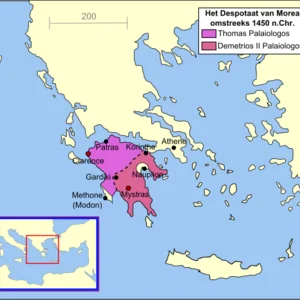
- He ruled the Peloponnese from Mistra, the cultural and political capital of the despotate
- He had to contend with Ottoman raids and tensions with neighboring Latin principalities
- His reign belongs to the period of the progressive fragmentation of the Byzantine Empire
Works & Achievements
Manuel Kantakouzenos established the first Byzantine administration of the Peloponnese, structuring the territory's defenses, local finances, and relations with neighboring Greek and Latin communities. His reign of more than thirty years laid the foundations of a political entity that survived until 1460.
Manuel oversaw and encouraged the reinforcement of the walls and defensive infrastructure of Mystras, enabling the city to withstand assaults and shelter Byzantine refugees fleeing the Ottoman advance in the Balkans.
Through a combination of diplomacy and military action, Manuel maintained the integrity of the despotate against the claims of the Principality of Achaea and the Navarrese, repelling several attempts to encroach on Byzantine lands.
In keeping with Byzantine imperial tradition, Manuel provided financial support to the monasteries and religious establishments of the Peloponnese, contributing to the spiritual and cultural vitality of the region, particularly around Mystras.
Anecdotes
Around 1349, Emperor **John VI Kantakouzenos** appointed his son **Manuel** as the first Despot of the Morea, establishing a Byzantine principality in the Peloponnese. This dynastic choice was both an act of paternal trust and a geopolitical strategy: entrusting the defense of the Peloponnese to a loyal son capable of withstanding Latin pressure and the rising Ottoman threat.
Manuel Kantakouzenos ruled from **Mystras**, a city perched on the steep foothills of **Mount Taygetos**, whose impressive fortifications allowed it to withstand assaults. Under his authority, Mystras became a true Byzantine cultural refuge, drawing scholars and artists fleeing territories lost to the Ottomans.
When his father **John VI** abdicated in **1354** and retired to a monastery under the monastic name Joasaph, Manuel found himself without direct imperial backing. He had to navigate skillfully between the ambitions of the Palaiologoi — now the sole emperors in Constantinople — and the mounting external threats, a situation that demanded constant diplomacy and composure.
Throughout his reign of more than thirty years, Manuel had to defend the despotate against Latin incursions — notably from the Achaeans and the Navarrese — while seeking diplomatic accommodations in the face of Ottoman power advancing inexorably through the Balkans. His longevity in power testifies to a remarkable political acumen for a ruler of limited resources.
At his death in **1380**, Manuel left behind an organized and well-defended despotate that would survive for another eighty years thanks to the foundations he had laid. His Palaiologan successors inherited an administrative and military structure solid enough to hold off the Ottomans until **1460**.
Primary Sources
John VI Kantakouzenos recounts in his memoirs the founding of the Despotate of Morea and the appointment of his son Manuel as despot, describing the political and military conditions that motivated this dynastic decision.
The Byzantine humanist Demetrios Kydones, in correspondence with several members of the Kantakouzenos family, bears witness to the intellectual and political life of the period, allowing us to contextualize Manuel's reign and the tensions surrounding the union of the Churches.
The chronicles relating to medieval Morea mention the conflicts between the Byzantine despotate and the Latin principalities of the Peloponnese, highlighting the role of the Kantakouzenoi in defending Byzantine positions against the Frankish lords.
The archives of the Serenissima preserve diplomatic records and bailo reports mentioning the Despotate of Morea and its relations with the Latin and Ottoman powers, indirectly illuminating the reign of Manuel Kantakouzenos.
Key Places
Capital of the Despotate of Morea, Mystras was a fortified city perched on the slopes of Mount Taygetos. Manuel Kantakouzenos resided and ruled there for more than thirty years, making it a center of Byzantine resistance and a flourishing cultural hub.
Capital of the Byzantine Empire, where Manuel was raised at the imperial court of his father John VI. He maintained delicate political relations with the Palaiologos emperors there following John VI's abdication in 1354.
A strategically vital city controlling the isthmus linking the Peloponnese to mainland Greece. Its possession was crucial for defending the despotate against Latin incursions and potential Ottoman advances from the north.
An important port on the western Peloponnese, Patras was a recurring flashpoint of conflict between the Byzantine despotate and the Latin lords. Manuel Kantakouzenos sought to extend and consolidate Byzantine authority over this strategically important region.
The mountain range dominating Mystras, the Taygetos formed a major natural defensive barrier for the despotate. The passes through these mountains were the scene of numerous military operations conducted under Manuel's authority.
Typical Objects

A badge of authority belonging to high Byzantine dignitaries, the scepter symbolized power delegated by the emperor. Manuel Kantakouzenos held it as the representative of imperial authority in the Morea during official ceremonies.

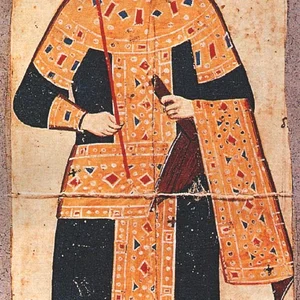
A ceremonial sash embroidered with gold and precious stones, worn by members of the imperial family during major religious feasts and receptions. Manuel, son of an emperor and despot, displayed this magnificent ornament to assert his dignity.

An official document bearing a golden seal, by which Byzantine rulers granted privileges and donations. Manuel issued these acts to administer his despotate, confirm the rights of monasteries, and seal diplomatic agreements.

A prestige weapon carried by 14th-century Byzantine commanders, incorporating Eastern influences. Manuel, military leader of the despotate, wore one during troop reviews and military ceremonies.

A small portable icon depicting a patron saint such as Saint George or Saint Demetrios, carried by Byzantine leaders on campaign. Manuel placed his trust in divine protection to defend the Morea against his many enemies.

Alliance and truce documents essential for a ruler forced to negotiate with Ottomans, Latins, and rival Byzantines. Manuel Kantakouzenos made extensive use of written diplomacy to maintain the precarious balance of his despotate.
School Curriculum
Vocabulary & Tags
Key Vocabulary
Tags
Daily Life
Morning
Manuel Cantacuzène began his day with liturgical offices in the palatial chapel at Mystras, following the tradition of intense devotion characteristic of Byzantine rulers. He then consulted his advisors and senior officials to handle day-to-day affairs: border defense, tax collection, and diplomatic correspondence with Constantinople and neighboring powers.
Afternoon
Afternoons were often devoted to military matters: troop reviews, inspection of fortifications, or receiving envoys from neighboring Latin principalities and Ottoman emirs. The small court of Mystras brought together officials, soldiers, and sometimes scholars, making the palace a center of political and intellectual activity.
Evening
In the evenings, Manuel dined in the great hall of the Palace of the Despots surrounded by his retinue. Evenings might include readings of classical or theological texts, in keeping with Byzantine intellectual culture, as well as strategic discussions about the future of the Despotate in the face of growing threats.
Food
The diet of a 14th-century Byzantine despot was rooted in Mediterranean produce: wheat bread, olives, dried or fresh fish, vegetables, Laconian cheeses, and local wine. On feast days, roasted meats and more elaborate dishes were served, while the many Orthodox fasting days required a strictly vegetarian diet.
Clothing
Manuel wore the sumptuous garments characteristic of despotic rank: an embroidered silk tunic (skaramangion), a purple mantle trimmed with gold, and red boots reserved for members of the imperial family. On military campaign, he wore lamellar or mail armor covered by a surcoat in his house's colors.
Housing
Manuel resided in the Palace of the Despots at Mystras, a vast palatial complex built against the fortress overlooking the city. This residence combined defensive and ceremonial functions, with richly decorated audience halls, chapels adorned with frescoes, and private apartments overlooking the plain of Laconia.
Historical Timeline
Period Vocabulary
Liens externes & ressources
Références
Œuvres
Fondation et consolidation du despotat de Morée
1349-1380
Renforcement des fortifications de Mystras
seconde moitié du XIVe siècle
Politique de résistance face aux Latins du Péloponnèse
1349-1380
Patronage des monastères et institutions religieuses de Morée
seconde moitié du XIVe siècle