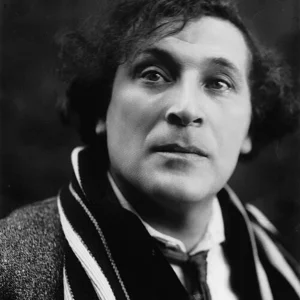

Marc Chagall was a French painter and engraver of Belarusian Jewish origin, a major figure in 20th-century art. Close to the School of Paris, he developed a poetic, dreamlike world blending memories of his native village of Vitebsk, Jewish folklore and love.
Marc Chagall(1887 — 1985)
Marc Chagall
France, Empire russe, apatride, Russie soviétique
6 min read
Frequently asked questions
Famous Quotes
« In our life there is a single color, as on an artist's palette, which provides the meaning of life and art. It is the color of love.»
Key Facts
- Born in 1887 in Vitebsk (Russian Empire, present-day Belarus) into a modest Jewish family
- Settled in Paris in 1910, frequented the School of Paris at La Ruche and mingled with the avant-gardes
- Fled occupied France for the United States in 1941 during the Second World War
- Created the ceiling of the Palais Garnier opera house in Paris in 1964
- Died in 1985 in Saint-Paul-de-Vence, France
Works & Achievements
An iconic painting blending memories of Vitebsk, animals and cubist-inspired geometry — a manifesto of his dreamlike universe.
A series of canvases celebrating his love for Bella, in which the lovers rise into the air, defying gravity.
An intimate scene where Chagall, lifted by joy, kisses Bella while floating: one of the most tender images in his body of work.
A vast collection of biblical engravings and paintings, a major project commissioned by the art dealer Ambroise Vollard.
A monumental decoration paying tribute to fourteen composers, which caused a scandal but became a symbol of Paris.
Luminous stained glass windows in which Chagall brings Christian art and Jewish heritage into dialogue through colour.
A poetic account of his childhood in Vitebsk and of his journey, written with the same whimsy as his paintings.
Anecdotes
As a child, Marc Chagall grew up in **Vitebsk** in a large, modest Jewish family: his father worked in a herring shop. All his life, he would paint the memories of this village — its wooden *izbas*, its musicians and its animals, which float through the skies of his paintings as if in a dream.
During the First World War, Chagall found himself stranded in Russia even though he had been living in Paris. After the revolution of **1917**, he was appointed Commissar for the Arts in Vitebsk and founded an art school there, but his poetic ideas clashed with those of more radical artists such as **Malevich**.
In **1941**, threatened as a Jewish artist by the Nazis, Chagall fled occupied France thanks to the help of an American journalist, **Varian Fry**, who organized the rescue of many artists and intellectuals. He went into exile in the United States and would not return until after the war.
In **1964**, at the age of 77, Chagall created the new ceiling of the **Opéra Garnier** in Paris, commissioned by the minister **André Malraux**. The colorful work, which pays tribute to great composers, caused a scandal because it covered over the original 19th-century décor.
Chagall created stained-glass windows for places all over the world, including Christian cathedrals (Reims, Metz) as well as a synagogue in Jerusalem. This Jewish artist said he wanted to make religions speak to one another through color and light.
Primary Sources
If all life moves inevitably towards its end, then we must, during our own, color it with our colors of love and hope.
My father, my poor father! [...] I remember my town, Vitebsk, its fences, its izbas, its churches.
In our life there is, as on the painter's palette, a single color that gives meaning to life and to art: the color of love.
Key Places
Chagall's birthplace, whose wooden houses, Jewish inhabitants and folklore would nourish his entire body of work. He also founded an art school there after the revolution.
An artists' colony in the Montparnasse district where Chagall discovered the avant-gardes around 1910. Paris became his second artistic homeland.
The place of his exile during the Second World War, fleeing the persecution of the Jews. It was there that his wife Bella died in 1944.
In 1964 Chagall painted here the famous colourful ceiling paying tribute to the great composers, commissioned by André Malraux.
A village on the French Riviera where Chagall spent the end of his life and where he died in 1985. He is buried there.
A national museum opened in 1973 to house the cycle of large biblical canvases that the artist gave to the French State.
Typical Objects

Basic tools of the painter, with which Chagall composed his bright, dreamlike colors. For him, color was the very heart of art.

An assembly of colored glass set in lead that Chagall created for cathedrals, synagogues, and public buildings. The light passing through the glass brought his biblical scenes to life.

Instruments used by Chagall for his etchings, notably to illustrate the Bible and literary works. He was a prolific engraver throughout his life.

An instrument dear to the Jewish folklore of Eastern Europe, ever-present in Chagall's paintings where musicians play perched on rooftops. It symbolizes the memory of Vitebsk and the klezmer tradition.

A Jewish ritual object found in Chagall's imagery, linked to memories of his childhood and the religious traditions of Vitebsk.

A recurring motif in Chagall's canvases, often associated with the lovers who float through the air. It evokes love, joy, and the generosity of nature.
School Curriculum
Vocabulary & Tags
Key Vocabulary
Daily Life
Morning
Chagall rose early and went to his studio, which he considered a sacred place. He liked to work in the silence of the morning, surrounded by his works in progress and the natural light.
Afternoon
The afternoon was devoted to painting, engraving, or stained-glass models. Meticulous, he would return to his works at length, blending memories, dreams, and symbols.
Evening
In the evening, he received friends, dealers, and poets, or read. Deeply attached to his family, he shared simple moments with his loved ones, notably Bella and later Valentina (Vava).
Food
Chagall kept an attachment to the Eastern European Jewish cooking of his childhood (bread, fish, modest dishes). Settled on the French Riviera, he also enjoyed Mediterranean cuisine, simple and convivial.
Clothing
He wore the clothes of a 20th-century artist: understated suits in town and a paint-stained smock in the studio. In photos from his older years, he is often seen in a light-colored shirt, with a mischievous look.
Housing
After a childhood in a wooden house in Vitebsk, he lived in Parisian studios, then in exile in New York, before settling in a sunlit house in Saint-Paul-de-Vence, in Provence.
Historical Timeline
Period Vocabulary
Liens externes & ressources
Références
Œuvres
Les Amoureux (cycle)
vers 1914-1920
Anniversaire
1915
Plafond de l'Opéra Garnier
1964
Vitraux de la cathédrale de Reims et de Metz
1960-1974