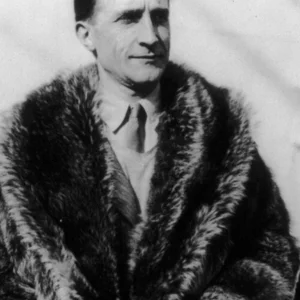

Marcel Duchamp (1887-1968) was a French artist and a major figure of 20th-century art. The inventor of the readymade, he overturned the very definition of the work of art and profoundly influenced conceptual and contemporary art.
Marcel Duchamp(1887 — 1968)
Marcel Duchamp
États-Unis, France
6 min read
Frequently asked questions
Famous Quotes
« It is the viewers who make the pictures.»
Key Facts
- 1912: paints Nude Descending a Staircase No. 2, rejected at the Salon des Indépendants and then a scandal at the New York Armory Show in 1913
- 1913: creates the Bicycle Wheel, the first readymade
- 1917: presents Fountain, a urinal signed R. Mutt, a founding work of conceptual art
- 1923: leaves The Large Glass unfinished (The Bride Stripped Bare by Her Bachelors, Even)
- 1968: dies in Neuilly-sur-Seine; his posthumous work Étant donnés is unveiled
Works & Achievements
A painting breaking down movement into a series of mechanical images; it caused a scandal at the New York Armory Show in 1913.
The first ready-made: a bicycle wheel mounted on a stool, inaugurating the art of the chosen object.
A urinal signed “R. Mutt,” Duchamp's most famous and most provocative work, and a founding piece of conceptual art.
A reproduction of the Mona Lisa sporting a moustache, an irreverent manifesto against the cult of the masterpiece.
A major and enigmatic work on glass, deliberately left unfinished, the fruit of eight years of research.
A portable museum gathering miniature reproductions of his works inside a small case.
His final work, created in secret over twenty years, an installation viewed through two holes in a door; revealed after his death.
Anecdotes
In 1917, Duchamp bought a porcelain urinal in a plumbing supply store, turned it on its side, signed it “R. Mutt” and titled it “Fountain.” He submitted it to a New York exhibition that was supposed to accept anything… but the jury refused to display it! This scandal is now regarded as one of the founding acts of twentieth-century art.
Duchamp was so passionate about chess that he nearly abandoned art to become a professional player in the 1920s. He even represented France in chess olympiads and declared that “all chess players are artists.”
In 1919, Duchamp took a reproduction of the *Mona Lisa*, drew a moustache and goatee on her, then wrote the letters “L.H.O.O.Q.” underneath. Read aloud in French, these letters form an irreverent joke, a way of mocking the cult of masterpieces.
For more than twenty years, Duchamp worked in secret on a final piece, *Étant donnés*, telling almost no one. It was discovered only after his death, in 1969: an installation that you view through two holes pierced in an old wooden door.
Duchamp invented a female alter ego named “Rrose Sélavy” (a pun on “Eros, c'est la vie” — “Eros, that's life”) and had himself photographed dressed as a woman by his friend Man Ray, signing certain works under this name.
Primary Sources
"Whether Mr. Mutt with his own hands made the fountain or not has no importance. He CHOSE it. He took an ordinary article of life, placed it so that its useful significance disappeared under the new title and point of view — created a new thought for that object."
"In the last analysis, it is the spectator who makes the picture." Duchamp argues that the artist alone does not complete the creative act: the public finishes it by interpreting the work.
"I wanted to put painting once again at the service of the mind." Duchamp explains his rejection of "retinal painting" — the kind that flatters only the eye without nourishing thought.
Key Places
Village in Seine-Maritime where Marcel Duchamp was born in 1887, into a cultured middle-class family that would produce several artists.
City where Duchamp trained as a painter (Académie Julian) and moved in avant-garde Cubist circles before the First World War.
American city where Duchamp settled as early as 1915 and became a central figure of New York Dada. There he presented “Fountain” in 1917.
Museum that holds the largest collection of Duchamp's works, including “The Large Glass” and the posthumous installation “Étant donnés.”
Town near Paris where Marcel Duchamp died in 1968. He is buried in the monumental cemetery of Rouen.
Typical Objects

An industrial porcelain sanitary fixture, simply chosen, turned around and signed by the artist. It embodies the idea that art is born from choice and concept, not from manual craftsmanship.

A bicycle wheel mounted upside down on a kitchen stool, the first “assisted ready-made” of 1913. It could be spun, like an object meant to be contemplated in motion.

A lifelong passion for Duchamp, who saw in it a mental and strategic form of art. He took part in international competitions representing France.

A galvanized iron bottle-drying rack bought in a Parisian department store and exhibited as is as a work of art in 1914.

A large work on two glass panels, combining paint, lead wire and dust, deliberately left “definitively unfinished.” The glass, shattered during transport, was kept by the artist.

A portable case containing miniature reproductions of his own works, a kind of portable museum produced from 1935 onward.
School Curriculum
Vocabulary & Tags
Key Vocabulary
Daily Life
Morning
More of a night owl, Duchamp did not get up early. In his small New York studio, he often began the day quietly, with coffee and a cigar, free from the frantic productivity of other painters.
Afternoon
A large part of his afternoons was devoted not to painting, but to thinking, reading, or working slowly on secret projects like *The Large Glass*. He laid claim to a kind of creative laziness and refused to produce work on an assembly line.
Evening
In the evening, Duchamp liked to meet up with his artist friends (Man Ray, the Surrealists) in cafés or around a chessboard. The games of chess could last well into the night.
Food
A sober and frugal man, Duchamp made do with little and lived for a long time on very little money. He nevertheless enjoyed life in Paris and New York, and was never one to turn down a good meal among friends.
Clothing
Elegant and understated, Duchamp wore the plain suits of a twentieth-century gentleman. Far from the disheveled bohemian artist, he cultivated a polished appearance and an unflappable calm.
Housing
He lived mostly in modest studios, in Paris and then in New York, often sparsely furnished. He preferred the freedom of simple lodgings to the security of a comfortable material life.
Historical Timeline
Period Vocabulary
Liens externes & ressources
Références
Œuvres
Roue de bicyclette
1913
Fontaine
1917
L.H.O.O.Q.
1919
La Mariée mise à nu par ses célibataires, même (Le Grand Verre)
1915-1923
Boîte-en-valise
1935-1941
Étant donnés
1946-1966