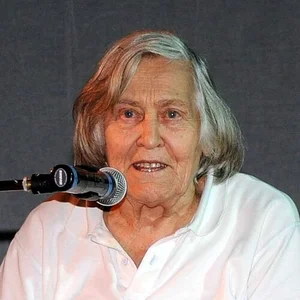

Italian astrophysicist born in Florence in 1922, she directed the Astronomical Observatory of Trieste for thirty years. A pioneer of stellar spectroscopy and a gifted science communicator, she made astronomy accessible to the general public.
Margherita Hack(1922 — 2013)
Margherita Hack
Italie, royaume d'Italie
8 min read
Frequently asked questions
Famous Quotes
« Science knows no borders.»
« We are all made of the same matter as the stars.»
Key Facts
- 1922: born in Florence, Italy
- 1954: becomes professor of astrophysics at the University of Trieste
- 1964–1987: directs the Astronomical Observatory of Trieste
- 1978: asteroid 8558 Hack is named in her honor
- 2013: dies in Trieste at the age of 91
Works & Achievements
A body of landmark scientific publications on B-type emission-line stars, establishing spectroscopic catalogues used by generations of astronomers to classify these distinctive objects with circumstellar envelopes.
A popular science book that introduced millions of Italians to astronomy, explaining with clarity and enthusiasm the birth of stars, the expansion of the universe, and the latest advances in modern astrophysics.
One of her most widely read popular science books, exploring star formation, black holes, and the origin of the universe. It was adopted in many Italian secondary schools and translated into several languages.
An autobiography in which Hack traces her journey as a woman in science in twentieth-century Italy — from athletics to astronomy — offering a testament to her humanist vision and her committed approach to the life of a researcher.
A passionate essay in defence of freedom in scientific research, in which Hack argues for a science free from dogma and ideological interference, placed at the service of truth and human progress.
A major institutional achievement: over 23 years, Hack transformed the OATs into an international research centre, attracted foreign collaborations, and trained several generations of Italian astrophysicists.
Anecdotes
In her youth, Margherita Hack was an accomplished athlete: in 1941, she won the Italian university championships in high jump and long jump in Florence. This drive for self-improvement accompanied her intellectual curiosity throughout her life, reflecting her conviction that mind and body must be equally exercised.
From 1964 to 1987, Margherita Hack directed the Trieste Astronomical Observatory, becoming the first woman in Italy to lead a major scientific research institution. Under her leadership, the observatory earned an international reputation through its cutting-edge work on variable stars and stellar spectroscopy.
A passionate animal lover, Margherita Hack had been vegetarian out of ethical conviction since her youth, and was deeply attached to the many cats she kept. She actively campaigned for animal rights throughout her life, long before such concerns became widely shared in Italian society.
A tireless science communicator, Hack continued to give lectures, write, and appear on television programmes well into old age, making astronomy a passion shared by millions of Italians. She personally replied to thousands of letters from readers, convinced that science belongs to everyone, not just specialists.
In 1994, an asteroid was named ‘8558 Hack’ in her honor by the International Astronomical Union. She would joke that she finally had “a foot in the stars” — she who had devoted her entire career to observing them from Earth.
Primary Sources
Understanding the universe means understanding ourselves, because we are made of the same matter as the stars — we are stardust that has organized itself into increasingly complex forms.
Spectroscopy has allowed us to decipher the chemical composition of stars millions of light-years away, a scientific revolution no less important than the invention of the telescope.
I have pedaled all my life, both literally and figuratively. The bicycle has been my faithful companion, like the stars and my cats.
Science cannot progress except in a context of full freedom of thought and research. Any ideological or religious interference in scientific work is a threat to truth.
The emission lines observed in the spectra of these stars reveal a circumstellar envelope of ionized gas rotating rapidly around the central star, a phenomenon she was among the first to document systematically.
Key Places
Born on 12 June 1922 in this city of art and science, Margherita Hack studied at the University there, earning her degree in physics in 1945, within the astronomical tradition inherited from Galileo.
Founded in 1872 on the Arcetri hill where Galileo spent his final years, this observatory was Hack's first research base. There she developed her spectroscopic analysis methods before moving to Trieste.
Hack served as its director from 1964 to 1987, transforming the institution into an internationally renowned centre specialising in stellar spectroscopy and the astrophysics of hot stars.
Hack taught astronomy there for decades, training generations of Italian astrophysicists and helping to establish Trieste as a scientific hub recognised across Europe.
A cultural crossroads between the Latin and Slavic worlds, Trieste was home to Hack for most of her adult life. She died there on 29 June 2013, leaving a city in mourning that paid her a national tribute.
Liens externes & ressources
Références
Œuvres
Travaux spectroscopiques sur les étoiles Be et à raies d'émission
1960-1980
L'universo di Margherita Hack (Rizzoli)
1988
Dove nascono le stelle (Sperling & Kupfer)
2004
La mia vita in bicicletta (Avverbi)
2007
Libera scienza in libero stato (Rizzoli BUR)
2010
Direction et modernisation de l'Observatoire de Trieste
1964-1987