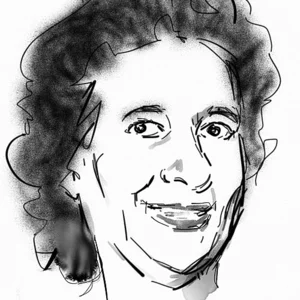

French chemist (1909–1975), collaborator of Marie Curie at the Radium Institute. In 1939 she discovered francium, the last natural element to be discovered, and in 1962 became the first woman elected to the French Academy of Sciences.
Marguerite Perey(1909 — 1975)
Marguerite Perey
France
8 min read
Frequently asked questions
Key Facts
- 1909: born in Villemomble, France
- 1929: joins the Radium Institute as Marie Curie's personal assistant
- 1939: discovers francium (element 87), the last natural element to be discovered
- 1962: first woman elected a member of the French Academy of Sciences
- 1975: dies of cancer, likely linked to her prolonged exposure to radioactivity
Works & Achievements
Perey's major scientific contribution: the identification of the last naturally occurring element in the periodic table, derived from the decay of actinium-227. She is the first woman to have discovered a chemical element.
Publication in the Comptes rendus de l'Académie des sciences describing the discovery of francium. This two-page article is one of the most important texts in 20th-century nuclear chemistry.
Thesis defended at the University of Paris, synthesizing her research on the chemical and physical properties of francium. In it, she establishes that francium is the last member of the alkali metal family.
Upon joining the University of Strasbourg, Perey created and directed a laboratory specializing in nuclear chemistry, training generations of students and contributing to French scientific influence in the post-war period.
A collection of articles published from Strasbourg deepening the understanding of francium's properties: chemical behavior in solution, analogies with cesium, and radiochemical separation methods.
Anecdotes
Marguerite Perey joined the Radium Institute in Paris in 1929, at just 19 years old, with no university degree, hired as Marie Curie's personal technician. She prepared radioactive samples, maintained instruments, and accompanied the great scientist until her death in 1934. This relationship of trust paved the way for an exceptional scientific career, at a time when women had great difficulty gaining access to laboratories.
In January 1939, while purifying a sample of actinium-227, Perey noticed an anomaly in the radioactive decay curve: an unexpected radiation betrayed the presence of an unknown element. After several weeks of meticulous verification, she identified element 87, the last natural element ever discovered. She named it “francium” in honor of her homeland.
In 1962, Marguerite Perey was elected to the French Academy of Sciences, becoming the first woman to sit on it in three hundred years of history. The irony is bitter: Marie Curie, her mentor and role model, had been rejected by that very institution in 1911, despite her two Nobel Prizes. Fifty years separate Curie's rejection from Perey's election.
Years of exposure to radioactive radiation — without the protections we know today — left irreparable damage in Marguerite Perey's body. She developed bone cancer in the 1960s, which gradually forced her to scale back her activities. She died in 1975, clear-eyed about the price of her scientific vocation, having declared that the discovery of francium was worth every sacrifice.
Although she discovered francium in 1939, Perey did not defend her doctoral thesis until 1946, at age 37, at the University of Paris. She had worked for years as a technician, without the academic title that matched her contributions. Her thesis focused specifically on the properties of actinium-K, the original name she had given to francium before renaming it.
Primary Sources
While studying the decay curves of actinium, I identified the presence of an alpha radiation that I could only attribute to a new element, a product of the disintegration of actinium itself.
Element 87, which I propose to call francium, is the heaviest isotope of the alkali group. Its half-life is approximately 21 minutes. It is emitted during the alpha disintegration of actinium-227.
The chemical properties of francium, the last naturally occurring alkali metal, were partially determined despite the very small quantities available and its short radioactive half-life. Francium behaves as a heavy analogue of caesium.
I am submitting my first observations on the anomaly noted in the disintegration of actinium. I believe I am dealing with a new element, but I do not yet dare to assert this without your guidance.
Key Places
Founded by Marie Curie, this laboratory in the 5th arrondissement is where Perey spent most of her career from 1929 to 1949, and where she discovered francium in 1939. The building, listed as a historic monument, still houses the archives and Marie Curie's former laboratory.
Perey moved here in 1949 as a professor and founded the nuclear chemistry laboratory, which she directed until her retirement. It was here that she continued her research on francium and trained a new generation of scientists.
The prestigious institution where Marguerite Perey was elected on 12 March 1962, becoming the first woman member in 300 years of history. This landmark election partly made amends for the injustice done to Marie Curie, who had been rejected by the same institution in 1911.
A commune in the eastern suburbs of Paris where Marguerite Perey was born on 19 October 1909. She grew up in modest circumstances, with little access to higher education, which makes her scientific journey all the more remarkable.
Liens externes & ressources
Références
Œuvres
Découverte du francium (élément 87)
1939
Sur un élément 87, dérivé de l'actinium — article fondateur
1939
Contribution à l'étude de l'actinium-K — thèse de doctorat
1946
Fondation du laboratoire de chimie nucléaire de Strasbourg
1949
Série de publications sur la chimie analytique du francium
1950-1965