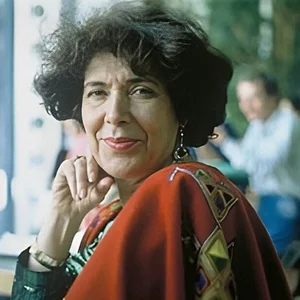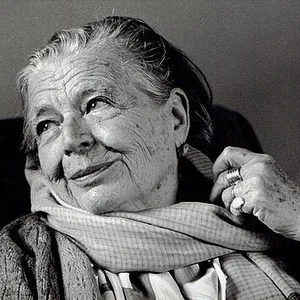

French writer (1903–1987), Marguerite Yourcenar is the author of Memoirs of Hadrian, a masterpiece of 20th-century literature. The first woman elected to the Académie française in 1980, she left a lasting mark on literature through her reflections on history and humanity.
Frequently asked questions
Famous Quotes
« Every man who repeats the same human experience repeats all of humanity.»
« I have tried to reconstruct the labyrinth of Hadrian.»
« True generosity toward the future consists in giving everything to the present.»
Key Facts
- Publication of Memoirs of Hadrian in 1951, a novel reconstructing the life and thought of the Roman emperor
- Election to the Académie française in 1980, becoming the first woman to join the institution
- Translator of ancient Greek, including the Greek tragedies of Sophocles
- Publication of The Abyss in 1968, a historical novel awarded the Prix Femina
- Lifelong commitment to humanism and profound reflection on the human condition throughout her work
Works & Achievements
Yourcenar's first novel, in the form of a letter from a man to his wife confessing his homosexuality. A pioneering work for its candor and spare classical style.
A masterpiece of twentieth-century French literature, an epistolary novel in which the Roman emperor Hadrian meditates on his life and legacy. Translated into more than forty languages, it is studied worldwide.
A historical novel about Zeno, an alchemist and philosopher of the Renaissance, winner of the Prix Femina 1968. A profound reflection on freedom of thought in the face of obscurantism and religious persecution.
The first volume of the autobiographical trilogy devoted to her Belgian maternal ancestors. Yourcenar interrogates family memory and history as living material.
The second volume of the trilogy, devoted to the paternal ancestors from northern France. Yourcenar traces the links between individual destinies and the great transformations of history.
A collection of essays on art, history, nature, and ecology. Yourcenar affirms her humanist vision and her concern for the preservation of the natural and cultural world.
Anecdotes
Marguerite Yourcenar spent nearly twenty years writing Memoirs of Hadrian. She had begun a first version in the 1920s, but had abandoned it. In 1948, while opening an old trunk, she came across her notes by chance and decided to start everything over from the beginning, which gave birth to one of the masterpieces of the 20th century.
When Marguerite Yourcenar was elected to the Académie française in 1980, she became the first woman to enter this institution founded in 1635. Some academicians had strongly opposed it, arguing that the statutes only provided for 'immortals' in the masculine form. Her election had the effect of a small cultural revolution in France.
Yourcenar spent the greater part of her adult life in the United States, on Mount Desert Island in Maine, with her companion Grace Frick. Their house, which they called Petite Plaisance, is today a museum. It was there, in that wild and isolated setting, that she wrote her most important works.
Marguerite Yourcenar was an environmental activist ahead of her time. As early as the 1970s, she was publicly raising the alarm about the destruction of the environment and the fate of animals — themes she considered inseparable from her humanist reflection on the human condition and each individual's responsibility toward the world.
Primary Sources
"Tried to read the lives of the Caesars and found nothing but puppets. [...] I wanted to write about Hadrian because it seemed to me that we were in the presence of a truly intelligent man, that is to say, one capable of seeing things clearly."
"When two texts, two assertions, two ideas are in opposition, beware of any desire to reconcile them. [...] The essential thing is never to lose sight of either the reality of the world or one's inner truth."
"We live in a world that is destroying itself with a haste and frenzy to which no previous century had accustomed us. [...] Nature is our mother and our sister, not our slave."
"I do not believe in the notion of an isolated masterpiece. Every work is the result of a long inner preparation, an accumulation of readings, travels, meditations, and human experiences."
Key Places
Birthplace of Marguerite Yourcenar, born on June 8, 1903. Her Belgian and French family instilled in her from childhood a love of languages and European history.
The house where Yourcenar lived for more than forty years with Grace Frick, and where she wrote her major works. Now a museum open to the public, it embodies her American roots while remaining a writing space deeply European in spirit.
Yourcenar stayed in Rome on several occasions and made extended visits to the Villa Adriana in preparation for Memoirs of Hadrian. These archaeological sites were decisive in her reconstruction of Hadrian's mental universe.
The city where Yourcenar began her literary career in the 1920s–1930s, moving in the intellectual circles of the interwar period. She returned regularly to maintain her relationship with her publisher Gallimard.
The institution to which Yourcenar was elected on March 6, 1980, occupying seat 3. Her acceptance speech marked a milestone in French literary history and symbolically opened the venerable institution to women.
Liens externes & ressources
Références
Œuvres
Alexis ou le Traité du vain combat
1929
Mémoires d'Hadrien
1951
L'Œuvre au noir
1968
Souvenirs pieux (Le Labyrinthe du monde, I)
1974
Archives du Nord (Le Labyrinthe du monde, II)
1977
Le Temps, ce grand sculpteur
1983