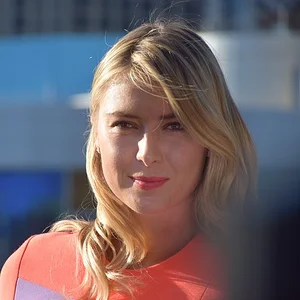

A Russian tennis player born in 1987, Maria Sharapova is one of the most decorated athletes of her generation. A former world number 1, she won five Grand Slam titles before retiring in 2020.
Maria Sharapova(1987 — ?)
Maria Sharapova
Russie, Union soviétique
8 min read
Frequently asked questions
Key Facts
- Born on April 19, 1987, in Nyagan, USSR (present-day Russia)
- First Russian woman to win Wimbledon in 2004, at just 17 years old
- Five Grand Slam titles won between 2004 and 2014
- Suspended for 15 months in 2016 following a positive test for meldonium
- Announced her retirement from professional tennis in February 2020
Works & Achievements
Her first Grand Slam title, won at age 17 against Serena Williams. This victory marked the emergence of a new generation of Russian champions and launched Sharapova to the world number 1 ranking.
Her second major title, confirming Sharapova's dominance on the international circuit. Her powerful serve and mental toughness earned widespread praise from tennis observers around the world.
Her third Grand Slam title, won after a difficult injury-plagued season. This success showcased her resilience and ability to sustain excellence at the highest level of women's tennis.
By winning Roland-Garros, Sharapova became the tenth player in history to achieve a Career Grand Slam — winning all four major tournaments over the course of a career. A rare feat in modern tennis.
At the London Olympic Games, Sharapova represented Russia and won the silver medal after a defeat in the final. This performance highlighted her role as an ambassador for Russian sport on the international stage.
Sharapova launched her own premium candy brand, Sugarpova, distributed in over 30 countries. This pioneering venture inspired many athletes to pursue entrepreneurship, fundamentally changing how professional athletes engage with the business world.
In this book, Sharapova recounts her childhood in Siberia, her move to Florida, and a career shaped by extraordinary challenges. It is a valuable resource for understanding the journeys of post-Soviet athletes and the globalization of sport.
Anecdotes
In 1994, when Maria Sharapova was just 7 years old, her father Yuri took her to Florida to join Nick Bollettieri's tennis academy. They arrived in the United States with only $700 to their name. For several months, Yuri was unable to obtain a visa, leaving Maria to train alone, far from her mother who had stayed behind in Russia.
In July 2004, at just 17 years old, Maria Sharapova won Wimbledon by defeating Serena Williams in the final. She became the third youngest player to win the London tournament, and the first Russian to triumph on the grass of Church Road. Her victory was hailed as the emergence of a new generation of champions from post-Soviet Russia.
In March 2016, Sharapova held a worldwide press conference to announce she had tested positive for meldonium, a substance added to the World Anti-Doping Agency's banned list in January of that year. She stated she had been taking the medication for ten years for medical reasons. Suspended for fifteen months, she returned to the tour in 2017 amid intense international controversy.
Sharapova was one of the first athletes to build a true commercial empire off the court. In 2012, she launched her own confectionery brand, Sugarpova, with candies sold in dozens of countries. The venture illustrates the rise of athletes as entrepreneurial figures in the globalized sport of the 21st century.
The Sharapova family is originally from the Gomel region of Belarus, an area heavily affected by the radioactive fallout from the Chernobyl disaster in 1986. Her parents left the region after the catastrophe and settled in Nyagan, Siberia, where Maria was born in 1987. Her personal story is thus inseparable from the major upheavals that marked the end of the Soviet era.
Primary Sources
My father had 700 dollars in his pocket when we arrived in America. He believed in me more than I believed in myself. He's the one who made everything possible.
I have been taking meldonium for ten years for medical reasons. I did not know it had been added to the list of banned substances as of January 1, 2016. I take full responsibility for this mistake.
Tennis showed me the world and taught me that limits exist only in the mind. Today, I say goodbye to the sport that gave me everything.
Sharapova embodies the transformation of women's tennis into a global phenomenon, at the intersection of sport, fashion, and business.
Key Places
A city in western Siberia where Maria Sharapova was born in 1987. Her family had settled there after fleeing the Gomel region, which was affected by the Chernobyl disaster. This starting point illustrates the remarkable journey of a girl from the Siberian provinces who became a world champion.
The tennis academy founded by Nick Bollettieri, where Sharapova began training in 1994. This place shaped her powerful baseline game and champion's mentality, in an international environment that brought together the greatest tennis prospects in the world.
The All England Club is where she achieved global recognition in 2004, winning the title at age 17. Wimbledon, the oldest and most prestigious tournament in the world, remains associated with her name as a symbol of her first major victory.
The stadium where Sharapova claimed her two latest Grand Slam titles (2012 and 2014), on the clay surface that suited her best in the later stages of her career. Her 2012 victory completed a career Grand Slam, an exceptionally rare feat in modern women's tennis.
The site of her Australian Open victory in 2008, her third Grand Slam title. Melbourne symbolizes the truly global reach of Sharapova's career, having triumphed on all four continents that host the sport's major tournaments.
Typical Objects

Sharapova played her entire career with Wilson rackets, the iconic equipment of great champions. Her powerful hitting, especially on serve, made her one of the most feared players on the tour.

Introduced at Wimbledon in 1986, standardized yellow balls are the universal symbol of modern tennis. For Sharapova, every ball she played represented years of relentless training from childhood.

At Wimbledon, the rules require players to wear almost entirely white clothing. In 2004, the outfit Sharapova wore during her historic victory became iconic and was later displayed in the tennis museum.

A symbol of the international mobility made possible after the fall of the USSR, Sharapova's Russian passport allowed her to travel the world, from Siberia to the courts of four continents.

In 2012, Sharapova launched her own confectionery brand, Sugarpova. Sold in airports and shops around the world, these sweets illustrate how professional athletes have diversified into entrepreneurship in the age of global sport.

Sharapova won the silver medal at the 2012 London Olympics representing Russia. This medal represents the crowning achievement of a career in service of Russian national sport, set against the backdrop of renewed Olympic prestige in the post-Soviet era.
School Curriculum
Vocabulary & Tags
Key Vocabulary
Daily Life
Morning
Sharapova's days start very early, around 6 a.m., with a physical training session (weight training, cardio) before she even picks up a racket. Breakfast is rich in proteins and complex carbohydrates to fuel the day's effort. She plans her sessions with her coach according to the tournament schedule.
Afternoon
The afternoon is devoted to technical training on the court: serve drills, baseline rallies, and tactical work with hitting partners. Between tournaments, she studies video footage of upcoming opponents. Match days are punctuated by rigorous warm-ups, physiotherapy sessions, and mental preparation.
Evening
In the evenings, Sharapova focuses on recovery: ice baths, massage, and stretching. She reads, manages her business commitments (Sugarpova, Nike partnerships), and stays in touch with her team. Nights are short during tournament periods, with rapid rotations between cities and time zones.
Food
Sharapova follows a strict athletic diet, high in lean proteins, vegetables, and complex carbohydrates. She avoids ultra-processed foods and adjusts her nutrition to each surface and climate. Since retiring, she has said she enjoys food and dining more freely, particularly Japanese and Italian cuisine.
Clothing
On court, Sharapova wears Nike outfits designed specifically for her, often in the colors of the current tournament. At Wimbledon, the regulation all-white dominates. Off court, she favors a sleek, elegant style that reflects her status as a fashion icon as much as a sporting champion.
Housing
During her career, Sharapova lived mainly in Florida, close to her training facilities. She also owns apartments in Monaco and Los Angeles. Her homes are modern and functional, close to sports infrastructure, yet comfortable and carefully decorated, reflecting her taste for contemporary design.
Historical Timeline
Period Vocabulary
Visual Style
Esthétique sportive internationale, entre la rigueur des courts de Grand Chelem et l'éclat médiatique d'une carrière à cheval entre la Russie post-soviétique et l'Occident.
Sound Ambience
Ambiance sonore des grands courts de tennis internationaux, entre silence tendu avant chaque échange et explosion de la foule, sur fond de voyages incessants entre continents.
Liens externes & ressources
Références
Œuvres
Victoire à Wimbledon
2004
Victoire à l'US Open
2006
Victoire à l'Open d'Australie
2008
Grand Chelem en carrière — Victoire à Roland-Garros
2012
Médaille d'argent olympique
2012
Lancement de Sugarpova
2012
Autobiographie Unstoppable: My Life So Far
2017