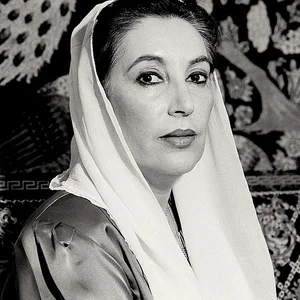

Benazir Bhutto was the first woman to lead a government in a Muslim-majority country, becoming Prime Minister of Pakistan in 1988. The daughter of Prime Minister Ali Bhutto, she fought against military dictatorships and became a symbol of democracy and women's rights in South Asia. Assassinated in an attack in 2007, she remains an iconic figure of political courage.
Benazir Bhutto(1953 — 2007)
Benazir Bhutto
Pakistan
7 min read
Frequently asked questions
Famous Quotes
« I didn't choose this life, this life chose me.»
« Democracy is necessary for peace and to defeat the forces of terrorism.»
Key Facts
- 1953: Born in Karachi into an influential political family
- 1977: Her father Ali Bhutto is overthrown by General Zia ul-Haq, then executed in 1979
- 1988: Elected Prime Minister of Pakistan — the first woman to lead a Muslim-majority state
- 1990–1993: Two terms cut short by dismissals on corruption charges, followed by a lengthy period of exile
- 2007: Return to Pakistan and assassination in a suicide attack in Rawalpindi
Works & Achievements
The first woman elected Prime Minister in a Muslim-majority country, she initiated social reforms and attempted to liberalize the Pakistani economy before being dismissed by the president.
Re-elected after three years in opposition, she continued her reforms and strengthened diplomatic relations with the West, but was again dismissed on grounds of corruption.
An account of her political life, from her father's execution to her rise to power, which has become a key reference on democracy and women's rights in the Islamic world.
A posthumous work in which she argues for the compatibility of Islam and democracy, advocating for dialogue between civilizations in the face of Islamist radicalism.
After her father's execution, she took over the PPP and led it for more than twenty years as Pakistan's main democratic opposition party.
Anecdotes
Benazir Bhutto was the first woman to lead a government in a majority-Muslim country. Elected Prime Minister of Pakistan in 1988 at just 35 years old, she broke a double glass ceiling: that of gender and that of the conservative Islamist tradition that dominated Pakistani political life.
During her exile in Great Britain and the United States, Benazir Bhutto studied at the University of Oxford, where she served as President of the Oxford Union, the famous debating club. There she faced the best British orators and developed a rhetorical talent that drew wide recognition, serving her throughout her political career.
Her father, Zulfikar Ali Bhutto, founder of the Pakistan Peoples Party (PPP), was overthrown in a military coup and then hanged in 1979. Benazir, imprisoned several times and placed under house arrest, carried his political legacy like a torch, transforming her personal grief into public commitment.
On October 18, 2007, having barely returned from exile to Karachi, Benazir Bhutto narrowly escaped a suicide bombing that killed 179 people during her welcome procession. She nonetheless continued her electoral campaign despite the threats, declaring that she would not be intimidated by terrorism.
Benazir Bhutto was assassinated on December 27, 2007 in Rawalpindi, just weeks before the general elections, at a political rally. Her courage in the face of repeated threats and her death as a martyr for democracy made her a global symbolic figure in the struggle for political rights in conservative societies.
Primary Sources
My father used to say that democracy is the best revenge. I have lived to see the truth of those words, for it is through the democratic process that I have been able to continue his work.
I am aware of being the first woman elected to lead a government in the Islamic world. I am aware that some doubt whether a woman can lead an Islamic state. But here I am, before you, democratically elected.
The fundamental premise of my political life is that Islam and democracy are not only compatible but mutually reinforcing. A true Islamic state must be a democratic state, because Islam itself mandates justice, equality, and the protection of human rights.
Women's rights are not Western rights. They are human rights. And human rights are universal. No religion, no culture, no tradition can legitimately deny women the right to participate fully in the life of their society.
Key Places
Benazir Bhutto's birthplace and Pakistan's economic capital, where she was born in 1953 and welcomed by millions of supporters upon her return from exile in 2007.
The site of Benazir Bhutto's assassination on December 27, 2007, during a campaign rally at Liaquat Bagh park, where she was killed in a suicide attack.
Benazir Bhutto studied at the University of Oxford (Lady Margaret Hall and then Christ Church) and served as President of the Oxford Union in 1977, shaping her intellectual and political formation.
Pakistan's capital and seat of government, where Benazir Bhutto served her two terms as Prime Minister (1988–1990 and 1993–1996).
The Bhutto family's hometown in Sindh province, a traditional stronghold of the PPP and the burial site of Benazir Bhutto alongside her father.
Typical Objects

Benazir Bhutto always wore a white headscarf in public appearances, a symbol of mourning for her father and of respect for Pakistani cultural traditions while remaining a modern woman.

An exceptional orator, Benazir Bhutto galvanized crowds of tens of thousands at her rallies. Her voice and impassioned speeches were her primary political tool.

Throughout her life, Benazir Bhutto was pursued by corruption charges. These legal files symbolize the relentless judicial battles she had to wage alongside her political action.

Forced into exile for several years, Benazir Bhutto traveled between Dubai, London, and Washington. Her passport represents the life of a political exile she led while maintaining her struggle from afar.

As a student at Oxford University, Benazir Bhutto developed her intellectual and rhetorical abilities. She became the first South Asian woman to preside over the prestigious Oxford Union in 1977.

Aware of the constant threats against her, Benazir Bhutto sometimes wore a bulletproof vest during public appearances, a tragic symbol of a political life lived under permanent threat.
School Curriculum
Vocabulary & Tags
Key Vocabulary
Tags
Daily Life
Morning
During her terms as Prime Minister, Benazir Bhutto started her days early with security and diplomatic briefings. She read the international press in English and Urdu, then consulted her political advisors before beginning a packed schedule of government meetings.
Afternoon
Her afternoons were devoted to parliamentary sessions, receiving foreign heads of state, and meetings with provincial delegations. On the campaign trail, she moved from rally to rally across different Pakistani cities, traveling by plane or secured convoy.
Evening
Evenings in power often included diplomatic dinners and official receptions. In exile in Dubai or London, she continued to work from home, granting interviews to international media and maintaining contact with PPP leaders remaining in Pakistan.
Food
Benazir Bhutto followed a traditional Pakistani diet: biryani, lentil curry (dal), naan bread, spiced chai tea. When traveling abroad, she readily adapted to local cuisine but retained a preference for the flavors of Sindh, her family's home region.
Clothing
She invariably wore the shalwar kameez (traditional tunic and trousers) paired with a white or pastel-colored dupatta (scarf). This attire symbolized both her Pakistani cultural roots and her mourning for her father. During official visits to the West, she maintained this traditional dress as an assertion of identity.
Housing
At the height of power, she resided in the official Prime Minister's residence in Islamabad. In exile, she lived in a villa in Dubai providing security and comfort for her family. The ancestral Bhutto estate in Larkana (Sindh) remained the family's symbolic home, rooted in the feudal tradition of rural Pakistan.
Historical Timeline
Period Vocabulary
Visual Style
Esthétique mêlant la tradition pakistanaise (shalwar kameez, dupatta blanc) et la modernité politique : affiches de campagne en script ourdou, foules immenses, palais gouvernementaux d'Islamabad sous un ciel intense.
Sound Ambience
L'univers sonore de Benazir Bhutto est celui des grands meetings populaires pakistanais : foules immenses scandant des slogans en ourdou, haut-parleurs résonnant dans les stades à ciel ouvert, appels à la prière en arrière-plan.
Liens externes & ressources
Références
Œuvres
Premier mandat de Premier ministre du Pakistan
1988-1990
Second mandat de Premier ministre du Pakistan
1993-1996
Daughter of Destiny (autobiographie)
1988
Reconciliation: Islam, Democracy, and the West
2008
Direction du Parti du peuple pakistanais (PPP)
1984-2007