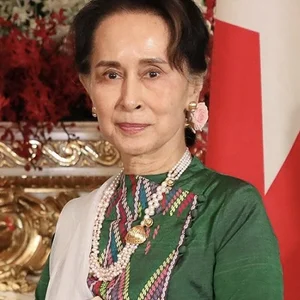

Burmese democracy activist, Aung San Suu Kyi devoted her life to peaceful resistance against the military junta in Myanmar. Winner of the Nobel Peace Prize in 1991, she spent 15 years under house arrest before leading her country from 2016 to 2021.
Aung San Suu Kyi(1945 — ?)
Aung San Suu Kyi
Birmanie
8 min read
Frequently asked questions
Famous Quotes
« It is not power that corrupts but fear.»
« Freedom and democracy are dreams that cannot be suppressed.»
Key Facts
- Born in 1945 in Rangoon, daughter of General Aung San, father of Burmese independence, who was assassinated in 1947
- Founded the National League for Democracy (NLD) in 1988, during the popular uprising against the junta
- Placed under house arrest several times between 1989 and 2010, totaling approximately 15 years
- Awarded the Nobel Peace Prize in 1991 for her non-violent resistance
- Led Myanmar's civilian government from 2016 to 2021, before being overthrown and imprisoned by the military in the February 2021 coup
Works & Achievements
Collection of political and philosophical essays in which she sets out her vision of democracy and non-violent resistance. The eponymous essay is considered her founding text.
Series of weekly columns published in a Japanese newspaper, recounting daily and political life in Burma. These letters were circulated clandestinely and helped sustain international attention.
A lengthy interview conducted in secret during her house arrest, in which she sets out her democratic and Buddhist convictions. A key reference for understanding her political thought.
Political party she co-founded in September 1988 following the popular uprising, which became the main opposition party under the Burmese dictatorship.
First woman to de facto lead the Burmese government, a role equivalent to that of Prime Minister. However, her handling of the Rohingya crisis severely damaged her international reputation.
Anecdotes
In 1989, as Aung San Suu Kyi was marching with supporters in Rangoon, soldiers were ordered to fire on the group. She stepped forward alone toward the rifles, refusing to flee. The commander eventually ordered his men to lower their weapons. This episode illustrates her exceptional courage in the face of the military junta.
During her long years of house arrest, Aung San Suu Kyi learned to play the piano and practiced Buddhist meditation daily. She listened to the BBC World Service to stay informed about the outside world. This inner discipline allowed her to remain morally strong through more than fifteen years of captivity.
In 1991, when the Nobel Committee awarded her the Peace Prize, she was still under house arrest in Rangoon. It was her son Alexander who accepted the prize on her behalf in Oslo. She was not able to travel to Norway to accept her prize until twenty-two years later, in 2012.
Aung San Suu Kyi is the daughter of General Aung San, hero of Burmese independence who was assassinated in 1947 when she was only two years old. Her full name literally means 'a collection of bright victories' in Burmese. She inherited her father's popularity, which partly explains the immense public support she received.
In the 1990 elections, the National League for Democracy she led won 80% of the seats in parliament. The military junta simply refused to recognize the results and kept her under house arrest. This ignored electoral victory became a global symbol of the injustice of authoritarian regimes.
Primary Sources
It is true that we must understand fear in order to overcome it. The fear of losing power corrupts those who wield it, and the fear of power corrupts those who are subject to it.
I ask you not to be discouraged. Our struggle is just and we must continue to move forward with gentleness but with determination.
During the years when I was cut off from the outside world, the Nobel Prize was like a ray of light penetrating my solitude. It reminded me that the struggle for democracy and human rights was not confined to our small country.
Democracy is the only ideological system that takes into account human fallibility, and that provides mechanisms to correct the errors of those who govern.
Key Places
The family home on the shores of Inya Lake, where Aung San Suu Kyi was placed under house arrest for more than fifteen years in total. It became a place of pilgrimage for her supporters, who would come to listen to her speak from the gate.
The former capital and largest city of Myanmar, the scene of the 1988 uprisings and Aung San Suu Kyi's major political speeches before hundreds of thousands of people.
The venue for the official Nobel Peace Prize award ceremony. Aung San Suu Kyi was only present to deliver her acceptance speech in 2012, twenty-one years after the prize was awarded.
The city where she studied (St Hugh's College, Oxford) and where her family lived — her husband Michael Aris and their two sons. She refused to leave Burma to rejoin her family for fear of not being allowed to return.
The administrative capital built by the junta, where Aung San Suu Kyi served as State Counsellor between 2016 and 2021, and where she has been detained since the 2021 coup.
Typical Objects

Aung San Suu Kyi almost always wore fresh flowers tucked into her dark hair, a detail that became an iconic symbol of her affirmed femininity in the face of military brutality. This personal touch became a globally recognised symbol of gentle resistance.

She consistently wore the longyi, the traditional Burmese garment, rather than Western clothing. This sartorial choice affirmed her cultural roots and her closeness to the Burmese people.

During her years of house arrest, a small radio allowed her to listen to the BBC World Service, her only window onto the outside world. She mentioned it on several occasions as one of her rare connections to international reality.

Aung San Suu Kyi played the piano during her captivity, including works by Bach. Music served her as a tool for mental discipline and active meditation in the face of isolation.

She had access to works of Buddhist philosophy and the writings of Gandhi, which nourished her thinking on non-violent resistance. Reading was at the heart of her intellectual life during her long years of isolation.

The 1991 Nobel Peace Prize medal, kept by her family for years, became the symbol of international recognition of her struggle. She was only able to receive it in person twenty-one years after it was awarded.
School Curriculum
Vocabulary & Tags
Key Vocabulary
Daily Life
Morning
Aung San Suu Kyi rose before dawn to practice Buddhist meditation, a daily discipline that structured her existence during her years of isolation. She would then begin her day with reading — Buddhist philosophical texts, political works, and foreign press when she had access to it.
Afternoon
She devoted her afternoons to writing essays, letters, and speeches, or to playing the piano. When accessible, she held question-and-answer sessions from the gate of her property, facing supporters gathered outside every weekend.
Evening
Evenings were spent listening to the BBC World Service to follow international news. She corresponded as much as possible with her family in exile in Oxford, with communications closely monitored by the junta. Prayer and meditation brought her days to a close.
Food
Aung San Suu Kyi followed a simple and frugal diet, often close to the vegetarian regime recommended by Buddhist practice. She ate rice, vegetables, tofu, and traditional Burmese soups. During periods of scarcity imposed by the authorities, she sometimes survived on very limited resources.
Clothing
She invariably wore the Burmese longyi — a tubular skirt in cotton or silk — paired with a traditional embroidered top. Her outfits were understated but carefully put together, often in deep tones such as green, burgundy, or gold. Fresh flowers in her hair were an invariable complement to her silhouette, whatever the occasion.
Housing
She lived in the family villa inherited from her mother, at 54 University Avenue, on the shore of Inya Lake in Rangoon. The colonial house, surrounded by a tropical garden, had become a kind of gilded prison — comfortable yet cut off from the world by permanently posted soldiers. The years of house arrest gradually allowed the residence to fall into disrepair due to lack of means.
Historical Timeline
Period Vocabulary
Visual Style
Style visuel entre la chaleur dorée de la Birmanie traditionnelle et la dignité austère d'une résistante — tons bijoux, soie, fleurs fraîches et lumière tropicale filtrée.
Sound Ambience
Ambiance sonore entre la sérénité d'une demeure au bord d'un lac birman et la tension sourde d'un pays sous régime militaire, ponctuée de prières bouddhistes et de musique classique.
Liens externes & ressources
Références
Œuvres
Freedom from Fear (La liberté de la peur — recueil d'essais)
1991
Letters from Burma (Lettres de Birmanie)
1997
Voice of Hope — entretiens avec Alan Clements
1997
Fondation de la Ligue nationale pour la démocratie (LND)
1988
Exercice du pouvoir comme conseillère d'État du Myanmar
2016-2021