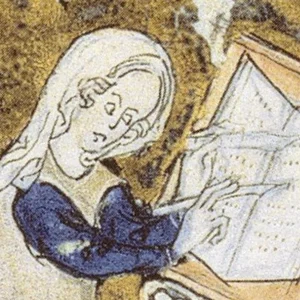

An Anglo-Norman poet of the 12th century, Marie de France is the first known woman writer in the French language. She is celebrated for her Lais, her Fables, and her Saint Patrick's Purgatory.
Marie de France(1101 — 1300)
Marie de France
royaume de France
8 min read
Frequently asked questions
Key Facts
- Active around 1160–1215 at the English court, probably under Henry II Plantagenet
- Author of the Lais, a collection of 12 narrative poems inspired by Celtic Breton traditions
- Translator of Aesop's Fables into the vernacular (around 1180)
- The first known woman to have written in the French language (langue d'oïl)
- Her exact identity remains debated by historians; several theories of identification have been proposed
Works & Achievements
A collection of twelve short narrative poems in octosyllabic verse, inspired by oral Breton traditions. Masterpieces of courtly literature, they explore impossible loves, transformations, and enchanted worlds.
A collection of 102 fables adapted from Aesopic sources via an English version, dedicated to a 'Count William.' It is the first collection of fables in the French language, and would directly influence Jean de La Fontaine.
A verse translation into French of the Tractatus de Purgatorio Sancti Patricii by the monk Henry of Saltrey. This journey into the afterlife reveals Marie's religious and scholarly interests beyond courtly poetry.
One of the most celebrated of the Lais, following a knight of Arthur's court who is loved by a fairy. The text is widely studied for its veiled critique of the Arthurian court and its portrayal of supernatural femininity.
The story of a knight transformed into a werewolf and betrayed by his wife. This lai explores themes of marital betrayal and the duality of human nature, blending a sense of wonder with genuine tragedy.
Anecdotes
Marie de France is the first identified woman of letters to write in the French language. She signs her works with a celebrated phrase: "Marie ai nun, si sui de France" ("My name is Marie, and I am from France"), reflecting a remarkable sense of authorial identity for a woman of the 12th century.
Her Lais are dedicated to a "noble king," whom historians generally identify as Henry II Plantagenet, King of England. This dedication suggests that Marie moved in the learned circles of the Angevin court, one of the most brilliant cultural centers in medieval Europe.
Marie de France translated and adapted Aesop's fables, which she claimed to have drawn from an English version attributed to King Alfred the Great. In doing so, she built a bridge between ancient tradition, Anglo-Saxon culture, and vernacular literature, embodying the rich cultural exchanges of her era.
The true identity of Marie de France remains a historical mystery. Several theories have been proposed: abbess of Shaftesbury, lady of the court, or even half-sister of Henry II. This uncertainty reflects the difficulty medieval women faced in leaving a trace in official records, even when they were famous during their own lifetimes.
In the Lai de Laustic, Marie tells the story of a lady who has a nightingale — killed by her jealous husband — placed in a golden casket. This poetic image of the imprisoned nightingale is often interpreted as a metaphor for forbidden love and female literary creation under constraint.
Primary Sources
"My name is Marie, and I am from France. It may be that many clerks will take my work upon themselves. I do not wish that anyone should claim it as their own."
"Whoever has received from God the gift of knowledge and the power of eloquent speech must not keep silent or conceal it, but should willingly make it known."
"At the end of this writing, which I have composed and set down in the vernacular, I will name myself for remembrance: my name is Marie, and I am from France."
"Marie had the book of the Purgatory translated into the vernacular, so that it might be accessible to laypeople who do not know Latin."
Key Places
Marie de France dedicates her Lais to a 'noble king' identified as Henry II. His court, which traveled between England and Anjou, was a major cultural hub where scholars, poets, and clerics mingled.
Marie describes herself as coming 'from France,' which may refer to Normandy or the Île-de-France. The Anglo-Norman culture she came from grew out of this geographic and linguistic in-between world.
One scholarly theory identifies Marie de France with Marie, abbess of Shaftesbury and half-sister of Henry II. This Benedictine monastery was a center of culture and learning for noblewomen in the 12th century.
Brittany is the legendary birthplace of the Breton lais that Marie rendered into French. She sets the action of most of her stories in this mysterious region associated with King Arthur and the fairies.
A major religious and intellectual center of medieval England, Canterbury was a crossroads of cultural exchange through which the Latin texts that Marie de France translated and adapted would circulate.
Typical Objects

Medieval texts were written on carefully prepared calfskin or sheepskin. Marie de France dictated or wrote her works herself on these materials, which were the prestigious writing medium of her time.

Marie drew on a collection of fables attributed to King Alfred to compose her own Fables. This type of volume, often illuminated, circulated in monastic libraries and royal courts of the 12th century.

In several of her Lais, the harp is the instrument of knights and poets who sing of their loves. The instrument symbolizes the oral transmission of Breton tales that Marie de France committed to writing.

The characters in her Lais often exchange precious objects as tokens of love or recognition. The ring is a recurring motif that seals vows and secret unions throughout her poetic world.

Reading and writing sessions in medieval courts often took place by the light of beeswax candles, reserved for wealthy households. Marie composed her works and had them read aloud in these intimate settings.

In the Lai of the Nightingale (Laustic), a dead nightingale is enclosed in a precious casket. These small reliquary or jewelry boxes are characteristic of the luxury craftsmanship of the Plantagenet court and symbolize the preciousness of courtly love.
School Curriculum
Vocabulary & Tags
Key Vocabulary
Tags
Daily Life
Morning
Marie rises at dawn to the sound of matins. In a monastic setting or at court, the day begins with prayer or Mass in the chapel. She devotes the first hours to intellectual work, dictating or drafting her texts while the morning light is most favorable for writing.
Afternoon
The afternoon is organized around the collective life of the court or convent: shared meals, readings aloud from Latin texts or vernacular works. Marie takes part in learned discussions, exchanges ideas with clerks and trouvères, and perhaps oversees the copying of her manuscripts by scribes.
Evening
In the evening, by candlelight, poems and stories are recited in the great hall. It is during these evening gatherings that the lais were sung or performed before the court. Marie listens, revises, composes in her mind, before joining compline and retiring for the night.
Food
The table of a court lady in the 12th century includes white bread, roasted or sauced meat, fish on fast days, cooked vegetables, spices imported from the East, and wine mixed with water. Feast-day meals are more lavish, featuring game, pastries, and fragrant hypocras.
Clothing
Marie wears a bliaut — a long, fitted gown with flared sleeves in dyed wool or silk for formal occasions. A veil and wimple frame her face in the Norman fashion. The most common colors are blue, madder red, and green, all symbols of social standing.
Housing
At an itinerant royal court such as that of the Plantagenets, lodgings are found in stone fortresses or episcopal palaces. High-ranking women have a private chamber, sometimes heated by a fireplace, furnished with a canopied bed, chests for clothing, and a prie-dieu.
Historical Timeline
Period Vocabulary
Visual Style
Esthétique des enluminures Anglo-normandes du XIIe siècle : tons parchemin, bleus au lapis-lazuli, or et ornements végétaux sur fond architectural roman.
Sound Ambience
L'ambiance sonore d'une cour anglo-normande du XIIe siècle : sons d'écriture, harpe courtoise, récitation de vers en français, feu de cheminée et chants liturgiques au loin.
Liens externes & ressources
Références
Œuvres
Les Lais
vers 1160-1178
Les Fables
vers 1180-1190
L'Espurgatoire Seint Patriz
vers 1189-1215
Lai de Lanval
vers 1160-1178
Lai du Bisclavret
vers 1160-1178