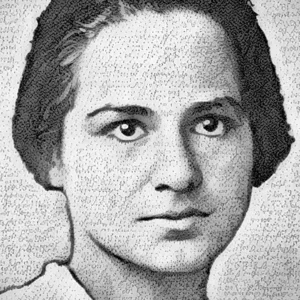

Marietta Blau (1894-1970) was an Austrian physicist who pioneered the photographic method of particle detection. Her sensitive emulsions made it possible to record cosmic rays and nuclear disintegrations, paving the way for particle physics.
Marietta Blau(1894 — 1970)
Marietta Blau
Autriche, Cisleithanie
6 min read
Frequently asked questions
Key Facts
- Born in 1894 in Vienna and died in 1970 in the same city.
- Developed the photographic method of nuclear particle detection at the Radium Institute in Vienna during the 1920s and 1930s.
- Discovered in 1937, together with Hertha Wambacher, the “disintegration stars” produced by cosmic rays in emulsions.
- Forced into exile in 1938 after the Anschluss because of her Jewish origins, she worked in Mexico and then in the United States.
- Nominated several times for the Nobel Prize (notably by Erwin Schrödinger) but never awarded it, while Cecil Powell won the 1950 Nobel Prize thanks to methods derived from hers.
Works & Achievements
Invention and refinement of the technique that made it possible to permanently record the trajectories of particles within an emulsion. It became a fundamental method of particle physics.
With Hertha Wambacher, demonstration of atomic nuclei shattered by cosmic rays, visible as star-shaped sprays on the plates.
International publication that brought attention to the significance of her method and paved the way for the study of high-energy particles.
Award granted to Blau and Wambacher for their work, one of the few official recognitions Blau received during her lifetime.
Demonstration that protons leave measurable tracks in the emulsion, the foundation of all later photographic detection of charged particles.
Research at Columbia, Brookhaven and the University of Miami on the analysis of particles produced by accelerators, including processes for automating measurement.
Anecdotes
Like many women scientists of her time, Marietta Blau worked for years at the Radium Institute in Vienna without receiving any salary at all. It was her family who funded her research, and she gave private lessons to earn a living while revolutionizing particle detection.
In 1937, Blau and her student Hertha Wambacher exposed photographic plates for months on end at the summit of the Hafelekar, at an altitude of 2,300 metres near Innsbruck. When they developed them, they discovered strange star-shaped figures: the traces of atomic nuclei shattered by cosmic rays, which were named “disintegration stars.”
When Nazi Germany annexed Austria in 1938, Blau, who was Jewish, had to flee in haste. The irony: her collaborator Hertha Wambacher was a member of the Nazi party. It was Albert Einstein himself who helped Blau find a position in Mexico City to escape persecution.
The physicist Erwin Schrödinger nominated Marietta Blau for the Nobel Prize several times, but she never received it. In 1950, Cecil Powell won the Nobel Prize in Physics thanks to the photographic emulsion method that she had invented and perfected.
Throughout her life, Blau handled radioactive sources and spent entire days bent over her microscope. She died of cancer in 1970, an illness probably linked to years of exposure to radiation, at a time when its dangers were still unknown.
Primary Sources
The authors describe the observation, on photographic emulsions exposed at high altitude, of showers of heavy particles emitted simultaneously from a single point, interpreted as the disintegration of atomic nuclei under the effect of cosmic rays.
Blau demonstrates that protons (H-rays) ejected from paraffin or aluminium leave recordable tracks in the photographic emulsion, laying the foundations for the detection of charged particles by photographic means.
The reports detail the development of more sensitive emulsions and the methods of prolonged exposure that make it possible to measure the range and energy of ionizing particles.
Key Places
Blau's birthplace and home to the Radium Institute where she carried out her major research. She returned there at the end of her life and died in 1970.
Where Blau studied physics and earned her doctorate in 1919, at a time when women could barely access higher education.
High-altitude station (about 2,300 m) where Blau and Wambacher exposed their plates to cosmic rays, revealing the “disintegration stars” in 1937.
Blau's refuge after the Anschluss: thanks to Einstein, she obtained a position at the National Polytechnic Institute to flee Nazi persecution.
American laboratory where Blau continued her work on particle tracks from accelerators, after her emigration to the United States.
Typical Objects

A glass plate coated with an emulsion rich in silver salts, in which charged particles leave a visible track after development. This was the key tool invented and perfected by Blau for particle physics.

An optical microscope used to scrutinize, track by track, the tiny furrows left by particles in the emulsion. The analysis demanded hours of patience and great visual acuity.

A small source emitting alpha particles or protons, used to test and calibrate the sensitivity of the emulsions. Its handling, poorly shielded at the time, exposed researchers to radiation.

A device producing X-rays, which Blau worked on early in her career in the medical industry in Berlin and Frankfurt. This experience gave her her mastery of photographic plates.

A register where exposure conditions, durations, and the measurements taken on each plate were recorded. Essential for making experiments reproducible.
School Curriculum
Vocabulary & Tags
Key Vocabulary
Daily Life
Morning
Marietta Blau arrived early at the Radium Institute, in the studious calm of the Viennese laboratories. She prepared her emulsions, checked the plates being developed, and organized the exposures to radioactive sources.
Afternoon
She spent most of the afternoon bent over the microscope, examining track by track the trails left by particles. This painstaking work demanded hours of concentration and extreme patience.
Evening
In the evening, she often gave private lessons in physics and mathematics to support herself, as her research position was unpaid. She also devoted time to reading international scientific publications.
Food
Her diet was that of the Viennese middle class between the wars: bread, soups, simmered dishes, cured meats, and the famous pastries of Vienna's cafés. Everyday meals remained simple.
Clothing
In the laboratory, she wore a lab coat to protect herself from chemicals. In town, she adopted the understated, neat attire of educated women of the time: long dresses, fitted coats, and hats.
Housing
She lived in Vienna in an urban apartment, for a long time with her mother, whom she cared for. Her lifestyle remained modest, due to the lack of regular income from research.
Historical Timeline
Period Vocabulary
Liens externes & ressources
Références
Œuvres
Méthode de détection des particules par émulsion photographique
1925-1937
Découverte des « étoiles de désintégration »
1937
Article dans Nature sur les désintégrations par rayons cosmiques
1937
Prix Lieben de l'Académie des sciences de Vienne
1937
Développement d'émulsions sensibles aux protons
1925
Travaux sur les traces de particules aux États-Unis
1944-1960