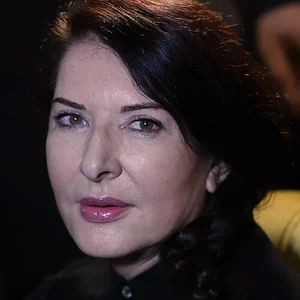

Marina Abramović is a Serbian artist born in 1946, a pioneer of performance art. Since the 1970s, she has explored the limits of the body, of endurance, and of the relationship between the artist and the audience, becoming one of the major figures of contemporary art.
Marina Abramović(1946 — ?)
Marina Abramović
Serbie, Yougoslavie, Serbie-et-Monténégro, république fédérative socialiste de Yougoslavie, république fédérale de Yougoslavie, république fédérale populaire de Yougoslavie
6 min read
Frequently asked questions
Famous Quotes
« The Artist Is Present»
Key Facts
- Born on 30 November 1946 in Belgrade, Yugoslavia (present-day Serbia).
- Created the Rhythm series of performances in the 1970s, including Rhythm 0 (1974), in which she passively offered herself to the audience.
- Collaborated with the artist Ulay from 1976 to 1988, ending with a walk along the Great Wall of China (The Lovers, 1988).
- Performed The Artist Is Present at the MoMA in New York in 2010, sitting facing visitors for nearly 736 hours.
- Founded the Marina Abramović Institute to pass on and preserve the art of performance.
Works & Achievements
A boundary-pushing performance in which the audience had access to 72 objects and the artist's own body, revealing the latent violence of a crowd.
Visitors had to squeeze between the two naked artists, questioning intimacy and our relationship to the body.
A 90-day walk along the Great Wall of China that brought their relationship to a close, becoming a legendary performance.
An installation-performance about the wars in the Balkans, awarded the Golden Lion at the Venice Biennale.
At the Guggenheim, she re-performed historic works, raising the question of how to preserve and pass on this ephemeral art form.
An extremely long-duration performance at MoMA, where she held the gaze of thousands of visitors; she became a global figure.
An account of her life and artistic approach, a landmark testimony on the art of performance.
Anecdotes
In 1974, during the performance *Rhythm 0* in Naples, Marina Abramović stood still for six hours and placed 72 objects at the public's disposal, including a rose, honey, scissors and a loaded pistol. As the hours passed, some spectators turned aggressive, tearing at her clothes and pressing the weapon against her neck: the experiment revealed, chillingly, what a crowd is capable of when all responsibility seems suspended.
For twelve years, Abramović and the German artist Ulay formed an inseparable couple, in life as in art. To part in 1988, they chose a spectacular gesture: each setting out from one end of the Great Wall of China, they walked toward one another for 90 days to meet in the middle and say goodbye.
In 2010, at the Museum of Modern Art in New York, she sat motionless and silent facing visitors one at a time for nearly 736 hours spread over three months (*The Artist Is Present*). In a dramatic twist, Ulay, whom she had not seen for years, sat down across from her, and emotion overcame them both before the eyes of the public.
As a child in Belgrade, Marina was raised with near-military discipline by parents who were heroes of the Yugoslav resistance. Her deeply religious grandmother often took her to the Orthodox church: these two worlds, communist rigor and spirituality, would lastingly shape her relationship to ritual and endurance.
In 1975, for *Art Must Be Beautiful, Artist Must Be Beautiful*, she violently brushed her hair and face while repeating that phrase until she hurt herself, ironically questioning clichés about beauty and the place of women in art.
Primary Sources
“Art must be beautiful, the artist must be beautiful”: I wanted to show the absurdity of this idea by brushing my hair until it hurt.
There are 72 objects on the table that can be used on me however one wishes. I am the object. During this period, I take full responsibility.
I never thought that sitting and looking people in the eye could stir up such emotion; many wept in front of me.
Key Places
Abramović's hometown, where she grew up in a family of communist heroes and studied at the Academy of Fine Arts. This austere environment fueled her taste for discipline and ritual.
Site of the performance “Rhythm 0” in 1974, one of the most famous and most dangerous of her career.
Setting of the performance “The Lovers” in 1988, where Abramović and Ulay walked for 90 days to meet each other and then part ways.
Site of the retrospective and the performance “The Artist Is Present” in 2010, which made her a global icon.
Where she received the Golden Lion in 1997 for “Balkan Baroque.” The Biennale cemented her international recognition.
The city where the artist settled permanently and founded her institute dedicated to performance. The center of her contemporary influence.
Typical Objects

Cutting tools used in the *Rhythm* and *Lips of Thomas* performances to test the body's resistance to pain. They embody the real risk assumed by the artist.

Minimalist furniture where the artist and the visitor sat facing each other in silence. The setup turns a simple exchange of glances into a work of art.

A mountain of bloodied bones that Abramović scrubbed for days at the Venice Biennale. They evoked the massacres of the Balkan wars.

Among the 72 objects left for the public, a real firearm together with a bullet. Its presence reveals the fragile boundary between artistic play and deadly danger.

Quartz and minerals used in her installations and attention exercises for the public. They symbolize her quest for energy, presence and concentration.

A long dress worn notably during *The Artist Is Present*, which became almost a visual signature. The garment underscores the solemnity and duration of the ritual.
School Curriculum
Vocabulary & Tags
Key Vocabulary
Daily Life
Morning
Marina Abramović often begins her days with breathing exercises, meditation, and sometimes long walks, all inherited from her preparation "method." The discipline of the body, learned in childhood, shapes her mornings.
Afternoon
Her afternoons are devoted to studio work, the meticulous preparation of performances, and endurance rehearsals, as well as teaching young artists. She reflects at length on the duration, the space, and the audience of each work.
Evening
In the evening, she meets with exhibition curators, collaborators, and friends from the art world, or rests in preparation for a demanding performance. Before her long-duration works, she imposes fasts and strict calm upon herself.
Food
To prepare for her longest performances, Abramović fasts and adopts a very spare diet in order to purify body and mind. Outside of these periods, she enjoys simple cooking, marked by her Balkan roots.
Clothing
On stage, she favors plain, solemn outfits, often a long red, white, or black dress that has become emblematic. In daily life, she cultivates a pared-down, almost ritual elegance.
Housing
Based mainly in New York, she lives and works in austere spaces conducive to concentration. Her institute and her workplaces reflect her taste for emptiness, silence, and attention.
Historical Timeline
Period Vocabulary
Liens externes & ressources
Références
Œuvres
Rhythm 0
1974
Imponderabilia (avec Ulay)
1977
The Lovers: The Great Wall Walk (avec Ulay)
1988
Balkan Baroque
1997
Seven Easy Pieces
2005
The Artist Is Present
2010
Walk Through Walls (autobiographie)
2016