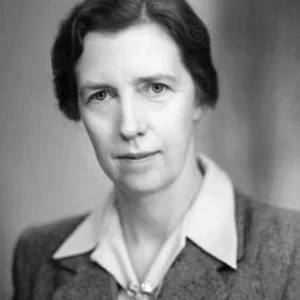

British mathematician and pioneer of dynamical systems theory. Her work on nonlinear differential equations foreshadowed chaos theory. She was the first woman mathematician elected to the Royal Society.
Mary Cartwright(1900 — 1998)
Mary Cartwright
Royaume-Uni, Royaume-Uni de Grande-Bretagne et d'Irlande
6 min read
Frequently asked questions
Key Facts
- Born on 17 December 1900 in Aynho (England)
- First woman mathematician elected a Fellow of the Royal Society in 1947
- Collaborated with John Littlewood from 1938 on nonlinear equations related to radar, laying the groundwork for the future chaos theory
- First woman president of the London Mathematical Society (1961-1963)
- Made a Dame Commander in 1969; died on 3 April 1998
Works & Achievements
Discovery that simple equations can produce solutions of chaotic complexity. These results foreshadow chaos theory, which emerged in the 1960s-70s.
A reference work on the theory of entire functions, published in the prestigious Cambridge Tracts in Mathematics series.
First woman mathematician admitted to the oldest scientific academy in the world.
First woman to lead the United Kingdom's principal learned society for mathematics.
A prestigious award for her contributions to mathematics; she was its first female recipient.
The society's highest distinction, which she was the first woman to receive, crowning her entire body of work.
Anecdotes
In 1938, the British Radio Research Board put out a call to mathematicians: engineers could not understand the strange behaviour of certain radio amplifiers, described by differential equations. Mary Cartwright and her colleague J. E. Littlewood took up the challenge and discovered that the solutions were unexpectedly complex — work that foreshadowed, decades ahead of its time, the future theory of chaos.
In 1947, Mary Cartwright became the first woman mathematician elected a Fellow of the Royal Society, the oldest scientific academy in the world, founded in 1660. It took nearly three centuries for a woman mathematician to be admitted.
Born in 1900, she studied mathematics at Oxford just after the First World War, at a time when women were a tiny minority there: the university only agreed to award degrees to women from 1920 onwards.
From 1949 to 1968, she was head of Girton College at Cambridge, one of the first British university colleges reserved for women. Leading a college while pursuing cutting-edge research was exceptional at the time.
She collected “firsts” for a woman: first female president of the London Mathematical Society (1961), first woman to receive the Sylvester Medal (1964) and then the De Morgan Medal (1968). In 1969, the Queen made her a Dame Commander of the British Empire.
Primary Sources
A study of the forced van der Pol equation showing that its solutions can display extraordinarily complex, non-periodic behaviour where regular oscillations had been expected.
A landmark treatise on the theory of entire functions, synthesising her research in complex analysis carried out from the 1930s onwards.
An account, aimed also at engineers, of forced-oscillation phenomena in nearly sinusoidal electronic systems.
Key Places
English village where Mary Cartwright was born in 1900, the daughter of a vicar. It is the setting of her childhood.
Oxford college where she studied mathematics in the early 1920s, among the few women admitted. She also pursued her doctorate there under the supervision of G. H. Hardy.
Women's college where she was a lecturer and then Mistress from 1949 to 1968. The heart of her academic career.
Town and university where she carried out most of her research in analysis and dynamical systems.
British scientific academy where she was elected a Fellow in 1947, the first woman mathematician to receive this honour.
Typical Objects

Wall surface on which mathematicians write and erase equations and proofs. It was the central tool of teaching and research at Cambridge.

Notebooks covered with calculations, sketched-out solutions and handwritten notes. This is where proofs came to life, line after line.

Electronic device whose unstable behaviour, modelled by the van der Pol equation, sparked Cartwright's research. Its “strange” oscillations were a puzzle for engineers.

Instrument that displays the evolution of an electrical signal over time as a curve. It made it possible to visualise the complex oscillations that Cartwright and Littlewood were studying mathematically.

Hand-cranked or electromechanical desktop calculator, used for the tedious numerical computations of the era before computers.

Black robe worn by Cambridge academics at ceremonies and in college life. As Mistress of Girton, Cartwright wore it often.
School Curriculum
Vocabulary & Tags
Key Vocabulary
Tags
Daily Life
Morning
Waking early in her rooms at Girton College, Mary Cartwright often began the day by reading her mail and preparing her lectures. The morning was a precious time for mathematical reflection, in quiet, before the bustle of the college.
Afternoon
The afternoon was divided between teaching, meetings with students and colleagues, and the administrative duties of a director. She also devoted time to her research, filling notebooks and boards with calculations.
Evening
Evenings were shaped by the communal dinners (“High Table”) of college life, where faculty and guests mingled. There she discussed science, literature and university affairs, then often returned to her work.
Food
She took her meals at the college's common table, in keeping with British university tradition: simple, hearty cooking, afternoon tea, and more formal dinners in the evening. The food reflected the restrictions of rationing during and after the war.
Clothing
Plain, practical academic clothing of the first half of the 20th century: well-cut skirts, blouses and jackets. For ceremonies and the official life of the college, she wore the black academic gown.
Housing
As director, she lived in the rooms reserved for the Mistress within Girton College, a vast red-brick building surrounded by gardens, on the outskirts of Cambridge. This setting blended private life with official duties.
Historical Timeline
Period Vocabulary
Liens externes & ressources
Références
Œuvres
Travaux sur les équations différentielles non linéaires (avec J. E. Littlewood)
1945-1947
« Integral Functions » (livre)
1956
Élection à la Royal Society
1947
Présidence de la London Mathematical Society
1961-1963
Médaille Sylvester de la Royal Society
1964
Médaille De Morgan de la London Mathematical Society
1968