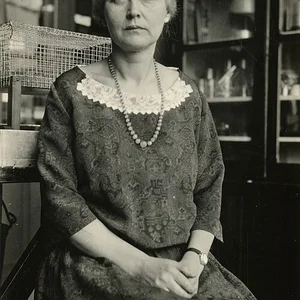

Maud Menten (1879-1960) was a pioneering Canadian biochemist and physician. She co-authored the Michaelis-Menten law of enzyme kinetics (1913), a cornerstone of biochemistry. She was one of the first Canadian women to earn a doctorate in medicine.
Maud Menten(1879 — 1960)
Maud Menten
Canada
8 min read
Frequently asked questions
Key Facts
- 1879: born in Port Lambton, Ontario, Canada
- 1913: publication of the law of enzyme kinetics with Leonor Michaelis in Berlin
- 1916: earned a doctorate in biochemistry from the University of Chicago
- Pioneer: one of the first Canadian women licensed to practice medicine
- 1960: died in Toronto, leaving a major scientific legacy in enzymology
Works & Achievements
Article co-written with Leonor Michaelis, published in the Biochemische Zeitschrift. It introduces the fundamental equation V = Vmax[S]/(Km+[S]) describing the rate of enzymatic reactions, a cornerstone reference in biochemistry worldwide.
A histochemical method devised by Menten to visually locate enzymes within tissue sections using azo dyes. This technique is still used in laboratories around the world.
Menten's earliest research, examining the effects of radioactive radiation on embryonic cells, conducted at the University of Chicago during a pioneering era of nuclear physics applied to biology.
A study of this key enzyme in cellular respiration, contributing to the understanding of enzymatic mechanisms involved in the body's gas exchange.
Menten was among the first scientists to use radioactive isotopes as tracers to track biochemical reactions in living cells, foreshadowing modern techniques in molecular biology and medical imaging.
Anecdotes
In 1912, Maud Menten had to leave Canada and travel to Berlin to work with biochemist Leonor Michaelis. At the time, women were not permitted to conduct research at most Canadian institutions. Far from seeing this as an obstacle, she crossed the Atlantic alone and settled in the German capital for an intense year of research that would change the history of biochemistry.
The Michaelis-Menten equation, published in 1913, became one of the most cited formulas in the entire history of biology. Yet for decades, Maud Menten received only limited recognition, her name often overshadowed by that of her male co-author. It was only much later that the scientific community fully acknowledged the extent of her personal contribution to the experiments.
Maud Menten was a remarkable individual: a polyglot who spoke at least six languages including Russian and German, an accomplished watercolor painter, a mountaineer, and an amateur singer. She embodied the ideal of the scientist who embraced both art and adventure, at a time when women were still largely excluded from universities and laboratories.
At the University of Pittsburgh, where she worked from 1918 to 1950, Menten developed a histochemical staining technique — azo coupling — still used today in laboratories around the world to visualize enzymes in biological tissues. She was also among the first to use radioactive tracers in biology.
Despite a brilliant career and major discoveries, Maud Menten never obtained a tenured professorship at the University of Pittsburgh, running up against the same institutional barriers faced by all women scientists of her era. She returned to Canada at the end of her life and died in 1960 in Leamington, Ontario, leaving behind a considerable scientific legacy.
Primary Sources
Wir haben die Kinetik der Invertinwirkung systematisch untersucht und gefunden, dass die Reaktionsgeschwindigkeit von der Substratkonzentration in einer charakteristischen Weise abhängt, die sich durch eine einfache mathematische Formel ausdrücken lässt.
A method is described for demonstrating the localization of alkaline phosphatase in tissue sections by means of the coupling of a diazonium salt with naphthol liberated by the enzyme, producing a visible colored precipitate at the exact site of enzyme activity.
The influence of radium emanation upon cell division was investigated. Results indicate a marked inhibitory effect upon the rate of division proportional to the concentration of radium applied.
Carbonic anhydrase was isolated and its kinetic properties examined. The enzyme was found to catalyse the reversible hydration of carbon dioxide at a rate far exceeding any known chemical catalyst.
Key Places
Maud Menten's birthplace, situated on the shores of Lake St. Clair. It was in this rural Canadian setting that she grew up before embarking on an exceptional academic journey.
The institution where Maud Menten earned her Bachelor of Medicine in 1907 and her medical doctorate in 1911, among the first women admitted to medical sciences in Canada.
It was in this Berlin laboratory that Menten and Michaelis carried out, in 1912–1913, the decisive experiments on the enzymatic kinetics of invertase, giving rise to their landmark equation.
Maud Menten conducted her earliest research on radium here as early as 1910, then completed her doctorate in biochemistry in 1916, deepening her scientific training.
The main site of her scientific career from 1918 to 1950, where she carried out important research in histochemistry and developed the azo-coupling technique whose influence endures to this day.
Typical Objects

Instrument measuring the absorption of light by a solution to quantify the rate of enzymatic reactions. Essential to Menten and Michaelis's experiments on invertase kinetics in 1912–1913.

Notebook in which biochemists recorded every experiment, measurement, and calculation with absolute rigor. Menten noted substrate concentrations and reaction rates that would lead to the fundamental equation.

Central tool in her histochemistry work in Pittsburgh, allowing observation of stained tissue sections using her azo coupling technique and precise localization of enzymes.

Device that kept enzymatic solutions at a constant temperature during experiments. Precise temperature control was crucial for obtaining reliable measurements of enzyme kinetics.

Precision instruments for measuring very small volumes of solutions. The rigor of Menten and Michaelis's measurements was central to the mathematical validity of their equation.

Chemical compounds used by Menten in her 1944 histochemical technique: they react with the products released by enzymes in tissues, making them visible as a colored precipitate under the microscope.
School Curriculum
Vocabulary & Tags
Key Vocabulary
Tags
Daily Life
Morning
Maud Menten arrived at the laboratory early in the morning, before most of her colleagues. She meticulously prepared her enzyme solutions, set the water baths to the exact required temperature, and recorded the parameters of each experiment in her notebook. Her contemporaries described her as absolutely rigorous and remarkably focused from the very first hours of the day.
Afternoon
Afternoons were devoted to reading experimental results, performing mathematical calculations, and writing scientific papers. In Pittsburgh, she also supervised young researchers and took part in medical consultations as a clinical pathologist at the university hospital, balancing fundamental research with medical practice.
Evening
Outside the laboratory, Menten cultivated her many artistic talents: she painted watercolors, practiced classical singing, and read in several languages. She moved in Pittsburgh's intellectual and artistic circles, where she was known as a woman of culture and lively conversation, well beyond her role as a scientist alone.
Food
Maud Menten lived in an era when North American meals consisted mainly of roasted meats, cooked vegetables, potatoes, and bread. In Germany, she discovered Germanic gastronomy — charcuterie, soups, and beer. Her busy laboratory days left little room for long meals; she ate simply and functionally.
Clothing
In her early years, Menten wore the long, fitted-waist dresses and buttoned bodices of Edwardian fashion. By the 1920s, hemlines rose and silhouettes became freer. In the laboratory, she invariably wore a buttoned white coat over her clothes — a symbol of the emerging professional identity of women scientists.
Housing
In Pittsburgh, Maud Menten lived in a comfortable apartment near the university, decorated with her own watercolors and bookshelves filled with volumes in many languages. Her home reflected her dual personality: scientific journals and measuring instruments sat alongside musical scores and works in progress.
Historical Timeline
Period Vocabulary
Visual Style
Style réaliste académique des années 1910, dominé par des teintes sépia, ambre et ivoire, évoquant les laboratoires de biochimie européens du début du XXe siècle baignés d'une lumière naturelle travaillée.
Sound Ambience
L'ambiance sonore d'un laboratoire de biochimie du début du XXe siècle : bain-marie bouillonnant, cliquetis de verrerie, brûleur à gaz et bruits feutrés de la rue berlinoise en toile de fond.
Liens externes & ressources
Références
Œuvres
Die Kinetik der Invertinwirkung
1913
Technique de couplage azoïque pour la détection de la phosphatase alcaline
1944
Études sur les effets biologiques du radium
1911
Recherches sur l'anhydrase carbonique
1932
Applications des traceurs radioactifs en biologie cellulaire
1944