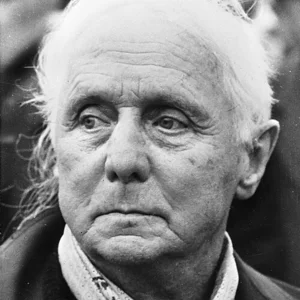

Max Ernst (1891-1976) was a German painter and sculptor, who later became an American and then a French citizen — a leading figure of Dadaism and then Surrealism. The inventor of techniques such as frottage and grattage, he explored the unconscious, dreams, and chance in a richly imaginative body of work.
Max Ernst(1891 — 1976)
Max Ernst
États-Unis, France, Allemagne, Cuba
6 min read
Frequently asked questions
Key Facts
- Born in 1891 in Brühl, near Cologne, Germany
- Co-founder of the Cologne Dada group in 1919, then joined Surrealism in Paris in 1922
- Invented the frottage technique in 1925, then grattage, to draw on chance and the imagination
- Fled Europe in 1941 and went into exile in the United States during the Second World War
- Received the Grand Prize for painting at the Venice Biennale in 1954; died in Paris in 1976
Works & Achievements
Surrealist canvas depicting a strange anthropomorphic spinning top in a deserted landscape, a grotesque allusion to tyrannical power.
Collage-novel made of nineteenth-century engraving images cut out and reassembled, a masterpiece of surrealist collage.
Painting created using the grattage technique, evoking a dense and oppressive forest, a recurring and anxiety-inducing motif in Ernst's work.
A monstrous and menacing creature painted as war approached, a reading of the rise of totalitarian regimes in Europe.
A landscape of ruins and decomposing flesh created using the decalcomania technique, a prophetic vision of a continent ravaged by war.
Bronze sculpture depicting a chessboard-figure, illustrating Ernst's interest in games, chance, and strategy.
Album of frottage plates published by Jeanne Bucher, which revealed to the public the technique invented by Ernst.
Anecdotes
During the First World War, Max Ernst served four years in the German artillery. He came out of it scarred, and later wrote about himself in the third person: “Max Ernst died on August 1, 1914”, the date of the mobilization. He considered that he was “resurrected” as an artist at the end of the conflict.
On a rainy day in 1925, in an inn by the sea, Ernst stared at the floorboards with their grooves worn by scrubbing. Fascinated by the patterns of the wood, he laid sheets of paper over them and rubbed them with a pencil: he had just invented “frottage”, a technique for letting chance suggest images.
In 1941, fleeing war-torn Europe, Ernst emigrated to the United States with the help of the wealthy collector Peggy Guggenheim, whom he married shortly afterward. The couple did not last: Ernst met the painter Dorothea Tanning and settled with her in Arizona.
Before being interned as an “enemy alien” in France at the start of the Second World War, then hunted by the Nazis who deemed his art “degenerate”, Ernst had already been declared undesirable on both sides. His friend the poet Paul Éluard and others helped him escape.
As a child, Ernst was troubled by the death of his pink parrot, which happened the same night his sister was born. All his life he associated birds with himself and created an alter ego named “Loplop, Superior of the Birds”, who appears in many of his works.
Primary Sources
On the 10th of August 1925, a childhood memory... made me fix my attention on the floor, whose grooves had been deepened by a thousand washings. I then decided to investigate the symbolism of this obsession and, to aid my meditative and hallucinatory faculties, I took from the floorboards a series of drawings by laying sheets of paper over them, at random, which I set about rubbing with a graphite pencil.
Max Ernst died on 1 August 1914. He was resurrected on 11 November 1918, a young man aspiring to become a magician and to find the myth of his time.
Surrealism is based on the belief in the superior reality of certain forms of previously neglected associations, in the omnipotence of dream, in the disinterested play of thought.
Key Places
Ernst's birthplace, near Cologne. His childhood in a strict Catholic household and the surrounding countryside fuel his imagination.
City where Ernst studies and founds the local Dada group in 1919 with Arp and Baargeld.
Heart of the Surrealist movement, where Ernst settles in 1922 and where he dies in 1976.
Place where Ernst settles with Dorothea Tanning in the 1940s-50s; the desert landscapes inspire his work.
A former tile factory turned internment camp where Ernst is detained as a German national at the start of the Second World War.
Liens externes & ressources
Références
Œuvres
Ubu Imperator
1923
La Femme 100 têtes
1929
L'Ange du foyer (Le Triomphe du surréalisme)
1937
L'Europe après la pluie II
1940-1942
Histoire naturelle
1926