
Ottoman Sultan (1432–1481), Mehmed II captured Constantinople in 1453, bringing the Byzantine Empire to an end. This event traditionally marks the close of the Middle Ages in Western historiography.
Mehmed
Mehmed
8 min read
Frequently asked questions
Key Facts
- 1432: born in Edirne (Adrianople)
- 1451: ascends to the Ottoman throne at age 19
- 29 May 1453: capture of Constantinople, end of the Byzantine Empire
- Renames Constantinople Istanbul and makes it his capital
- 1481: dies during a military campaign
Works & Achievements
The capture of the Byzantine capital after a 53-day siege, ending the Eastern Roman Empire after more than a thousand years. This event is considered one of the major turning points in world history, marking the end of the Middle Ages in Western historiography.
A vast palace complex built on the Seraglio promontory overlooking the Bosphorus, which remained the primary residence of the Ottoman sultans for nearly four centuries and is today one of the most visited museums in the world.
A grand mosque built in Constantinople on the site of the Church of the Holy Apostles, developed into a religious, academic, and social complex (*külliye*) at the heart of the new Ottoman capital.
A legislative code unifying the Empire's customary laws and Islamic prescriptions, laying the administrative and judicial foundations of a centralized state that would endure until the 19th century.
Over his thirty-year reign, the Ottoman Empire doubled in size: conquest of the Balkans, Anatolia, and Crimea, as well as campaigns in the Mediterranean. Mehmed II was posthumously titled *Fatih* (the Conqueror) by his successors.
Anecdotes
Mehmed II was an exceptional polyglot for his era: he mastered Turkish, Greek, Latin, Persian, Arabic, and Serbian. This linguistic breadth allowed him to read Caesar and the Greek philosophers directly, drawing on them to build the image of a universal empire as heir to both Rome and Byzantium.
To bypass the chain the Byzantines had stretched across the Golden Horn, Mehmed II ordered a daring military operation: sliding part of his fleet on greased wooden rollers over the hills of Galata, across roughly three kilometers. This nocturnal maneuver, accomplished in a single night, caught the defenders of Constantinople completely off guard and proved decisive in the fall of the city.
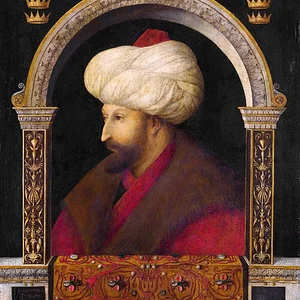
In 1480, Mehmed II invited the Venetian painter Gentile Bellini to his court in Constantinople to paint his portrait. That painting, now held at the National Gallery in London, is one of the earliest realistic portraits of an Ottoman ruler and stands as testament to Mehmed II's curiosity about Italian Renaissance culture and art.
After the capture of Constantinople, Mehmed II visited Hagia Sophia and, according to several chroniclers, spent a long time contemplating its mosaics and the splendor of the building. He ordered its conversion into a mosque while preserving the structure, and brought in scholars, craftsmen, and families of all faiths to repopulate the city that had become his new capital.
Mehmed II issued a *Kanunname* (legal code) that legalized imperial fratricide: to prevent the civil succession wars that had weakened the Empire, the sultan could have his brothers executed upon his accession. This measure was presented as a necessity of state to ensure the stability of the Ottoman Empire, and was endorsed by several *ulema* of the time.
Primary Sources
He entered the great church and gazed at its immense expanse and magnificent beauty from every side. Struck with admiration, he said to those around him: “Truly, this is a wonder.” He then ordered that it be immediately converted into a mosque.
The sultan ordered his men not to destroy the houses or the churches, but to seize the inhabitants to sell them or keep them in his service. As for the treasures and goods, he reserved them for the imperial treasury and for distribution to his soldiers.
On Monday, May 28, the enemy sounded his trumpets and beat his drums, and on the 29th at dawn he launched a general assault. The Emperor, seeing that all was lost, said: “The city is taken and I still live.” He then threw himself into the fray and was never seen again.
As for my sons and grandsons who shall attain the sultanate, they are permitted to put their brothers to death for the good of the world order. Most of the ulemas have approved this. Let them act accordingly.
Mehmed was a man of great intelligence, stern in war, skilled in affairs of state, speaking several languages, and eager to learn the customs and laws of the peoples around him.
Key Places
Former Ottoman capital where Mehmed II was born in 1432. It was from Edirne that he organized and launched the siege of Constantinople, assembling his troops and his formidable artillery.
Capital of the Byzantine Empire conquered by Mehmed II on **29 May 1453**, which became the new capital of the Ottoman Empire under the name Istanbul. It was here that he built the Topkapi Palace and the great Fatih Mosque.
Fortress built in **1452** by Mehmed II on the European shore of the Bosphorus in just four months, to cut Constantinople off from any supply coming from the Black Sea. It stands as a testament to the sultan's strategic and logistical genius.
The first great Ottoman capital and a center of military and religious training. Mehmed II spent time there during the early years of his reign, drawing on the legacy of the dynasty's founding sultans.
A town near Constantinople where Mehmed II died on **3 May 1481**, just as he was preparing to launch a major new military campaign, most likely against Safavid Persia or Italy.
Liens externes & ressources
Références
Œuvres
Conquête de Constantinople
1453
Palais de Topkapi
vers 1459-1465
Mosquée Fatih (le Conquérant)
1463-1470
Kanunname-i Al-i Osman (Code de lois ottoman)
vers 1477-1481
Expansion territoriale de l'Empire ottoman
1451-1481