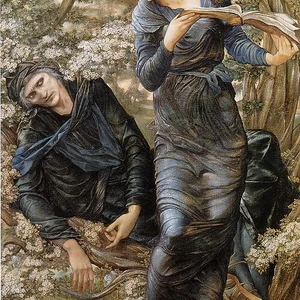

Merlin is a legendary wizard or druid from Arthurian legend, known as advisor and sorcerer to King Arthur. A central figure in medieval literature, he embodies magical wisdom and supernatural influence in the kingdoms of Britain.
Frequently asked questions
Key Facts
- Central figure in Arthurian legend, notably in the works of Chrétien de Troyes and Malory
- Credited with organizing the order of the Round Table and advising King Arthur
- Associated with magical and supernatural powers in medieval tales
- First mentioned in Geoffrey of Monmouth's Historia Regum Britanniae (c. 1135)
- An important figure in Welsh and Breton tradition, later taken up by courtly literature
Works & Achievements
According to Arthurian tales, Merlin used his magic to transport giant stones from the Giant's Dance in Ireland to England, thereby creating the megalithic monument. This feat symbolizes the character's superhuman magical power.
Merlin is credited with obtaining or arranging the magical sword Excalibur for King Arthur. This legendary weapon becomes the symbol of royal power and Arthurian legitimacy.
Merlin advises the creation of the Round Table, an institution symbolizing equality among knights and the political order of the kingdom. This achievement represents his major influence on Arthurian governance.
Merlin plays a decisive role in Arthur's birth and upbringing, arranging his fostering by Uther Pendragon and guiding his development until his accession to the throne. This foundational act establishes his position as the architect of royal power.
Medieval texts attribute to Merlin numerous prophecies about the fate of Arthur and the kingdom of Britain. These divinations shape the Arthurian narrative and demonstrate his access to supernatural knowledge.
Merlin enters into a complex magical relationship with Viviane (or Nimue), who ultimately imprisons him in a forest or tower. This event marks the decline of the wizard and the growing role of feminine magical influence in Arthurian legend.
Anecdotes
Merlin is first described in detail by the Welsh writer Geoffrey of Monmouth around 1138, in his work Historia Regum Britanniae. Geoffrey presents him as born of a mortal woman and a supernatural being, which grants him powers of prophecy and magic. This character was probably inspired by a legendary Welsh bard named Myrddin, mentioned in ancient Celtic poems.
According to legend, Merlin is said to have orchestrated the magical transport of Stonehenge's massive stones from Ireland to England. According to Geoffrey of Monmouth, Merlin convinces King Uther Pendragon that the stones have healing properties, and moves them by magic alone. This story shows how people in the Middle Ages sought supernatural explanations for ancient monuments they could not understand.
The Prophecies of Merlin, written in the 12th century, were taken very seriously by medieval rulers and intellectuals. These prophetic texts, written in Latin, circulated throughout Europe and were sometimes invoked to justify wars or legitimize royal dynasties. They reflect the great importance placed on divination and mystical wisdom in the political culture of the Middle Ages.
In the Lancelot-Grail cycle, written in the early 13th century, Merlin is presented as the true architect of Arthur's reign: he arranges his birth, oversees his secret upbringing, and then reveals his royal legitimacy through the trial of the sword in the stone. This figure of the unseen wise counselor embodies a medieval ideal: the power of knowledge and cunning over brute force alone.
Merlin's fate in medieval romances is particularly symbolic: the fairy Viviane, whom he himself taught the magical arts, imprisons him for eternity in an enchanted forest or an invisible tower. This episode, present in several versions of the Arthurian cycle, raises a question that fascinated medieval scholars: can even the greatest of sages be undone by his own teachings?
Primary Sources
Merlin, son of a spirit and a mortal woman, possessed extraordinary prophetic gifts. He helped Uther Pendragon take on the appearance of the Duke of Cornwall and played a key role in the conception of King Arthur.
After the Battle of Arfderydd, Merlin, driven mad, retreated into the Forest of Caledon where he lived as a hermit, endowed with the gift of prophecy and able to communicate with animals.
Through his enchantments and wisdom, Merlin laid the foundations of the Arthurian kingdom, forging Excalibur and guiding Arthur from birth to the fulfillment of his royal destiny.
Merlin appears as the keeper of the mysteries of the Grail and the secrets of the Arthurian world, shaping the fates of knights through his magic and supernatural knowledge.
A collection of cryptic predictions attributed to Merlin concerning the future of Britain and the Arthurian kingdoms, revealing his role as prophet and all-seeing sage.
Key Places
A town in Wales associated with Merlin's birth according to Welsh tradition. Its Welsh name, Caerfyrddin, means 'Merlin's fortress,' making it his legendary place of origin.
A mysterious legendary island where Merlin was said to have been raised or exiled in some versions of the legend. It is also the place where King Arthur was taken after his wounds, linking it to Merlin's ultimate fate.
A legendary Cornish fortress where Arthur was said to have been conceived with Merlin's magical assistance. The wizard plays a crucial role in Arthurian tales here as a shaper of royal destinies.
The legendary castle of King Arthur, where Merlin serves as chief advisor and court sorcerer. The heart of Arthurian power, where Merlin wields his political and magical influence.
A legendary forest in Brittany where Merlin is said to have lived as a hermit, and where he was imprisoned according to some later versions of the Arthurian cycle.
A legendary Breton site associated with versions of the legend in which Merlin is connected to magical and druidic traditions. It represents the places of spiritual and magical power in medieval Brittany.
Typical Objects

An emblematic magical accessory of druids and medieval sorcerers, symbolizing Merlin's supernatural power. Used to cast spells and assert his magical authority before King Arthur.

A book containing magical formulas and esoteric knowledge, representing Merlin's wisdom and scholarship. A typical object associated with scholars and sorcerers of the late Middle Ages.

Though technically King Arthur's sword, Merlin is credited with using his magic to secure its acquisition. This legendary weapon symbolizes the inseparable bond between the sorcerer and the monarch.

A long, flowing garment, often described as blue or purple in Arthurian tales, marking his status as a wise man and practitioner of medieval magic.

A divination object that allows Merlin to see the future and possess supernatural vision. A symbol of his gift of prophecy and his connection to the invisible world.

A sacred artifact central to Arthurian legend, associated with magical quests and the mystical knowledge that Merlin guarded or passed on.

Though created for Arthur, Merlin is its legendary designer, symbolizing the equality among the knights and the harmony the sorcerer sought to bring to the kingdom.

An emblem associated with the royal power that Merlin helped establish and legitimize, representing his ability to shape the destiny of the kingdoms of ancient Britain.
School Curriculum
Vocabulary & Tags
Key Vocabulary
Tags
Mythologie
Daily Life
Morning
Merlin wakes in his secluded dwelling — described variously as a cave, a tower, or an enchanted forest depending on the telling. He devotes his mornings to studying the magical arts, consulting ancient texts, and observing the natural phenomena that fuel his supernatural knowledge. He occasionally receives visitors seeking counsel, most notably King Arthur and those close to him.
Afternoon
The afternoon is dedicated to meditation and communion with occult forces. Merlin travels back and forth between his retreat and the Arthurian court to advise the king on major political and military decisions. He takes part in the kingdom's great events, including the selection of knights and the safeguarding of royal secrets.
Evening
As night falls, Merlin withdraws into solitude to practice his magical arts and maintain the spells protecting the kingdom. He devotes time to meditation and stargazing, the heavens being a source of esoteric wisdom in his eyes. His evenings remain shrouded in mystery, far from the eyes of the court.
Food
Living on the margins of feudal society, Merlin eats simply: bread, wild fruits, medicinal herbs, freshwater fish, and game as needed. His diet reflects his ascetic way of life and his independence from ordinary social structures, favoring austerity over culinary richness.
Clothing
Merlin wears long, flowing garments — often described as a robe or tunic in dark or grey tones — symbols of his standing as a sage and sorcerer. He is frequently depicted with a long white beard, a staff or magical wand, and sometimes a distinctive pointed hat, setting him apart in appearance from ordinary men.
Housing
Merlin lives far from feudal civilization, in a cave, an enchanted forest, or an isolated tower depending on the version of the legend. His dwelling is a place of magical power, filled with mystery and difficult to reach for the uninitiated, reflecting his role as an intermediary between the world of men and the supernatural.
Historical Timeline
Period Vocabulary
Visual Style
Un style inspiré des manuscrits enluminés médiévaux du XIIe-XIIIe siècles, mêlant la richesse des arts gothiques à l'atmosphère mystique de la magie arthurienne. L'esthétique combine l'or et les tons profonds des parchemins anciens avec des effets surnaturels et lumineux caractéristiques de la fantasy médiévale romantique.
Sound Ambience
Une ambiance mystique et intemporelle mêlant sons naturels d'une forêt ancienne, tonalités magiques éthérées, murmures d'incantations et notes de harpe médiévale, créant l'atmosphère immersive d'un grand mage arthérien entouré de pouvoirs surnaturels.
Liens externes & ressources
Références
Œuvres
Construction de Stonehenge
Légende médiévale
Forging de l'épée Excalibur
Légende médiévale
Fondation de la Table Ronde
Légende médiévale
Conception et éducation du roi Arthur
Légende médiévale
Prophéties et divinations arthuriennes
Légende médiévale
Enchantement de Viviane
Légende médiévale