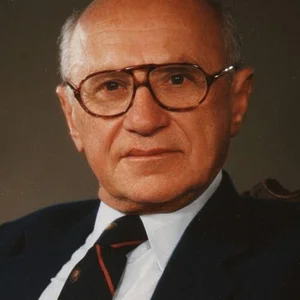

American economist, leader of the Chicago School and a major figure of monetarism. A champion of economic liberalism and free markets, he received the Nobel Prize in Economics in 1976. His influence shaped the economic policies of the late 20th century.
Milton Friedman(1912 — 2006)
Milton Friedman
États-Unis
6 min read
Frequently asked questions
Famous Quotes
« There is no such thing as a free lunch.»
« Inflation is always and everywhere a monetary phenomenon.»
Key Facts
- Born in 1912 in New York, died in 2006 in San Francisco.
- Professor at the University of Chicago, where he founded the monetarist school of thought.
- Published “Capitalism and Freedom” in 1962, a manifesto of economic liberalism.
- Received the Nobel Prize in Economics in 1976 for his work on consumption and monetary theory.
- His ideas inspired the policies of Reagan and Thatcher in the 1980s.
Works & Achievements
Introduces the “permanent income” hypothesis, which transforms our understanding of household consumption behavior.
A manifesto defending the role of the free market and the limitation of state intervention. One of his most widely read works.
A major work co-written with Anna Schwartz, reinterpreting the Great Depression as a failure of monetary policy.
Introduces the concept of the “natural rate of unemployment” and criticizes the Phillips curve, transforming macroeconomics.
Honors his analyses of consumption, monetary history, and stabilization policy.
A bestselling book and television series popularizing his free-market ideas for general audiences around the world.
A school of thought asserting that controlling the money supply is the key to price stability, which influenced central banks.
Anecdotes
In 1980, Milton Friedman and his wife Rose presented a television series called *Free to Choose*. Broadcast on the American public channel PBS, it made complex economic ideas accessible to a wide audience and became a genuine best-seller once turned into a book.
Friedman was very short (about 5 feet, or 1.52 m) and often joked about it himself. That did not stop him from becoming one of the most feared debaters of his time, capable of throwing his opponents off balance with a smile and relentless arguments.
During the Second World War, Friedman worked for the U.S. Treasury, where he helped set up the system of withholding income tax directly from wages. The irony of history: this fierce advocate of a smaller state later admitted he regretted having helped make tax collection so efficient.
In 1976, when he received the Nobel Prize in Economics in Stockholm, a protester interrupted the ceremony by shouting slogans because of Friedman's supposed ties to Pinochet's Chilean dictatorship. Friedman had indeed briefly advised the “Chicago Boys” who reformed Chile's economy.
Friedman liked to repeat that “there's no such thing as a free lunch,” a phrase that became famous for reminding us that everything has a cost, even when it appears to be given for free.
Primary Sources
“History suggests only that capitalism is a necessary condition for political freedom. Clearly it is not a sufficient condition.”
“Inflation is always and everywhere a monetary phenomenon, in the sense that it is and can be produced only by a more rapid increase in the quantity of money than in output.”
“A society that puts equality before freedom will get neither. A society that puts freedom before equality will get a high degree of both.”
“The monetary contraction from 1929 to 1933 was not an inevitable consequence of outside forces: it largely reflected the ineffectiveness of the Federal Reserve.”
Key Places
Neighborhood where Friedman was born in 1912, into a modest family of immigrants. He spent part of his childhood there before growing up in Rahway, New Jersey.
The heart of his career from 1946 to 1976, where he founded the “Chicago School” and trained generations of economists. An iconic home of economic liberalism.
The institution where Friedman earned his first degree in 1932, at the height of the Great Depression. It was there that he discovered economics through his professors.
The city where he received the Nobel Prize in Economics in 1976, at a ceremony marked by protests. The international crowning of his work.
The city where Friedman settled late in life and where he died in 2006. There he continued his work at Stanford's Hoover Institution.