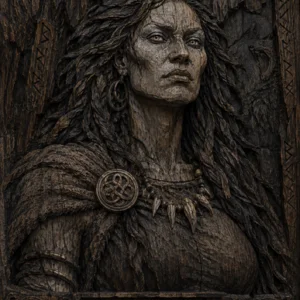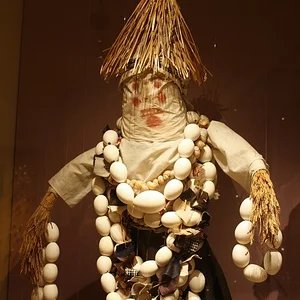

Slavic goddess of winter, death, and night, Morana is a central figure in the mythology of Slavic peoples. Known under various forms (Marzanna in Polish, Morena in Czech and Slovak), she personifies the cycle of nature: her symbolic death in spring marks renewal. Her cult, passed down through oral tradition, is attested from the early Middle Ages to the present day.
Morana
Morana
9 min read
Frequently asked questions
Key Facts
- Morana has been venerated by Slavic peoples since at least the early Middle Ages (c. 6th–10th century), according to oral traditions preserved in folklore.
- Her name is linked to the Slavic root *mor-*, meaning 'death' or 'darkness', found across several Slavic languages.
- The ritual of burning or drowning her effigy at the end of winter (Marzanna in Poland, Morena in the Czech Republic and Slovakia) is still practiced today, marking the arrival of spring.
- She is associated with similar figures in other Indo-European mythologies, illustrating the widespread diffusion of beliefs around death and renewal.
- Her cult is attested solely through indirect sources: medieval Christian chronicles (which condemned these practices) and later folk traditions.
Works & Achievements
A collection of songs, ritual gestures, and spring processions forming the cult of Morana. This intangible collective 'work' is the primary living trace of the goddess, passed down orally over more than a thousand years.
A body of Slavic folk narratives in which Morana appears as a character: sometimes a terrifying old woman, sometimes a beautiful winter maiden. These tales were collected and published by ethnographers such as Erben (Bohemia) and Kolberg (Poland).
A collection of Czech epic poems inspired by Slavic folk ballads and legends, several of which evoke Morana and the forces of death and renewal. Considered a masterpiece of Czech Romantic literature.
Though centered on the Rusalka (water sprite), this opera by the Czech composer draws from the same Slavic mythology and evokes the powers of death and the underworld closely associated with Morana.
The Czech Republic has officially recognized and inscribed this ancient spring ritual in the national intangible cultural heritage, ensuring its transmission and promotion to new generations.
Anecdotes
Every spring, Slavic peoples would craft an effigy made of straw and rags representing Morana, then carry it in procession to the nearest river. There they would burn it and throw it into the water, symbolizing the death of winter and the triumph of life over death. This ceremony, called 'topienie Marzanny' in Polish, is still practiced in some Polish and Czech villages today.
The name Morana is rooted in Indo-European words meaning 'death' and 'darkness,' echoes of which survive in modern Slavic languages — such as 'mor' (plague, blight) and 'mrak' (darkness). This etymology reveals just how deeply the goddess was associated with the most feared forces of nature in the ancient Slavic imagination.
According to some East Slavic traditions, Morana ruled over an underworld realm called Nav, the world of the dead and of non-being. She stood in opposition to Prav, the realm of celestial order, and Yav, the world of the living. This tripartite cosmology shaped the entire worldview of the ancient Slavs.
In Slavic folk tales, Morana sometimes appears as a beautiful young woman in winter, but she ages and withers as spring advances, dying on the first truly warm day of the year. This metaphor for the natural cycle cast her not as a malevolent figure, but as a necessary and inevitable cosmic force.
Traces of Morana's cult survive in late-winter folk festivals celebrated each year around March 21 across several Slavic countries. In the Czech Republic, the ceremony known as 'vynášení Moreny' (the carrying out of Morena) is listed as part of the national intangible cultural heritage, bearing witness to a ritual continuity of more than a thousand years.
Primary Sources
The chronicle mentions the deities venerated by the Slavs before Christianization, evoking cults linked to the cycles of nature, water spirits, and the forces of death and renewal.
Helmold describes the religious practices of the Baltic Slavs in the 12th century, noting the persistence of seasonal rituals tied to female deities of death and rebirth despite Christianization efforts.
Polish folk songs collected in the 18th and 19th centuries describe the Marzanna procession: 'Marzanna is leaving, fair spring is coming, carry her to the river, drown her in the waves.'
The 15th-century Polish historian identifies Marzanna as a Slavic deity equivalent to the Roman Ceres or Hecate, associated with the dying harvest and the death of winter.
This monumental ethnographic study documents the folkloric survivals of the Morana/Marzanna cult in Slavic rural communities in the early 20th century, with numerous accounts of ritual practices still very much alive.
Key Places
At the heart of the first great Slavic state, Moravia is one of the regions where the cult of Morena is best attested and most enduring. The spring ceremonies of 'vynášení Moreny' are still practiced there today.
Poland's great river is the symbolic setting par excellence for the ritual drowning of Marzanna. Since the Middle Ages, spring processions have ended on its banks, where the effigy of the goddess is submerged.
The last great sanctuary of the Baltic Slavs, destroyed in 1168. While the cult of Svantovit was dominant there, rituals connected to the cycles of death and rebirth typical of the Slavic pantheon were also celebrated.
The former royal capital of Poland and a major cultural center, Kraków is today one of the cities where the Marzanna festival is most solemnly celebrated each year on March 21st, with school processions marching down to the Vistula.
The high peaks of the Carpathians have preserved the most archaic Slavic folk traditions. It was in the mountain villages of this region that 19th-century ethnographers collected the most complete accounts of Morana/Morena.
Typical Objects

A straw figure dressed in black and white women's clothing, made each spring to represent Morana. Burning it and then drowning it in a river symbolized the ritual dismissal of winter and death.

In Slavic traditions, mistletoe harvested in winter was associated with the powers of the afterlife and with Morana. Priests and healers wore crowns of these plants during winter ceremonies to invoke or appease the goddess.

A central element of the Morana ritual, fire was used to burn the goddess's effigy. The torch represented the victory of spring light over the winter darkness embodied by Morana.

Morana's colors were the white of snow and the black of night and death. Her ritual representations and officiants wore these contrasting fabrics, evoking both the purity of winter and the darkness of the realm of the dead.

An attribute of Morana in certain traditions, the sickle recalled her role as a 'reaper' of human lives. It also symbolized the harvest of grain that dies in winter only to be reborn the following spring.

The river played an essential role in the Morana ritual: the effigy was thrown into it after being burned. Running water symbolized the boundary between the world of the living and the world of the dead, carrying Morana away to the underworld realm of Nav.
School Curriculum
Vocabulary & Tags
Key Vocabulary
Tags
Daily Life
Morning
As a mythological deity, Morana has no ordinary day in the human sense: she reigns over winter like a long sleep of the world. In the heart of the Slavic winter, dawn comes late and pale, the sun remaining low on the horizon. Peasants begin their day in cold and darkness, reciting protective incantations to ward off Morana's influence.
Afternoon
Winter afternoons in Slavic lands are short and grey. Women spin wool and embroider by firelight, passing down oral tales and songs connected to Morana. Elders tell children the myths of the goddess to teach them respect for the forces of nature and the need to accept death as part of life's cycle.
Evening
Night falls quickly, and Morana is in her kingdom. Winter evening gatherings take place around the fire, where ritual songs and prayers are offered to the spirits for protection. The goddess's name is not spoken lightly after sunset, for fear of drawing her attention to one's loved ones.
Food
The diet of Slavic peoples in winter — Morana's season — is frugal and marked by scarcity: stored grains, root vegetables preserved in the earth, smoked or dried meat. Ritual fasts are observed during feasts tied to death and renewal. In spring, the return of fresh food symbolically coincides with Morana's death.
Clothing
Ritual representations of Morana dress her in white and black: a white linen smock embroidered with Slavic geometric patterns, covered by a dark cloak or shawl evoking the night. Raven feathers and winter branches adorn her depictions, symbols of death and passage between worlds.
Housing
Morana reigns in the Slavic underworld known as Nav, conceived as a dark, inverted mirror of the world of the living. On earth, her sacred sites were crossroads, riverbanks, and forest edges — liminal spaces between the world of the living and that of the dead. Ancient Slavs lived in semi-subterranean dwellings (zemlyankas) that symbolically brought them closer to the underworld.
Historical Timeline
Period Vocabulary
Visual Style
Style romantique sombre inspiré des enluminures médiévales et du Symbolisme, représentant Morana en déesse pâle de l'hiver dans un paysage slave nocturne de neige et de glace.
Sound Ambience
Ambiance sonore d'une nuit d'hiver slave avec vent glacé, craquements de la glace, chants rituels féminins autour d'un bûcher, puis l'émergence progressivement du printemps.
Liens externes & ressources
Références
Œuvres
Cycle rituel du brûlage de Marzanna (tradition orale slave)
VIe–Xe siècle, survivances jusqu'à aujourd'hui
Contes et légendes slaves mettant en scène Morana
tradition orale, collectés aux XVIIIe–XIXe siècles
Karel Jaromír Erben — Kytice (Bouquet de fleurs des champs)
1853
Cérémonie 'vynášení Moreny' inscrite au patrimoine culturel tchèque
XXIe siècle