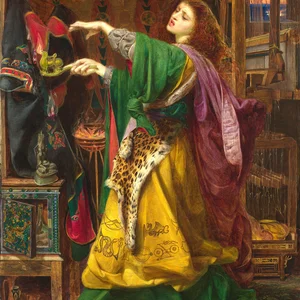

Morgan le Fay is a major figure in Arthurian legend, portrayed as an enchantress and half-sister of King Arthur. She embodies magic and moral ambiguity in medieval narratives, shifting between adversary and protector depending on the version of the story.
Morgan le Fay
Morgan le Fay
France
8 min read
Frequently asked questions
Key Facts
- Morgan le Fay first appears in Geoffrey of Monmouth's Historia Regum Britanniae (c. 1136)
- Portrayed as one of the nine enchantresses of Avalon who tends to the wounded Arthur after the Battle of Camlann
- Different traditions cast her alternately as Arthur's enemy (as mother of Mordred) or as his protector
- Her mastery of magic and her enchanting powers make her a central figure in the romances of Chrétien de Troyes and Malory (15th century)
- Associated with the isle of Avalon, the mythical realm of immortality and Celtic wisdom
Works & Achievements
Morgan creates and rules the enchanted isle of Avalon, a magical realm outside of time where she heals the wounded and preserves Arthurian magical artifacts. This achievement represents her role as guardian of Celtic mysteries and magic.
Morgan intervenes in the fate of Excalibur, either by reclaiming it at the end of Arthur's life or by protecting it. As keeper of Arthurian relics, she ensures its magical preservation.
Morgan takes in the wounded Arthur after the Battle of Camlann and tends to him in Avalon, keeping him in a state of enchanted sleep. This pivotal act symbolically extends the presence of the legendary king.
Morgan plots against Arthur, most notably by supporting Mordred or seeking to reclaim power. These conflicts embody the moral ambiguity of her character and the magical tensions within the kingdom.
In some versions, Morgan educates or influences the knight Lancelot through magic, guiding him through his quests and trials of initiation.
Morgan commands enchantments, potions, and magical transformations, embodying the esoteric knowledge and pre-Christian Celtic traditions woven throughout Arthurian legend.
Anecdotes
In the 'Lancelot en Prose' (12th century), Morgan appears as a fairy endowed with magical powers. She abducts the young Lancelot and raises him in her castle at Avalon before releasing him to become a knight of the Round Table. This story shows how medieval authors transformed Morgan into an ambiguous figure — at once protector and manipulator.
According to Malory's 'Le Morte d'Arthur' (15th century), Morgan forges the sword Excalibur with the help of her smith-sorcerer Wayland. This creation of King Arthur's most famous attribute reveals the importance medieval tradition placed on Morgan's magical power in later Arthurian lore.
In several medieval texts, Morgan is presented as the daughter of Igraine and the Duke of Cornwall, making her Arthur's half-sister. This complex family relationship reflects the themes of legitimacy and rivalry at the heart of the Arthurian legend as it was passed down through the Middle Ages.
Legend holds that Morgan takes in the mortally wounded King Arthur after the Battle of Camlann and carries him to Avalon, a mysterious island where her magic would heal him. This role as psychopomp — a guide to the otherworld — transforms Morgan into the keeper of the mystery surrounding the vanished king, an enduring image in medieval culture.
In the 'Lancelot-Grail' cycle (12th–13th centuries), Morgan is described as a powerful enchantress who rivals Merlin himself and controls many magical castles. This portrayal makes her a major political and magical figure in Britain, far beyond the simple role of antagonist.
Primary Sources
Morgana, soror Arturi, ars magica instructa, ad insulam Avallonis navigavit, ubi vulnera regis curare poterat. Illa erat mulier sapientissima et in medicinis et in incantationibus peritissima.
And then Sir Mordred cried unto all the people and said 'Behold, here standeth that traitor Sir Lancelot.' But when Queen Guenever heard of Sir Lancelot's coming, she fled to the Tower of London. And there came Morgan le Fay unto King Arthur with a company of knights, and she spake to him of his death.
Morgan fu fille Ygraine et du duc de Tintagel, et ot frère le roi Arthur. Et li rois l'ama molt, mais ele estoit assez malfaisante et sorciere.
Morgen vocatur, cui novem sorores praesunt in usu medicinarum, quae dum mortalia corpora vulnerata vel infirma susceperit, ac dum potuerit, sanet.
La sage Morgane, qui savoit moult de arts et d'enchantements, fist tant par son saver qu'ele decela les amours de Tristan et d'Iseut au roi Marc.
Key Places
Legendary island of the fairy realm where Morgan le Fay reigns as queen and receives the wounded King Arthur. This place symbolizes the magical, Celtic otherworld — a refuge for the enchantress and the center of her power in Arthurian tradition.
A site associated with the conception or birth of Arthur in certain versions of the legend. Morgan, as his half-sister, is connected to this seat of Breton power, though her role there varies across different texts.
The residence of King Arthur where Morgan frequently intervenes, sometimes as an advisor, sometimes as an adversary. It is the center of Arthurian power where the enchantress wields both magical and political influence.
The broader geographical setting of Arthurian legend. Morgan exercises her magical powers here, particularly in Cornwall and Wales — Celtic regions strongly associated with sorcery in medieval tales.
A magical kingdom ruled by Morgan in certain Arthurian versions. There she holds sovereign authority as both queen of the fairies and temporal ruler, far removed from the Arthurian world.
The legendary body of water that surrounds or leads to Avalon. It is from this lake that a feminine hand rises to receive the sword Excalibur, and where Morgan welcomes Arthur at his death.
Liens externes & ressources
Références
Œuvres
L'enchantement d'Avalon
traditions textuelles XIIe-XVe siècles
L'épée Excalibur (garde et transmission)
traditions textuelles XIIe-XVe siècles
La guérison du roi Arthur
traditions textuelles XIIe-XVe siècles
L'opposition à Arthur (intrigues politiques)
traditions textuelles XIIe-XVe siècles
La formation de Lancelot du Lac
traditions textuelles XIIe-XVe siècles
Les arts magiques (enseignement et transmission)
traditions textuelles XIIe-XVe siècles