
The demon of the Faustian pact, Mephistopheles is the Devil's agent tasked with seducing the scholar Faust. Made famous by Marlowe in Doctor Faustus (1592) and then by Goethe in Faust (1808), he embodies intellectual temptation and the corruption of the soul through the thirst for knowledge.
Mephistopheles
Mephistopheles
9 min read
Frequently asked questions
Key Facts
- First appears in the Historia von D. Johann Fausten (1587), a German chapbook
- Marlowe brings him to the stage in The Tragical History of Doctor Faustus (c. 1592)
- Goethe develops the character in Faust, Part One (1808) and Part Two (1832)
- His name has uncertain etymology, likely derived from Hebrew or Greek
- He strikes the famous pact: Faust sells his soul in exchange for knowledge and pleasures
Works & Achievements
The first printed text to feature Mephistopheles and the Faustian pact. A bestseller across sixteenth-century Europe, it established the narrative structure of the myth.
The first major theatrical tragedy of the myth, performed in London. Marlowe portrays Mephistopheles as a figure who is at once terrifying and pathetic — himself a prisoner of damnation.
A masterpiece of world literature. Goethe reimagines Mephistopheles as a philosophical spirit, the embodiment of ironic negation. The text is on the curriculum in secondary schools across France and Germany.
The posthumously published conclusion to Goethe's work, in which Mephistopheles ultimately loses his wager: Faust's soul is saved by love. A work of immense symbolic complexity.
A dramatic work for orchestra, chorus, and soloists. Berlioz creates a cynical and virtuosic Mephistopheles whose musical interventions rank among the most striking in the Romantic repertoire.
A lyric opera in five acts and one of the most performed in the world. It brought the figure of Mephistopheles to a vast audience and helped establish him as a universal cultural icon.
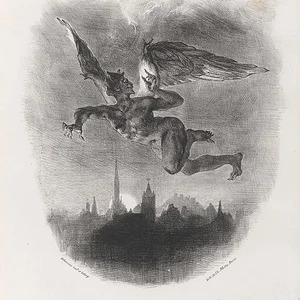
A series of seventeen lithographs illustrating Goethe's Faust. Goethe himself praised Delacroix for these images. They defined the French Romantic iconography of Mephistopheles.
Anecdotes
The name 'Mephistopheles' first appears in the German Faustbuch of 1587, published in Frankfurt by Johann Spies. This popular book recounts the adventures of a certain Johann Faust, presented as a real scholar who sold his soul to the devil. The work was an immediate success and was translated throughout Europe, launching a legend that would endure for centuries.
The character is partly based on a historical figure: Johann Georg Faust (c. 1480–1540), a German itinerant alchemist and astrologer mentioned in several period documents. The theologian Philip Melanchthon and the humanist Conrad Gessner describe him as a charlatan. Yet his scandalous reputation inspired a literary figure far greater than himself.
In Christopher Marlowe's play (c. 1592), Mephistopheles claims he does not need to travel to reach Faust — he is already present wherever a man despairs of his soul. This line — 'Why, this is hell, nor am I out of it' — is one of the most celebrated in Elizabethan theatre. It suggests that hell is not a place, but a state of mind.
Goethe worked on his Faust for more than sixty years, from 1772 to 1831. He published Part One in 1808 and the posthumous Part Two in 1832. In his version, Mephistopheles is less a terrifying demon than an ironic and philosophical spirit, defining himself as 'part of that power which eternally wills evil and eternally works good' — a phrase drawn from the Book of Job.
The composer Hector Berlioz wrote The Damnation of Faust in 1846, in which Mephistopheles sings a mocking Serenade beneath Marguerite's window. This work helped popularize the figure of the demon in French Romantic culture, particularly among audiences in the great Parisian concert halls.
Primary Sources
Doctor Faustus […] gab sich dem Teufel auf eine gewisse Zeit, nämlich vierundzwanzig Jahre. In dieser Zeit sollte Mephostophiles sein Diener und Knecht sein und alles tun, was Faustus von ihm begehrte.
Mephistophilis: Why this is hell, nor am I out of it. Think'st thou that I, who saw the face of God, and tasted the eternal joys of heaven, am not tormented with ten thousand hells in being deprived of everlasting bliss?
Mephistopheles: Ich bin ein Teil von jener Kraft, die stets das Böse will und stets das Gute schafft. [I am part of that power which eternally wills evil and eternally works good.]
Faustum quendam […] qui ausus est se nomine Faustum appellare, fontem necromantiae esse jactitantem. [A certain Faust […] who dared to call himself Faust, boasting that he was the very source of necromancy.]
Mephistopheles appears here as a manipulator of the world's powerful, guiding Faust through Antiquity and modernity, up to the final scene in which angels wrest Faust's soul from his grasp.
Key Places
The university town where Faust is said to have practiced as a doctor and professor. It is also the place where Luther posted his theses in 1517 — a deliberate choice, as Wittenberg was the symbol of intellectual freedom during the Reformation.
The city where several 16th-century chronicles place the exploits of the 'real' historical Faust. The University of Erfurt is one of the oldest in Germany, a plausible setting for an arrogant scholar.
The city where the Faustbuch of 1587 was printed and distributed. It is also the birthplace of Goethe, who grew up with the Faustian legend before turning it into his masterwork.
Goethe's home from 1775 onwards, where he worked for decades on Faust. The city became a major cultural center of German Classicism, and it was here that Mephistopheles was in some ways 'domesticated' into a philosophical figure.
It was in the popular theatres of London — most notably the Rose Theatre — that Marlowe's Doctor Faustus was first performed before mixed audiences. The figure of Mephistopheles gained a theatrical and dramatic dimension there.
The capital of the Romantic reception of the Faustian myth: Berlioz premiered The Damnation of Faust there in 1846, Delacroix illustrated Faust in 1828, and Gounod staged his opera in 1859. Paris was the great French conduit for the myth.
Typical Objects

In every version of the legend, the pact with Mephistopheles is signed in Faust's own blood. This act symbolizes the total surrender of the self — the soul handed over as a contractual commodity.

Faust, a scholar consumed by despair, reaches for a cup of poison before Mephistopheles appears. It symbolizes the boundary between chosen death and chosen damnation — two faces of the same hopelessness.

In the popular imagination of the era, demonic invocations required spell books known as grimoires. Mephistopheles often appears in response to an incantation read aloud from such a volume.

In illustrations and stage productions since the 17th century, Mephistopheles wears a dark cloak — sometimes bright red. These colors evoke mystery, danger, and diabolical seduction.

A fixture in many iconographic depictions, it represents the power to command supernatural forces and connects to the tradition of magic wands in medieval sorcery.

In Goethe's Faust, Mephistopheles gives Faust a symbolic key that unlocks access to the Mothers — mythical underground deities. It represents the power to cross beyond the boundaries of the world of the living.

The Faustian pact is bound by time — twenty-four years in the Faustbuch. The passage of time is therefore a constant presence, symbolized by the hourglass: the instrument of diabolical accounting.
School Curriculum
Vocabulary & Tags
Key Vocabulary
Tags
Daily Life
Morning
Mephistopheles, a timeless spirit, has no morning in any human sense: he is summoned the moment Faust draws his magic circle and speaks his incantations. In the Faustbuch, he appears first as a Franciscan monk before taking the form of an elegant servant, ready to carry out orders.
Afternoon
Throughout the twenty-four years of the pact, Mephistopheles accompanies Faust on his travels across Europe, brings him to the Emperor's court, arranges meetings with spirits of Antiquity, and satisfies his every intellectual or carnal whim. He serves as a sardonic secretary as much as a demon.
Evening
Nights are Mephistopheles' preferred domain: sabbaths, magical feasts, spectral apparitions. In Goethe's Faust, it is Walpurgis Night — the night of April 30 — that marks his finest hour: a cosmic ball of witches and spirits on the Brocken mountain.
Food
As a supernatural being, Mephistopheles neither eats nor drinks. Yet in his role as Faust's household master, he conjures lavish banquets, wines from the finest cellars in Europe, and delicacies that reason alone could never provide — magical fare designed to bind the scholar ever more tightly.
Clothing
In stage productions since the 17th century, Mephistopheles wears an elegant court costume, often in red and black, with a cape and sword — the dress of a seductive gentleman rather than a horned demon. Goethe emphasizes his refined appearance, that of an aristocrat of the intellect.
Housing
Mephistopheles has no home of his own: he is everywhere and nowhere, dwelling in the gaps of the world. When he materializes, it is in Faust's study — a room cluttered with books, retorts, and measuring instruments — a setting that mirrors the intellectual pride he has come to corrupt.
Historical Timeline
Period Vocabulary
Visual Style
Clair-obscur dramatique inspiré de la Renaissance nordique : cabinet d'alchimiste entre lumière ambrée et ombre infernale, figure élégante et menaçante.
Sound Ambience
Ambiance nocturne d'un cabinet d'alchimiste du XVIe siècle : feu, parchemin, cloches lointaines et présence sourde du surnaturel.
Liens externes & ressources
Références
Œuvres
Historia von D. Johann Fausten (Faustbuch)
1587
Doctor Faustus, Christopher Marlowe
vers 1592
Faust, Eine Tragödie (Première partie), Johann Wolfgang von Goethe
1808
Faust, Zweiter Teil, Johann Wolfgang von Goethe
1832
La Damnation de Faust, Hector Berlioz
1846
Les Lithographies illustrant Faust, Eugène Delacroix
1828