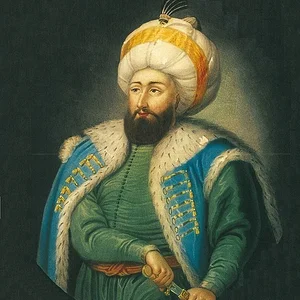

Mehmed II, known as the Conqueror (1432–1481), was an Ottoman sultan who conquered Constantinople in 1453, bringing the Byzantine Empire to an end. He modernized Ottoman administration and transformed Constantinople into the capital of his empire.
Mehmet II(1432 — 1481)
Mehmed II
Empire ottoman
8 min read
Frequently asked questions
Key Facts
- 1451: Accession to the Ottoman throne for the second time
- 1453: Conquest of Constantinople, ending the thousand-year Byzantine Empire (May 29)
- 1453–1481: Transformation of Constantinople (renamed Istanbul) into the Ottoman capital
- 1461: Annexation of the Empire of Trebizond, the last surviving Byzantine state
- 1480: Expedition into Italy and siege of Otranto, marking Ottoman expansion toward the West
Works & Achievements
A major event in world history marking the fall of the Byzantine Empire and the dawn of the Renaissance. Mehmed II deployed an innovative military strategy combining heavy artillery and bold naval maneuvers.
A collection of secular laws promulgated by Mehmed II to organize the administration, court hierarchy, and imperial succession. This founding text distinguished Ottoman law from purely Islamic religious law.
A grand palace and garden complex built on the promontory overlooking the Bosphorus, intended to become the heart of Ottoman power. This architectural masterpiece housed the Ottoman sultans until the 19th century.
A vast urban program aimed at repopulating, beautifying, and Islamizing Constantinople after the conquest. Mehmed II commissioned the construction of mosques, bazaars, madrasas (Quranic schools), and encouraged the settlement of diverse populations.
A series of military campaigns that extended the Ottoman Empire into Greece, Serbia, Bosnia, Albania, and much of Anatolia. These conquests made the Ottoman Empire the foremost military power in the eastern Mediterranean.
Mehmed II attracted Greek, Italian, and Persian poets, scholars, philosophers, and artists to his court, making Istanbul a thriving cultural center. He notably commissioned his famous portrait from Gentile Bellini and took a keen interest in ancient Greek texts.
Anecdotes
Mehmed II was only 21 years old when he ordered the construction of an enormous bombard capable of firing stone cannonballs weighing over 500 kilograms. This piece of artillery, designed by the Hungarian engineer Urban, played a decisive role in the capture of Constantinople by breaching the city's walls, reputed to be indestructible.
During the siege of Constantinople, to bypass the chain blocking the Golden Horn harbor, Mehmed II had part of his fleet dragged on greased wooden logs across the hills, over several kilometers. This audacious maneuver, carried out in a single night, stunned the Byzantine defenders who believed themselves protected by the waters.
A great scholar who spoke several languages including Greek, Arabic, Latin, and Persian, Mehmed II invited the Venetian painter Gentile Bellini to his court to paint his portrait in 1479. This painting, now held at the National Gallery in London, bears witness to the sultan's intellectual curiosity and cultural openness.
After the conquest, Mehmed II went to Hagia Sophia in person and prayed there according to the Islamic rite, symbolically marking the transformation of the church into a mosque. He then reportedly walked through the dilapidated imperial palace and recited a melancholic Persian poem on the fragility of empires: 'The spider weaves its web in the palace of the Caesars.'
Mehmed II was a rigorous lawgiver: he had a code of laws drawn up, the Kanunname, which organized the hierarchy of the Ottoman state and even provided for the legal execution of the sultan's brothers to prevent civil wars of succession. This law, as cold as it was pragmatic, was enforced by several of his successors.
Primary Sources
The sultan, after entering the city, ordered that the massacre and pillaging cease, and had it proclaimed that everyone could return home safely. He then visited the great church and admired its construction and beauty.
I saw the young sultan Murad, father of Mehmed, and his troops; they are very well organized and disciplined, and their janissaries are soldiers of great courage.
On 29 May 1453, at dawn, the Turks entered the city from several points. Emperor Constantine died fighting, and with him perished the Empire of the Romans.
Whichever of my sons ascends to the throne shall have his brothers put to death in the interest of world order. Most of the ulema have approved this. Let them act accordingly.
The sultan had his bombards positioned facing the walls and ordered them fired day and night without pause. The cannonballs were so heavy that upon striking the ramparts they made considerable breaches.
Key Places
City conquered by Mehmed II on May 29, 1453, which he made the new capital of the Ottoman Empire. He symbolically renamed it Istanbul and undertook extensive construction to transform it into an Islamic metropolis.
Former Christian basilica converted into a mosque by Mehmed II immediately after the conquest of 1453. This symbolic act marked the victory of Islam over the Christian empire of the East.
Fortress built by Mehmed II in 1452 on the European shore of the Bosphorus to cut off Constantinople's supply lines. Its construction in just four months demonstrated the sultan's determination and military organization.
Former Ottoman capital where Mehmed II was born in 1432 and where he was enthroned for the second time in 1451. The city served as his launching point for the siege of Constantinople.
Grand palatial complex founded by Mehmed II from 1459 onward, which became the center of Ottoman power for several centuries. It symbolizes the sultan's imperial vision and the greatness of the Ottoman state.
Liens externes & ressources
Références
Œuvres
Conquête de Constantinople
29 mai 1453
Kanunname (Code de lois)
vers 1477
Construction du palais de Topkapi
1459-1465
Reconstruction et islamisation d'Istanbul
1453-1481
Conquête des Balkans et de l'Anatolie
1453-1481
Mécénat artistique et intellectuel
1451-1481