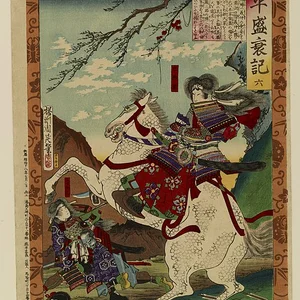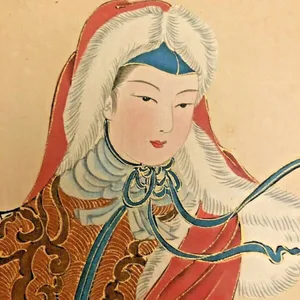

Mulan is a legendary figure from Chinese literature — a young woman said to have disguised herself as a man to take her father's place in the army. Her story, popularized by the Disney animated film, embodies the values of filial piety and courage.
Frequently asked questions
Key Facts
- According to Chinese legend, Mulan enlisted in the army disguised as a man to spare her aging father from military service
- Her story appears in the Ballad of Mulan, an ancient Chinese epic poem
- The character has inspired numerous literary and cinematic adaptations, most notably the 1998 Disney film
- Mulan embodies the Confucian virtue of filial piety (xiao) in Chinese culture
Works & Achievements
An ancient Chinese narrative poem telling the legendary story of Mulan disguising herself as a man to serve in the army in her father's place. This work is the primary source of the myth and illustrates the values of filial piety and family duty in Chinese culture.
Mulan is said to have served in the Chinese army for several years without her true identity being discovered, fighting against barbarian invasions. This feat embodies personal sacrifice and martial courage.
After the victory, Mulan is said to have refused the titles and rewards offered by the emperor, choosing instead to return simply to her family life. This act symbolizes humility and respect for Confucian values.
Mulan's story inspired various adaptations in classical Chinese literature, notably in novels and theatrical plays, gradually enriching her legend over time.
A major Western adaptation that brought Mulan to a worldwide audience, reinterpreting her legend for the modern Western public while preserving the central themes of courage and identity.
Anecdotes
The story of Mulan comes from a very ancient Chinese poem called the "Ballad of Mulan" (木兰辞, *Mùlán Cí*), probably written between the 5th and 6th centuries during the Northern and Southern Dynasties period. This text, about one hundred lines long, is one of the most celebrated poems in all of classical Chinese literature and is still memorized by students in Chinese schools today.
In the original version of the poem, Mulan serves in the army for twelve full years without anyone discovering she is a woman. Upon her return, she puts on her feminine clothes and receives a visit from her former comrades-in-arms, who are astonished to see her. The poem concludes with a poetic riddle: how do you tell a male hare from a female hare when they run side by side?
The name "Mulan" (木兰) literally means "magnolia" in Chinese, a flower symbolizing purity and nobility in Chinese culture. This choice of name in the poem is no accident: it deliberately contrasts the gentleness associated with femininity and the warrior strength that Mulan displays throughout her journey.
Unlike the Disney version, in the original poem the Emperor offers Mulan a great reward and an official position for her bravery, which she declines. She simply asks for a swift horse to return home to her family. This decision illustrates the fundamental Confucian value of filial piety, placed above any personal ambition or military glory.
The Ballad of Mulan has inspired countless adaptations over the centuries in China: plays, operas, novels, and films. Long before the 1998 Disney movie, a Chinese black-and-white film about Mulan had already been made in 1927, followed by another in 1939. The character has thus become one of the most enduring cultural symbols in China, representing both family duty and the capacity of women to achieve great things.
Primary Sources
Mulan has no elder brother, Mulan has no elder father. So she enlists in the army in her father's place and becomes a soldier for twelve years of campaign.
A female warrior is said to have enlisted in the army disguised as a man, fulfilling her filial duty toward her family.
Mulan dons her father's clothes and goes off to war, keeping her secret for many years before returning to her family and revealing her true identity.
Key Places
The supposed homeland of Mulan's family according to ancient versions of the legend. This is where she is said to have left from to join the army, disguising herself as a man to take her father's place.
The battlefield against invasions from northern peoples (Rouran/Gokturks) according to the legend. Mulan is said to have served as a soldier there for 12 years in some versions of the myth.
The center of Chinese imperial power where Mulan is said to have been received and honored by the emperor after her victorious return, revealing her true identity.
A traditional temple in China dedicated to the memory of the heroine, serving as a place of veneration and a site for passing down the historical myth of the character.
The geographic areas of Mulan's legendary battles against the steppe invaders, illustrating the periods of warfare that shaped ancient China.
Typical Objects

Military equipment made of metal, consisting of a breastplate and arm and leg protections. Mulan must wear this armor to blend in among the soldiers of the Chinese army and conceal her female identity.

A classic bladed weapon from the Chinese medieval period, used by infantry soldiers. It is Mulan's primary instrument of combat throughout her military campaigns.

The traditional Chinese garment Mulan wears before enlisting. This costume symbolizes her role as a young woman bound by family conventions, before her act of rebellion.

A major visual symbol of Mulan's transformation: cutting off her long hair is an act of breaking with her female identity and a key element of her disguise.

Ranged weapons used by the medieval Chinese army. Mulan masters them and uses them to demonstrate her skill as a warrior.

The mark of belonging to the Chinese imperial army, which Mulan dons upon enlisting. This uniform is essential to her integration into the ranks and to maintaining her disguise.

A symbolic object representing family honor and victory. In the modern version, the feather becomes an emblem of Mulan's achievement and the restoration of her family's honor.

An object representing the ancestors and the clan's honor in Chinese culture. Mulan acts out of filial piety toward her aging father and to preserve the honor of her household.
School Curriculum
Vocabulary & Tags
Key Vocabulary
Tags
Mythologie
Daily Life
Morning
Mulan rises before dawn to complete her household chores. She prepares the family meals and handles essential domestic tasks, particularly textile work — spinning and weaving — which takes up a large part of her day.
Afternoon
The afternoon is devoted to agricultural tasks if the family owns land, or to continuing textile work. She may also help with meal preparation and tend to the family vegetable garden.
Evening
At nightfall, Mulan joins the family for dinner. She continues her handwork by firelight or oil lamp, then retires to rest in the family home.
Food
Daily meals consist mainly of rice — the staple of Chinese cuisine — accompanied by local vegetables and occasional fish or meat. Meals are simple, prepared over a central hearth, and seasoned with salt and aromatic herbs.
Clothing
Mulan wears a long robe or tunic typical of her era, with wide sleeves and a sash belt. Before her departure to war, she dresses according to the strict feminine conventions of ancient Chinese society, keeping her body fully covered.
Housing
She lives in a modest dwelling of wood or rammed earth, typical of peasant or mid-ranking soldier families. The house has few rooms, with a central hearth for cooking and heating, and mats for sitting and sleeping.
Historical Timeline
Period Vocabulary
Visual Style
Un style mêlant la peinture à l'encre traditionnelle chinoise avec des touches d'aquarelle, créant une atmosphère légendaire et intemporelle. L'illustration privilégie les silhouettes fluides, l'éclairage doré et les paysages montagneux brumeux, évoquant à la fois l'authenticité historique et la magie narrative.
Sound Ambience
Une ambiance sonore envoûtante mêlant sons militaires traditionnels chinois et introspection intime, évoquant une jeune femme trouvant le courage de se transformer pour servir l'honneur familial et la patrie.
Liens externes & ressources
Références
Œuvres
La Ballade de Mulan (Mulan Ci)
VIe siècle (composition orale), fixée par écrit ultérieurement
Service militaire déguisée
Période incertaine (Ve-VIe siècles selon la légende)
Retour honorable et refus des honneurs
Période légendaire
Adaptations littéraires médiévales
XIIIe-XIVe siècles
Film d'animation Disney
1998