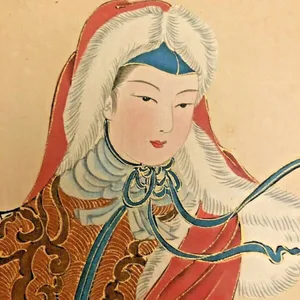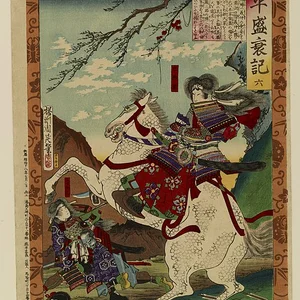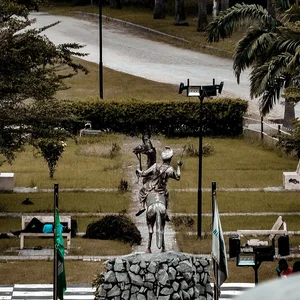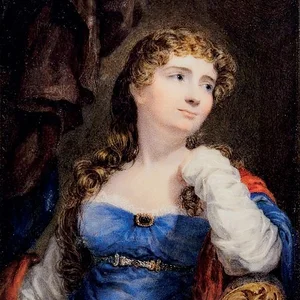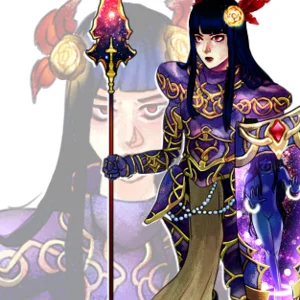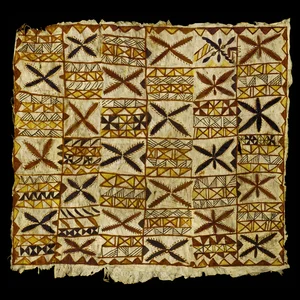

A warrior goddess of Samoan mythology, Nafanua is a central figure of feminine power in Polynesia. According to the oral traditions of the Samoan people, she led armies to victory and contributed to the unification of the Samoan islands in the pre-colonial era.
Frequently asked questions
Famous Quotes
« "The power of war belongs to me, but I give it to those who deserve peace." (words attributed by Samoan oral tradition)»
Key Facts
- A figure from Samoan oral tradition, not attested by any written sources prior to European contact
- According to mythological accounts, Nafanua was born through supernatural means and received divine attributes of war
- Tradition credits her with leading military campaigns that brought about the political unification of the Samoan islands (pre-colonial era)
- She is associated with a prophecy foretelling the arrival of a new faith, interpreted in retrospect as announcing Christianity (19th century)
- Her cult and stories were partially recorded by European missionaries and ethnographers from the 19th century onward
Works & Achievements
By distributing the four supreme titles (tafa'ifā) among the great noble families, Nafanua is said to have laid the foundations of a lasting political balance among the different regions of the Samoan archipelago, preventing any centralization of power.
According to oral traditions, Nafanua led the Samoan armies to victory against the tribute demands of the Tu'i Tonga empire, restoring the sovereignty of the islands and the independence of the Samoan people.
A body of narratives, chants (solo), and genealogies (gafa) passed down orally from generation to generation, forming the primary source of knowledge about Nafanua and preserving her memory within Samoan culture.
One account attributes to Nafanua a prophecy foretelling the coming of a new power and a new faith from the sea. This tradition, collected by missionaries, cast her as a prophetic figure as much as a warrior.
The example set by Nafanua — a goddess who fights and then redistributes power rather than keeping it for herself — helped shape Samoan values around warrior leadership: courage in service of the community rather than personal gain.
Anecdotes
Nafanua is said to have been born in Pulotu, the Samoan underworld, to a mortal mother and Saveasi'uleo, the lord of the dead. According to oral tradition, she was hidden inside a gourd until adulthood, then emerged fully armed and ready to fight in defense of her people against invaders.
Legend holds that Nafanua possessed four sacred war clubs, each bearing a name: Ulimasao, Tafesilafa'i, Fa'auliulito, and Savea. These weapons were said to have been given to her by her divine father and were reputed to be invincible. She wielded them toward the four cardinal directions to defeat her enemies.
After leading the Samoan warriors to victory against Tongan domination, Nafanua refused to keep the supreme chiefly titles (the tafa'ifā) for herself alone. She distributed them among the four great noble families of the Samoan islands, laying the foundation for a political balance that endured for centuries.
One oral account describes Nafanua charging alone into the heart of battle, her long hair loose and flowing behind her. Enemy warriors, at first mistaking her for a man because of her great strength, are said to have fled upon recognizing her as a goddess, convinced that the gods themselves were fighting alongside the Samoans.
Samoan tradition holds that Nafanua prophesied the arrival of a new religion and a new power from across the sea. Some accounts collected in the 19th century present this prophecy as a foretelling of the coming of Christianity, which cemented her place in collective memory as a figure of wisdom no less than of war.
Primary Sources
Nafanua, the war goddess, is said to have come from Pulotu, the Samoan Hades. Her father was Saveasi'uleo, the ruler of that spirit world. She fought and conquered in Samoa, and gave away the government of the islands.
The name of Nafanua is still held in the greatest reverence among the Samoans. She is regarded as the great national war-goddess, whose prowess secured to the natives the independence of their islands from the Tongans.
Nafanua is considered the most important war goddess of Samoa. Oral traditions report that she possessed four sacred war clubs and distributed the Tafa'ifā titles among the leading chiefly families.
O Nafanua na ia auina atu i lana taua le malo o Samoa. Na ia tuuina atu fo'i le pule o le atunu'u i tamaita'i ma tama a le nu'u. (Nafanua herself led the war of Samoa. She also handed over the governance of the land to the children of the people.)
The war-goddess of Samoa, Nafanua, occupies in Polynesian mythology a place analogous to that of Athena among the Greeks — a divine warrior-woman who bestows victory and wisdom upon favoured peoples.
Key Places
The westernmost point of the island of Savai'i, considered in Samoan tradition to be the gateway to Pulotu, the underworld. According to oral genealogies, this is the mythical place from which Nafanua originated.
The largest island in the Samoan archipelago, cradle of its oldest oral traditions and the setting for the legendary wars waged by Nafanua against Tongan invaders.
The main island of Samoa and seat of traditional political power, where the great tafa'ifā titles were bestowed according to the legend of Nafanua. Apia, the current capital, is located here.
The realm of spirits and gods in Samoan cosmology, symbolically located to the west beyond the ocean. Nafanua emerged from Pulotu, granting her a divine nature and sacred legitimacy.
A Polynesian archipelago whose Tu'i Tonga empire extended its influence over Samoa. The wars against this empire form the historical and mythological backdrop for Nafanua's military exploits.
Liens externes & ressources
Références
Œuvres
Unification politique des îles Samoa
v. XIIIe siècle (tradition orale)
Libération de la suzeraineté tongienne
v. XIIe-XIIIe siècle (tradition orale)
Corpus mythologique oral — Tala o Nafanua
Xe-XVe siècle, transmission continue
Prophétie de l'arrivée du christianisme
Tradition collectée au XIXe siècle
Fondation du code guerrier samoan (aiga et taua)
Époque précoloniale