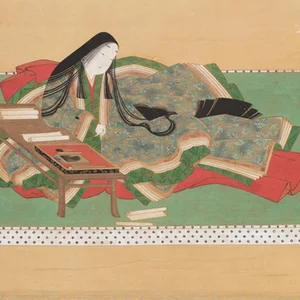

Japanese noblewoman, poet, and lady-in-waiting at the Imperial court during the Heian period
Murasaki Shikibu(970 — 1100)
Murasaki Shikibu
Japon
7 min read
Frequently asked questions
Key Facts
- Murasaki Shikibu naît vers 970 au Japon, dans une famille de la petite aristocratie cultivée de l'époque de Heian
- Elle rédige vers 1000-1008 le Genji Monogatari (Le Dit du Genji), considéré comme le premier roman psychologique de l'histoire de la littérature mondiale
- Elle est nommée dame de compagnie de l'impératrice Shōshi à la cour impériale de Heian-kyō (Kyoto) vers 1005
- Elle tient un journal intime, le Journal de Murasaki Shikibu (Murasaki Shikibu Nikki), témoignage précieux sur la vie à la cour impériale japonaise au début du XIe siècle
- Son œuvre majeure compte 54 chapitres et met en scène le prince Genji, explorant avec finesse les émotions humaines et la société aristocratique japonaise
Works & Achievements
A novel in 54 chapters following the life of Prince Genji and his descendants at the Heian court. Considered the first psychological novel in the history of world literature, it remains to this day a canonical work of Japanese literature.
A personal diary recounting her observations at the imperial court, particularly the ceremonies surrounding the birth of the crown prince. A primary historical and literary document on aristocratic life during the Heian period.
An anthology of some 128 waka poems composed by Murasaki Shikibu, bearing witness to her mastery of classical Japanese poetry and her sensitivity to themes of love, grief, and nature.
Anecdotes
Murasaki Shikibu was not her real name: it was a nickname given to her by her contemporaries at the imperial court. 'Murasaki' refers to the purple-violet color, the color associated with a central character in her novel, and 'Shikibu' alludes to her father's position at the Ministry of Ceremonial (Shikibu-shō). Her true given name remains unknown to this day.
Around 1008, Murasaki Shikibu was appointed as a lady-in-waiting to Empress Shōshi. In her personal diary, she describes her court colleagues with sharp lucidity, characterizing some as arrogant or superficial. She portrays herself as reserved and often lonely amid the bustle of court life.
Murasaki Shikibu had learned classical Chinese by listening to the lessons given to her brother, as scholarly education was reserved for boys. Her father reportedly said, in a mixture of admiration and resignation: 'What a pity you were not born a son!' Mastery of Chinese was considered a mark of high masculine culture at the time; her acquiring it was deemed extraordinary.
The Genji Monogatari, which she most likely began after the premature death of her husband Fujiwara no Nobutaka around 1001, features more than 400 characters and spans several decades. Written in kana (the Japanese syllabic script), it is regarded as the world's first psychological novel, nearly seven centuries before European novels of the same kind.
A later legend holds that Murasaki Shikibu was punished after her death and condemned to Buddhist hell for having composed 'lies' in her novel. Monks at Ishiyama-dera organized prayers for her soul. This story illustrates the tension between female literary creation and the moral and religious norms of the era.
Primary Sources
The moon was setting. An indefinable sadness seized the prince, who gazed upon the branches laden with cherry blossoms, reflecting on how fleeting everything is in this world.
I see around me ladies who affect an air of learning, quoting verses on every occasion. I prefer to keep silent and efface myself, for showing off too much is a form of foolishness.
How many nights have I kept vigil, while the moon glided over the waters of the lake, searching for words to say what the heart cannot keep silent?
She records with precision the ceremonies of the court, the garments worn, the poems exchanged, and the rivalries among ladies-in-waiting at the birth of the imperial prince.
Key Places
Imperial capital of Japan where Murasaki Shikibu lived and wrote. It is within its aristocratic palaces and gardens that most of The Tale of Genji takes place.
Residence of Empress Shōshi where Murasaki Shikibu served as a lady-in-waiting from 1008 onward, and where she wrote a large portion of her work.
According to tradition, it was in this Buddhist temple on the shores of Lake Biwa that Murasaki Shikibu began writing The Tale of Genji during a spiritual retreat. A museum dedicated to her is now located on the site.
The region where Murasaki Shikibu briefly accompanied her father upon his appointment as governor in 996. This period away from the capital nourished her sense of longing and her literary sensibility.
According to tradition, Murasaki Shikibu's family residence was located on the site of the present-day Rozan-ji temple in Kyoto, where a garden is dedicated to her.
Typical Objects

Murasaki Shikibu's fundamental writing tools, used to calligraph the scrolls of the Genji Monogatari and her waka poems. The quality of calligraphic brushwork was a mark of refinement and culture at court.

Texts were written on scrolls of Japanese handcrafted paper (washi), often dyed or perfumed. The original Genji Monogatari circulated in the form of these hand-copied scrolls distributed among the court ladies.

A stringed musical instrument present in all aristocratic scenes of the Genji Monogatari. Murasaki Shikibu, like the ladies of the Heian court, was trained in its practice, inseparable from refined feminine education.

The ceremonial feminine costume of the Heian court, composed of many layers of silk in colors matched to the seasons. Murasaki Shikibu describes these garments with precision in her diary as indicators of each lady's rank and taste.

An accessory of courtly communication: poems were slipped inside them, and they were exchanged as calling cards or love messages. They appear frequently in the exchanges between characters in the Genji Monogatari.

The art of fragrance (kōdō) was central to Heian court life. Characters in the Genji Monogatari are often identified by their personal scent; Murasaki Shikibu describes incense as an essential component of seduction and social presence.
School Curriculum
Vocabulary & Tags
Key Vocabulary
Tags
Daily Life
Morning
Murasaki Shikibu rose at sunrise, after nights often cut short by court vigils and nocturnal ceremonies. She practiced Buddhist devotions, recited sutras, and prepared her ink before calligraphing poems or chapters of her novel onto carefully chosen washi paper scrolls.
Afternoon
Afternoons were devoted to her duties as a lady-in-waiting to Empress Shōshi: reading aloud, composing waka poems for the court's epistolary exchanges, participating in seasonal ceremonies and literary competitions. She keenly observed the intrigues and behaviors of her colleagues.
Evening
Evenings and nights were her time for personal writing, by the light of oil lamps. Murasaki Shikibu would draft scenes of the Genji Monogatari or record her observations in her diary. The court also came alive with concerts, poetic recitations, and games centered around the moon or nocturnal blossoms.
Food
The Heian aristocratic diet was simple and ritualized: white rice, vegetable broths, mushrooms, seaweed, dried or grilled fish, and seasonal fruits. Meals were served in refined lacquerware, and the visual presentation of dishes was considered as important as their taste, in keeping with courtly aesthetics.
Clothing
Murasaki Shikibu wore the jūni-hitoe, a layered ensemble of twelve silk robes in graduated colors evoking the seasons and nature. The combination of hues, visible at the wrists and neckline, signaled the lady's rank, taste, and aesthetic sensibility. Maintaining the harmony of these robes required constant attention.
Housing
She resided in a wooden pavilion of the imperial palace of Heian-kyō, consisting of rooms opening onto inner gardens, separated by painted screens and silk curtains. Court ladies lived in these semi-public spaces where the boundary between interior and exterior, between visible and hidden, was governed by strict etiquette.
Historical Timeline
Period Vocabulary
Visual Style
Esthétique Yamato-e de la cour Heian : peinture japonaise médiévale aux pigments minéraux riches, figures en robes superposées, jardins sous la lune et calligraphie raffinée.
Sound Ambience
Une atmosphère feutrée et raffinée de cour impériale japonaise médiévale, entre froissements de soie, musique de koto et pluie sur les jardins palatiaux.
Liens externes & ressources
Références
Œuvres
Genji Monogatari (Le Dit de Genji)
vers 1008-1012
Murasaki Shikibu Nikki (Journal de Murasaki Shikibu)
vers 1008-1010
Murasaki Shikibu Shū (Recueil de poèmes)
vers 1000-1015