 flip
flipEarth-oven hākari — steamed kūmara and fish
Earth-oven hākari — steamed kūmara and fish
Why this dish? Muri-ranga-whenua is the devouring grandmother, the ancestor who swallows whatever approaches, an image of the earth reclaiming the living. The hākari cooked in the belly of the soil is the exact opposite and complement of this myth: we entrust the kai to the earth, and the earth returns it cooked and warm. A feast to honor the one who gave her jawbone to Māui.
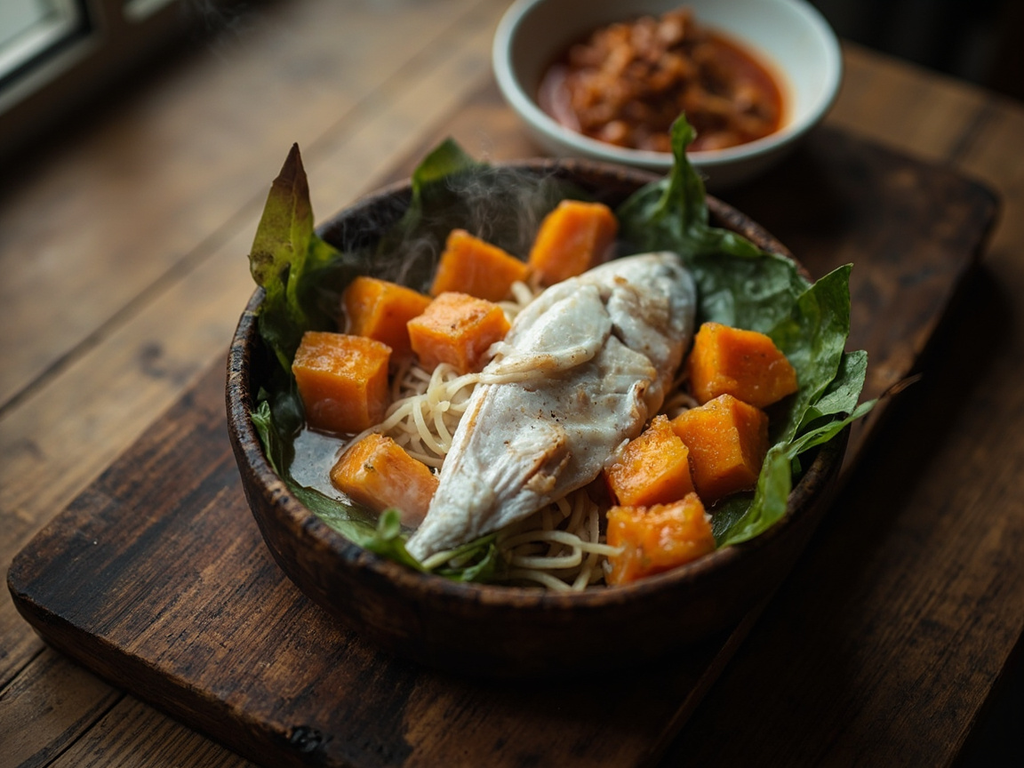
The feast par excellence: sweet, tender kūmara tubers and whole fish, steamed for hours in the earth oven until the flesh falls apart. A cuisine without fat, all steam and patience, shared by the entire tribe.
Come closer, mokopuna, and do not fear my old mouth. See: we open the earth, lay down the red-hot stones, place the kūmara and ika on a bed of leaves, and throw water — listen to the hiss that rises, it is my breath. Then we close the ground like closing eyelids, and wait for the earth to chew for us. What I devour, you see, I return tender.
- •Kūmara (Polynesian sweet potato) — one basket (sweet starch, heart of the feast)
- •Whole sea fish or eel (tuna) — several (flesh and umami)
- •Pikopiko (young fern fronds) — a handful (green forest vegetable)
- •Fresh leaves (harakeke, fern) — as needed (to line and wrap)
- •Volcanic stones + spring water — according to the oven (to produce steam)
Earth-oven hākari — steamed kūmara and fish
The feast par excellence: sweet, tender kūmara tubers and whole fish, steamed for hours in the earth oven until the flesh falls apart. A cuisine without fat, all steam and patience, shared by the entire tribe.
Why this dish? Muri-ranga-whenua is the devouring grandmother, the ancestor who swallows whatever approaches, an image of the earth reclaiming the living. The hākari cooked in the belly of the soil is the exact opposite and complement of this myth: we entrust the kai to the earth, and the earth returns it cooked and warm. A feast to honor the one who gave her jawbone to Māui.
Come closer, mokopuna, and do not fear my old mouth. See: we open the earth, lay down the red-hot stones, place the kūmara and ika on a bed of leaves, and throw water — listen to the hiss that rises, it is my breath. Then we close the ground like closing eyelids, and wait for the earth to chew for us. What I devour, you see, I return tender.
Ingredients (period version)
- Kūmara (Polynesian sweet potato) — one basket (sweet starch, heart of the feast)
- Whole sea fish or eel (tuna) — several (flesh and umami)
- Pikopiko (young fern fronds) — a handful (green forest vegetable)
- Fresh leaves (harakeke, fern) — as needed (to line and wrap)
- Volcanic stones + spring water — according to the oven (to produce steam)
Ingredients
- Sweet potato — 1 kg, in large chunks (sweet starch)
- Whole white fish (sea bream, mackerel) or firm fillets — 800 g (flesh and umami)
- Young green shoots (spinach, edible fern if available) — 200 g (green vegetable)
- Banana leaves or parchment paper — a few (to wrap for steaming)
- Water — 1 cup (steam)
Method
- Without an earth oven, use a large steamer or a pot with a steamer basket: bring a shallow layer of water to a simmer.
- Line the basket with banana leaves (or parchment paper) for fragrance.
- Place the sweet potato chunks at the bottom (they take longest to cook), cover, and steam for 20 minutes.
- Add the fish wrapped in a leaf and the green shoots on top; cover and steam for another 15–20 minutes.
- Check that the sweet potato is tender and the fish is opaque, then tip everything onto a large platter of leaves, to share by hand.
How it was made : An authentic hāngī requires digging a pit, burning wood over volcanic stones for hours, then removing the embers, placing food baskets on the hot stones, sprinkling with water, covering with wet leaves and earth. The kūmara, brought by Polynesian ancestors during great voyages long before 1492, was THE Māori starch, stored in pits (rua) for winter.
The contemporary twist : Serve the feast on a large board lined with green leaves, modern marae-style hāngī, with a squeeze of lime and some fresh herbs.
Muri-ranga-whenua · Charactorium