 flip
flipLamb with Pomegranate and Walnuts
Lamb with Pomegranate and Walnuts
Why this dish? Nowrouz, the Persian New Year on the first day of spring, celebrates the renewal of creation willed by Ahura Mazda. For this great day, a feast was prepared where the pomegranate — fruit of fertility associated with sacred gardens — and lamb from the flock honored the god of light and life.
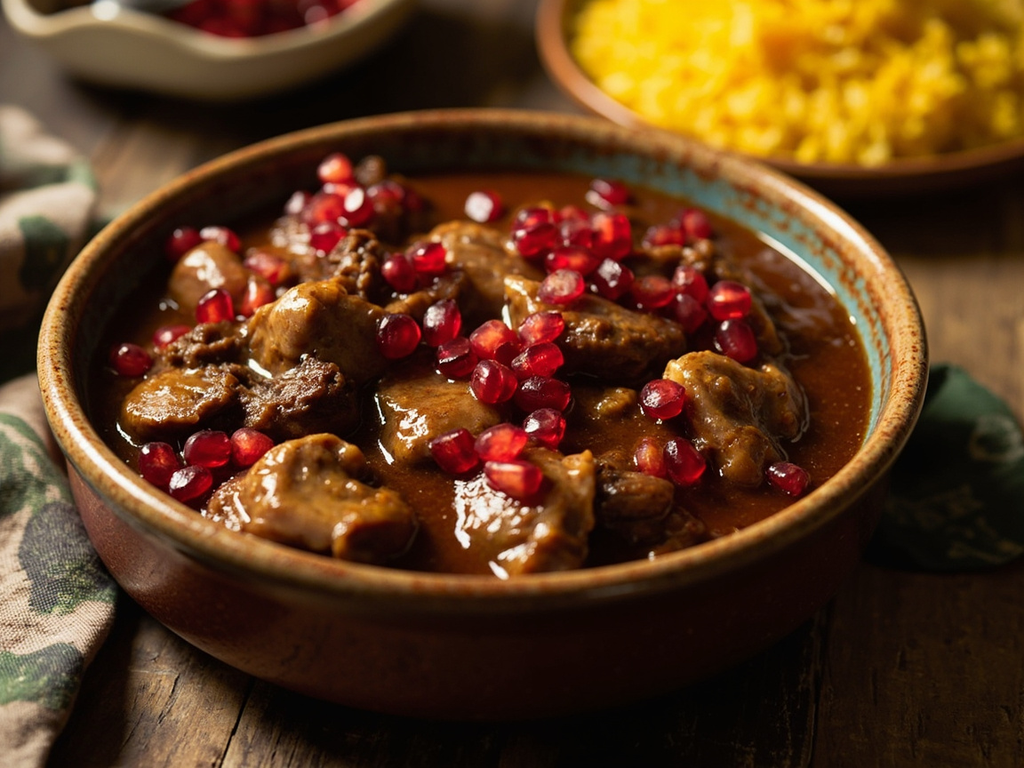
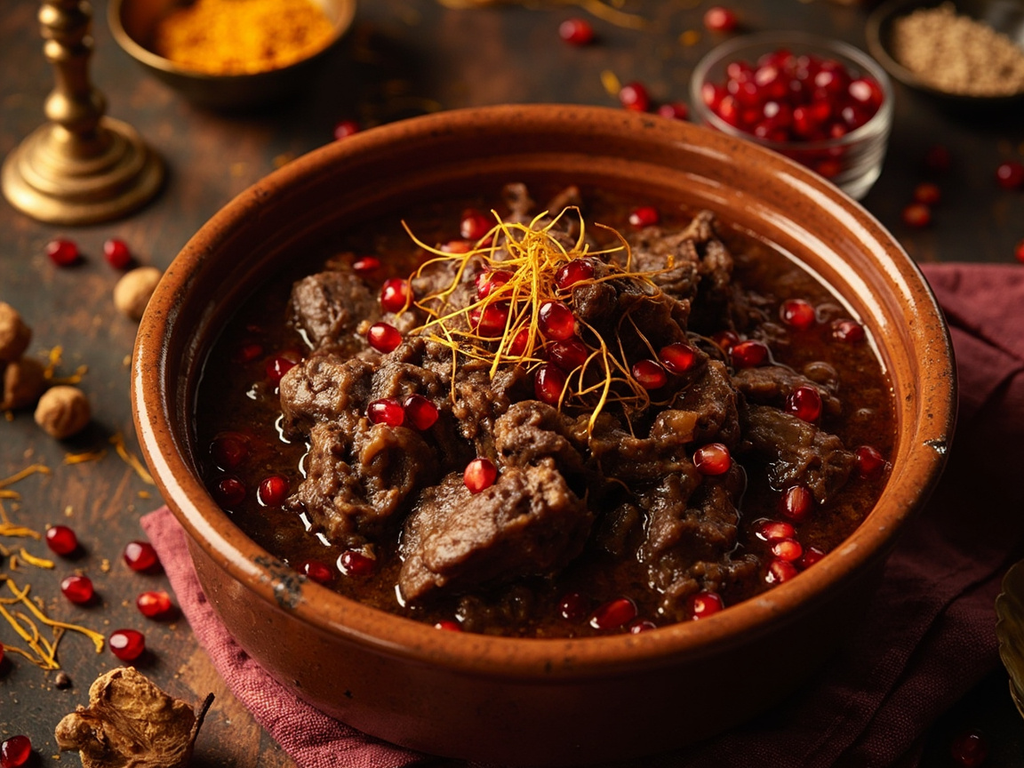
A melting festive stew, where lamb simmers in tangy pomegranate juice and ground walnuts, between sour and sweet: the dish for the great tables of the Persian New Year.
When the sun returns to conquer the night and the earth I created greens again, set your finest table! On this day, My followers slaughtered the lamb in due measure, and let it slowly melt in the juice of pomegranates from their orchards, thickened with pounded walnuts. Smell how the sour and the sweet unite: thus go the struggle and harmony of the world. Eat, rejoice, and do not forget the poor at your door — for celebrating life is sharing it.
- •Lamb shoulder — a fine piece (festive meat)
- •Pomegranate juice — several cups (fruity acidity and cooking liquid)
- •Walnuts — two handfuls, pounded (creamy binder and umami)
- •Onions — two (aromatic base)
- •Honey — a drizzle (sweet balance)
- •Herbs and saffron — according to the orchard (noble fragrance)
Lamb with Pomegranate and Walnuts
A melting festive stew, where lamb simmers in tangy pomegranate juice and ground walnuts, between sour and sweet: the dish for the great tables of the Persian New Year.
Why this dish? Nowrouz, the Persian New Year on the first day of spring, celebrates the renewal of creation willed by Ahura Mazda. For this great day, a feast was prepared where the pomegranate — fruit of fertility associated with sacred gardens — and lamb from the flock honored the god of light and life.
When the sun returns to conquer the night and the earth I created greens again, set your finest table! On this day, My followers slaughtered the lamb in due measure, and let it slowly melt in the juice of pomegranates from their orchards, thickened with pounded walnuts. Smell how the sour and the sweet unite: thus go the struggle and harmony of the world. Eat, rejoice, and do not forget the poor at your door — for celebrating life is sharing it.
Ingredients (period version)
- Lamb shoulder — a fine piece (festive meat)
- Pomegranate juice — several cups (fruity acidity and cooking liquid)
- Walnuts — two handfuls, pounded (creamy binder and umami)
- Onions — two (aromatic base)
- Honey — a drizzle (sweet balance)
- Herbs and saffron — according to the orchard (noble fragrance)
Ingredients
- Boneless lamb shoulder — 800 g, cut into large cubes (braised meat)
- Pure pomegranate juice (or diluted pomegranate molasses) — 40 cl (tangy sauce)
- Walnut halves — 150 g, ground (binder and depth of flavor)
- Onions — 2 large, sliced (aromatic base)
- Honey — 1 tbsp (sweet-sour balance)
- Saffron — 1 pinch, infused (color and fragrance)
- Clarified butter — 2 tbsp (cooking fat)
- Salt — to taste (seasoning)
Method
- Brown the lamb cubes on all sides in clarified butter, then set aside.
- In the same pot, cook the sliced onions over low heat until golden.
- Add the ground walnuts and toast for 2 minutes, stirring, to release their oil.
- Return the meat, pour in the pomegranate juice, season with salt, add the infused saffron.
- Cover and simmer over very low heat for 1.5 to 2 hours, until the lamb is meltingly tender and the sauce is thick and dark.
- Adjust the sweet-sour balance with honey at the end of cooking, and serve sprinkled with fresh pomegranate seeds.
How it was made : Long before the tomato came from America, Persian cuisine built its stews (khoresht) on fruit acidity: pomegranate, verjuice, dried fruits. Braised meat, pomegranate juice, and ground walnuts form a sweet-sour marriage long attested in the gardens of Iran. Saffron and honey marked a festive dish, worthy of the great day of Nowrouz dedicated to the renewal created by Ahura Mazda.
The contemporary twist : Top the dish with pomegranate seeds and saffron petals just before serving, and call it "stew of creation": the direct ancestor of famous Iranian fesenjân, here without any New World ingredients.
Sources : Charles Perry & alii, Medieval Arab Cookery (Persian sweet-sour khoresht traditions) · Margaret Shaida, The Legendary Cuisine of Persia, Penguin, 1992 · Mary Boyce, Zoroastrians: Their Religious Beliefs and Practices, Routledge, 1979 (Nowrouz and seasonal festivals)
Ahura Mazda · Charactorium