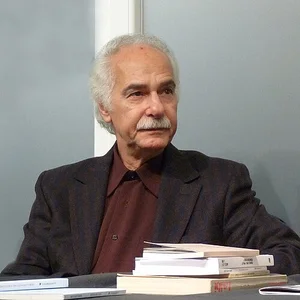

Egyptian writer, the first Arabic-language author to receive the Nobel Prize in Literature, in 1988. A master of the realist novel, he portrayed the everyday life of Cairo through a vast body of work.
Naguib Mahfouz(1911 — 2006)
Naguib Mahfouz
Égypte, royaume d'Égypte, khédivat d'Égypte, République arabe unie, sultanat d'Égypte, République d'Égypte
6 min read
Frequently asked questions
Famous Quotes
« You can tell whether a man is clever by his answers. You can tell whether a man is wise by his questions.»
Key Facts
- Born in 1911 in the working-class district of Gamaliya, in Cairo
- Published the “Cairo Trilogy” (Palace Walk, Palace of Desire, Sugar Street) between 1956 and 1957
- First Arabic-language writer to receive the Nobel Prize in Literature, in 1988
- Survived a knife assassination attempt by Islamist extremists in 1994, following the controversy over his novel “Children of Gebelawi”
- Died in 2006 in Cairo at the age of 94
Works & Achievements
A choral portrait of a poor alley in Cairo during the Second World War; one of his first great realist successes.
His major fresco: three generations of a Cairo family through the upheavals of early 20th-century Egypt. His masterpiece.
An allegorical novel about religion and humanity, deemed blasphemous and banned for decades in Egypt; the cause of the 1994 attack on his life.
A short, taut novel marking a turn toward a more introspective writing style and a critique of post-revolutionary society.
A disillusioned satire of Egyptian society under Nasser, gathered aboard a Nile houseboat; successfully adapted for the screen.
A multi-voiced novel set in an Alexandria boarding house, mirroring the political tensions of 1960s Egypt.
The first award of this level given to an Arabic-language author, bringing contemporary Arabic literature to global prominence.
Anecdotes
When he was born, his mother's labour was so difficult that a famous Cairo physician, Doctor Naguib Pasha Mahfouz, was called in. Out of gratitude, his parents gave the obstetrician's first name to the child: this is how the future Nobel laureate carried, all his life, the name of the man who had helped him come into the world.
As a seven-year-old child, Mahfouz watched from the window of his house in old Cairo the demonstrations of the 1919 revolution against the British occupation. He would later recount that the sight of the soldiers and the angry crowds left a lasting mark on his imagination and nourished the sense of history that runs through all his work.
In 1988, when he received the Nobel Prize in Literature, Mahfouz refused to travel to Stockholm: he hated travelling and leaving his beloved Cairo. It was his two daughters who went to collect the award, and his speech was read on his behalf before the Academy.
In October 1994, at the age of 82, the writer was stabbed in the neck outside his home by an extremist who condemned him for his novel “Children of the Alley.” He survived, but the nerves of his right hand were damaged: the man who used to write with such discipline could no longer hold his pen for long, and from then on he dictated only a few minutes a day.
A civil servant by day and a novelist the rest of the time, Mahfouz was famous for his clockmaker's precision. He also led a circle of intellectual friends, the “Harafish,” and kept to his habits in the old cafés of Cairo such as El-Fishawi, in Khan el-Khalili, where he observed the everyday life that fills his books.
Primary Sources
I am the son of two civilizations that, at a certain point in history, formed a happy marriage. The first, seven thousand years old, is the Pharaonic civilization; the second, one thousand four hundred years old, is the Islamic civilization.
A foreign correspondent in Cairo told me that the moment my name was linked to the prize, silence fell and many wondered who I was.
You can tell a man's intelligence by his answers, and his wisdom by his questions.
Key Places
A working-class, medieval district of Cairo where Mahfouz was born, and whose alleys, mosques, and markets directly inspired the setting of many of his novels.
Where Mahfouz studied philosophy and earned his degree in 1934, before wavering between an academic career and literature.
A famous café in Cairo's great bazaar that Mahfouz frequented to observe everyday life and gather with his circle of intellectual friends.
A spot along the Nile where the writer lived during the latter part of his life, and where he was attacked outside his home in 1994.
The city where Mahfouz died in 2006, and which remains the great character running through all his work — the heroine as much as the backdrop of his novels.
Typical Objects

The writer's writing instrument; he composed his novels by hand on a strict schedule. The injury to his right hand in 1994 prevented him from using it for long.

Red felt headdress topped with a tassel, worn by the urban middle class and the “effendi” civil servants in Egypt during the first half of the 20th century.

Small, strong black coffee served in the “ahwas,” Cairo's working-class cafés. Mahfouz spent hours there observing the locals and conversing with his friends.

Water pipe emblematic of Cairo's cafés, around which men and neighborhood regulars would gather. It gives rhythm to the working-class street scenes in Mahfouz's novels.

Major Egyptian daily in which Mahfouz serialized several works, including “Children of the Alley,” and where he kept a regular column.

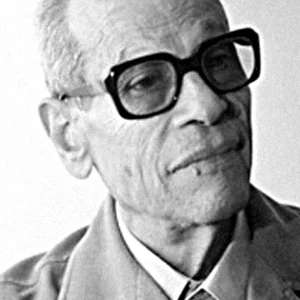
Toward the end of his life, his sight and hearing declined sharply, and his dark glasses became a recognizable feature of his silhouette in Cairo's cafés.
School Curriculum
Vocabulary & Tags
Key Vocabulary
Tags
Daily Life
Morning
An early riser and methodical, Mahfouz read the newspapers, then went to his civil servant's office in a Cairo ministry. For more than thirty years, he thus led a double life as a morning employee and a writer.
Afternoon
Back home, he would have lunch and rest, before devoting rigorously timed writing sessions to his novels. His discipline was legendary: he wrote at set hours, like filling in an office schedule.
Evening
In the evening, he joined the cafés of Cairo and his circle of intellectual friends, the “Harafish,” to discuss literature and politics. He also loved walking along the Nile and watching the passers-by.
Food
His table was that of ordinary Egypt: foul (fava beans), taamiya (falafel), flatbread, vegetables and cheeses. He carried himself through his days with sweet tea and Turkish coffee drunk at the café.
Clothing
He wore the sober suit of the “effendi,” the educated urban middle class, long topped by the red tarboosh. In his older years, he was recognizable by his dark, thick-lensed glasses.
Housing
Born in a house in the old Gamaliyya quarter, he later lived in Abbassiya and then in the Agouza district, on the banks of the Nile. His modest dwellings contrasted with his worldwide fame.
Historical Timeline
Period Vocabulary
Liens externes & ressources
Références
Œuvres
Passage des miracles (Zuqaq al-Midaq)
1947
La Trilogie du Caire (Impasse des deux palais, Le Palais du désir, Le Jardin du passé)
1956-1957
Les Fils de la médina (Awlad Haratina)
1959
Le Voleur et les chiens (al-Liss wa-l-kilab)
1961
Dérives sur le Nil (Tharthara fawq al-Nil)
1966
Prix Nobel de littérature
1988