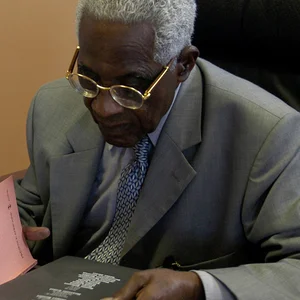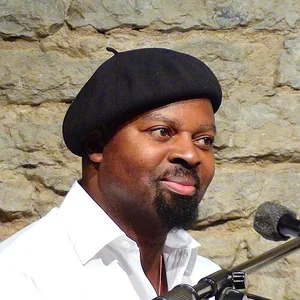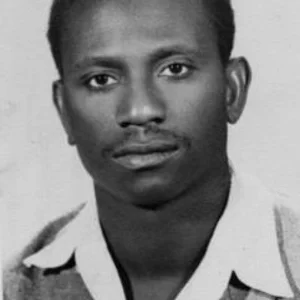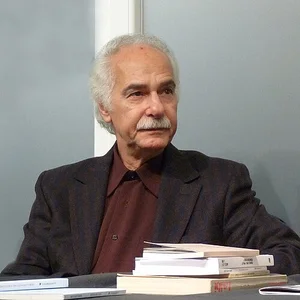

Moroccan poet, novelist and translator born in 1942 in Fez. Founder of the journal Souffles and a major figure of French-language Moroccan literature, he was imprisoned for his ideas before receiving the Prix Goncourt for poetry in 2009.
Abdellatif Laâbi(1942 — ?)
Abdellatif Laâbi
Maroc
6 min read
Frequently asked questions
Key Facts
- Born on 1 March 1942 in Fez (Morocco)
- In 1966 founded the literary and cultural journal Souffles, a hub of the Moroccan avant-garde
- Imprisoned from 1972 to 1980 for “undermining state security” during the Years of Lead
- Went into exile in France from 1985 onward
- Received the Prix Goncourt for poetry in 2009, then the Grand Prix de la Francophonie of the Académie française in 2011
Works & Achievements
A magazine he founded and edited, which became the manifesto of a generation of Moroccan writers and artists seeking renewal.
His first novel, a poetic and fragmented narrative exploring identity and the Moroccan condition.
A collection of poems written partly in prison, denouncing repression and celebrating freedom.
Letters written from his cell, a deeply moving testimony about prison and hope.
A largely autobiographical novel inspired by his experience in prison.
An autobiographical novel about his childhood in the medina of Fez, praised by critics.
A major literary honor rewarding the whole of his poetic work.
An award from the Académie française honoring his contribution to the French language.
Anecdotes
In 1966, at just 24 years old, Abdellatif Laâbi founded the magazine *Souffles* with a few poet friends. Printed on a shoestring budget, it quickly became the voice of a Moroccan generation that wanted to decolonize not only the country, but also minds and culture.
In 1972, Laâbi was arrested at his home because of his ideas and his writings. Sentenced to ten years in prison, he was tortured and spent nearly eight and a half years locked up. From his cell, however, he kept writing poems and letters that would be published clandestinely.
During his imprisonment, a vast international campaign called for his release: Amnesty International, writers such as Jean-Paul Sartre, and intellectuals from all over the world signed petitions. This mobilization helped secure his release from prison in 1980.
In 2009, at age 67, Laâbi received the Goncourt Poetry Prize for his entire body of work. The man who had been imprisoned for his words was thus celebrated as one of the greatest French-language poets of his time.
His autobiographical novel *Le Fond de la jarre* (2002) recounts his childhood in the medina of Fez. The title evokes the large jars used to store oil and olives: for the child he once was, scraping the bottom of the jar was both a chore and an adventure.
Primary Sources
Something is changing. Something is taking shape within French-language Maghrebi creative work. The writers bear witness to it, seeking to define themselves in relation to an audience, to a collective destiny.
To write is to bite into the flesh of the fruit of life, to deliver the essential pulp to the air and the light.
Fez, my city, I have carried you within me like a wound and like a pride, through all my wanderings.
Poetry has always been for me a weapon of struggle and freedom, a way of saying no to barbarism and yes to human dignity.
Key Places
Birthplace of Laâbi in 1942, whose medina and childhood nourish his entire body of work, notably *The Bottom of the Jar*.
Capital where Laâbi studies, teaches, and founds the magazine *Souffles* in 1966.
Where Laâbi was held during much of his years of imprisonment (1972-1980), and where he continued to write.
Major city where political trials and protests were organized during the Years of Lead.
City where Laâbi settles in exile from 1985 onward and where he continues his work, recognized by the Goncourt Poetry Prize in 2009.
Typical Objects

A literary and cultural journal founded by Laâbi in 1966, which became the manifesto of a generation of Moroccan artists and intellectuals. Its name, meaning *breaths*, symbolizes a new breath for North African creativity.

Notebooks and loose sheets on which Laâbi wrote his poems, including in prison where paper was scarce. These writings were sometimes smuggled out of his cell.

Correspondence written during his detention, addressed notably to his wife and published under the title *Chronicles of the Citadel of Exile*. They bear witness to prison life and the strength of hope.

A large terracotta jar used to store oil and olives in the houses of Fez. It gives its title to his childhood novel, *The Bottom of the Jar*.

Books by Arab poets, including **Mahmoud Darwish**, that Laâbi translated into French. His work as a translator introduced contemporary Arabic poetry to French-speaking readers.

The central prison of Kénitra, where Laâbi was held for a long time, became for him a place of writing and reflection. It symbolizes the confinement endured by many opponents during the Years of Lead.
School Curriculum
Vocabulary & Tags
Key Vocabulary
Daily Life
Morning
As a young man in Rabat, Laâbi begins his days with reading and preparing his lessons, for he was also a French teacher. Mornings are often devoted to writing, in the quiet before the city's bustle.
Afternoon
In the afternoon, he meets the other contributors to *Souffles*: they discuss the texts to be published, proofread the galleys, and debate the ideas stirring 1960s Morocco. These meetings are hotbeds of intellectual ferment.
Evening
In the evening, Laâbi continues his work as a poet and translator, bent over his notebooks. In prison, these evening hours will become a refuge where he writes poems and letters by the fragile light of his cell.
Food
His diet is that of a twentieth-century Moroccan from Fez: bread, olive oil, mint tea, tagines, and couscous on Fridays. In detention, food is scarce and meager, far from the flavors of the medina of his childhood.
Clothing
In public life, Laâbi wears the Western suit of the intellectual of his time, jacket and shirt. In private or during festivities, traditional Moroccan dress, such as the djellaba, remains present.
Housing
As a child, he grows up in a traditional house in the medina of Fez, organized around a patio. As an adult, he lives in an apartment in Rabat, then experiences the prison cell, before settling in exile in a Parisian dwelling.
Historical Timeline
Period Vocabulary
Liens externes & ressources
Références
Œuvres
Revue Souffles
1966-1972
L'Œil et la nuit
1969
Le Règne de barbarie
1976
Chroniques de la citadelle d'exil
1978
Le Chemin des ordalies
1982
Le Fond de la jarre
2002
Prix Goncourt de la poésie
2009