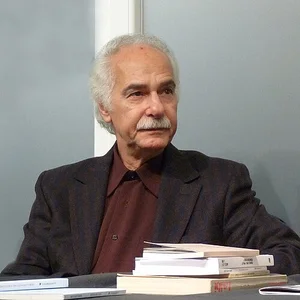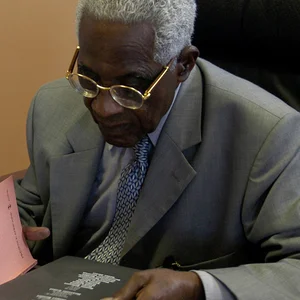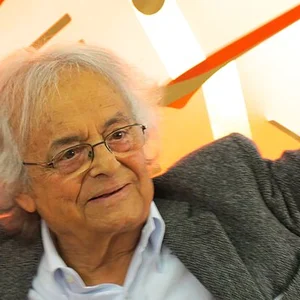

Adonis is a Syrian-Lebanese poet and literary critic writing in Arabic, born in 1930. A major figure of Arab poetic modernity, he profoundly renewed the language and forms of contemporary Arabic poetry.
Adonis(1930 — ?)
Adonis
Liban
5 min read
Frequently asked questions
Key Facts
- Born in 1930 in Qassabine, Syria, under the name Ali Ahmad Said Esber
- Adopted the pseudonym “Adonis” in the late 1940s
- Co-founded the literary review Shi'r (“Poetry”) in Beirut in 1957, a driving force behind the renewal of Arabic poetry
- Published “Songs of Mihyar the Damascene” in 1961, a major work of Arab poetic modernity
- Regularly cited as a candidate for the Nobel Prize in Literature from the 2000s onward
Works & Achievements
First major collection that reveals the distinctive voice of the young poet.
Landmark work in which Adonis creates a persona-mask and profoundly renews the Arabic poetic language.
A long poem confronting the modern Western city with the memory and spirituality of the East.
A vast critical essay in several volumes that rereads Arab cultural history through tradition and modernity.
A major reflection, drawn from lectures, on the evolution and challenges of Arabic poetry.
A monumental work in three volumes, regarded as the culmination of his poetic project.
Two foundational journals that shaped Arab literary and intellectual modernity.
Anecdotes
Born in a poor village in northwestern Syria, the young Ali Ahmad Said did not attend school until adolescence: it was his father who taught him to read and to memorize classical Arabic poetry. Around 1944, the Syrian president Shukri al-Quwatli visited the region; the teenager recited a poem of his own composition before him, which earned him a scholarship to study. That recitation changed the course of his life.
The name “Adonis” is a pseudonym he adopted at the age of 17. Tired of seeing his poems rejected by magazines under his real name, he signed them with the name of the Phoenician and Greek god of beauty, death, and rebirth. The very same editors then accepted his texts, and the name stayed with him for the rest of his life.
In 1955, Adonis was imprisoned for nearly a year in Syria because of his membership in the Syrian Social Nationalist Party. Upon his release, he left the country for Lebanon in 1956, where he was able to write and publish more freely.
In 1957, together with the poet Yusuf al-Khal, he founded the magazine Shi'r (“Poetry”) in Beirut, which became the laboratory of Arabic poetic modernity and championed the prose poem, then highly contested by the defenders of classical metrics.
Adonis has regularly been mentioned among the favorites for the Nobel Prize in Literature since the 1980s, making him one of the best-known figures of contemporary Arabic poetry worldwide.
Primary Sources
Through the character of Mihyar, a wanderer and rebel, Adonis invents a voice that rejects the inherited gods and seeks to recreate the world through language.
Here Adonis rereads the entire history of Arab culture through the opposition between rigid tradition and the forces of renewal and creation.
Drawn from his lectures, it shows how Arabic poetry has been pulled between orality, fidelity to the ancient model, and the demand for modernity.
A long poem in which the modern city becomes the symbol of a material civilization, confronted with memory and the East.
Key Places
Village in northwestern Syria, near Latakia, where Adonis was born in 1930 into a peasant family.
Adonis studied philosophy here and earned his degree in 1954.
Lebanese capital where Adonis settled in 1956 and founded the journals Shi'r (1957) and Mawaqif (1968).
City of exile where Adonis settled permanently from the 1980s onward, continuing his work and his teaching.
Typical Objects

Notebook where the poet jots down lines, drafts, and crossings-out before publication. A witness to the long process of rewriting that is characteristic of Adonis.

The everyday writing instrument of the 20th-century writer. A tool for composing poems and critical essays.

A literary magazine founded in Beirut in 1957. A platform for spreading the new Arabic poetry and the prose poem.

A book gathering an author's poems, a form inherited from the Arabic tradition. Adonis used it to publish his poetic cycles.

The cut reed and ink of traditional Arabic calligraphy. A symbol of the bond between writing, art, and Arabic heritage.

A persona-mask invented by Adonis, a wandering and rebellious poetic alter ego. A symbolic figure of modern man confronting tradition.
School Curriculum
Vocabulary & Tags
Key Vocabulary
Daily Life
Morning
An intellectual and writer, Adonis devotes his mornings to reading and writing, in the quiet of his study surrounded by books. He rereads and reworks his poems at length, faithful to a demand for precision.
Afternoon
The afternoon is often taken up by his work as a critic and editor: correcting texts for his journals, preparing lectures, and exchanging correspondence with other Arab and European writers.
Evening
In the evening comes the time for literary gatherings and debates in the cafés and intellectual circles of Beirut and later Paris, where poetry, politics, and the future of Arab culture are discussed.
Food
His table reflects the Mediterranean cuisine of the Levant: bread, olive oil, vegetables, mezze, cheeses, and fruit, accompanied by coffee or tea shared during conversations.
Clothing
Like the intellectuals of his time, he wears modern Western dress — a jacket and shirt — suited to urban life in Beirut and Paris.
Housing
He lives in urban apartments, first in Lebanon and then in France, the homes of a learned city-dweller whose walls are lined with bookshelves.
Historical Timeline
Period Vocabulary
Liens externes & ressources
Références
Œuvres
Première poésie (Qasa'id ula)
1957
Chants de Mihyar le Damascène
1961
Tombeau pour New York
1971
Le Fixe et le Mouvant
1973-1978
Une introduction à la poétique arabe
1985
Le Livre (Al-Kitab)
1995-2003
Fondation des revues Shi'r et Mawaqif
1957 et 1968