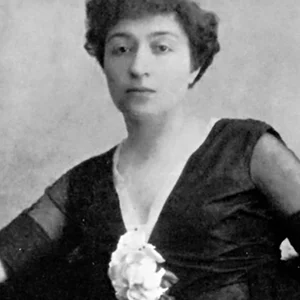

Russian painter, draughtswoman, and set designer, a major figure of the early 20th-century avant-garde. Co-founder of Rayonism with Mikhail Larionov, she also distinguished herself through her sets and costumes for Diaghilev's Ballets Russes.
Natalia Goncharova(1881 — 1962)
Natalia Goncharova
France, Empire russe
6 min read
Frequently asked questions
Key Facts
- Born in 1881 near Tula (Russia), died in Paris in 1962
- Co-founds Rayonism with Mikhail Larionov around 1912-1913
- Designs the sets and costumes for the ballet The Golden Cockerel for Diaghilev's Ballets Russes in 1914
- Exhibits her Neo-Primitivist works inspired by Russian folk art and icons in the 1910s
- Settles permanently in Paris from 1919 after leaving Russia
Works & Achievements
Large neo-primitivist compositions inspired by Russian peasant women, blending icons and folk art.
An iconic work of Russian Futurism, in which a cyclist's movement is broken down into superimposed images.
A manifesto work of Rayonism, in which the animal vanishes behind a web of coloured rays; a pioneering abstraction.
A creation for Diaghilev's Ballets Russes that revolutionised stage design with its dazzling folkloric colours.
A Futurist celebration of the machine and of speed, a witness to the era's fascination with technical progress.
A series of panels blending religious imagery from the Apocalypse with modern symbols, a bold fusion of tradition and modernity.
Spare yet powerful stage design for Stravinsky's ballet, the high point of her Parisian collaboration with Diaghilev.
Anecdotes
In 1910, Natalia Goncharova exhibited nudes in Moscow: the police seized her canvases and the artist was dragged before a court on charges of “pornography.” She was acquitted, but the scandal made her one of the most talked-about painters in Russia.
Around 1912, together with her partner Mikhail Larionov, she invented “Rayonism,” a kind of painting made of beams and rays of light that broke objects apart — one of the first attempts at abstract art in Russia.
In 1914, she created the sets and costumes for the ballet *The Golden Cockerel* for Sergei Diaghilev: her dazzling colors, inspired by Russian folk art, amazed Parisian audiences and launched her career as a theater designer.
A provocateur, she would sometimes walk through Moscow with her face and body painted with patterns, flowers, or animals, in Futurist happenings meant to shock the bourgeoisie and turn her own body into a work of art.
A refugee in Paris after the Russian Revolution, she would never see her homeland again. Long forgotten, she is today one of the most expensive women artists in the world, with one of her paintings having topped 10 million dollars at auction.
Primary Sources
The Rayonist style of painting that we advocate is concerned with spatial forms that arise from the intersection of rays reflected by various objects.
I shake the dust from my feet and leave the West behind… my path leads toward the source of all the arts, the East.
Mme Goncharova and M. Larionov are the leaders of one of the youngest and boldest schools of painting in Russia.
Key Places
Family estate in the Russian countryside where she was born in 1881. The peasant women, flowers, and folk art of the region would shape her entire body of work.
Institution where she trained from 1898 and met Mikhail Larionov. It was here that her commitment to the avant-garde was born.
Heart of the Russian avant-garde, where she exhibited, caused scandal, and invented Rayonism between 1910 and 1915. Her major 1913 retrospective created a sensation there.
Stage where her set design for *The Golden Cockerel*, created for the Ballets Russes, triumphed in 1914. This success launched her international career as a set designer.
City of exile where she lived from 1919 until her death, within the Russian émigré community. There she continued painting, illustration, and stage design despite a modest end to her life.
Liens externes & ressources
Références
Œuvres
Les Vendangeurs (cycle de la moisson)
vers 1911
Chat (Composition rayonniste)
1913
Décors et costumes du Coq d'or
1914
L'Aviateur (Aéroplane au-dessus d'un train)
1913
Polyptyque de la Moisson / Anges et avions
1911
Décors pour Les Noces de Stravinsky
1923