
Nicolas Poussin was a 17th-century French painter and a leading figure of pictorial classicism. Living in Rome for most of his life, he favored drawing, rigorous composition, and historical, mythological, and religious subjects inspired by Antiquity.
Nicolas Poussin(1594 — 1665)
Nicolas Poussin
France, Royaume de France
6 min read
Frequently asked questions
Famous Quotes
« I have neglected nothing.»
Key Facts
- Born in 1594 in Les Andelys, Normandy
- Settled permanently in Rome from 1624, where he studied ancient art and Raphael
- Painted The Arcadian Shepherds (Et in Arcadia ego) around 1638-1640
- Called back to Paris in 1640 by Louis XIII and Richelieu as First Painter to the King, before returning to Rome in 1642
- Died in Rome in 1665, having become a model of reference for the Royal Academy of Painting
Works & Achievements
A grand scene of Roman history that established Poussin's reputation in Rome and showcases his taste for ancient gravity.
A mythological allegory in which Apollo crowns a poet, a manifesto of the artist's learned, classical ideal.
A dynamic composition drawn from Roman history, an example of dramatic rigor and balanced gestures.
A meditation on death, present even in the land of happiness; one of Poussin's most famous and discussed works.
A biblical scene in which the expression of the passions and the clarity of the composition serve a demonstration of justice.
A cycle of four biblical landscapes painted at the end of his life, the pinnacle of his reflection on nature and human destiny.
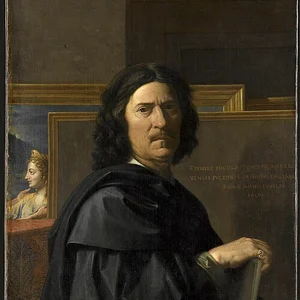
A portrait of himself painted for his friend Chantelou, an image of the painter-philosopher surrounded by his ideas on art.
Anecdotes
Born in Normandy near Les Andelys around 1594, Poussin left his province for Paris, then crossed France on foot several times in his attempts to reach Rome. He failed twice before finally arriving in 1624: the Eternal City would become his adopted homeland for the rest of his life.
In 1640, King Louis XIII and his minister Richelieu summoned Poussin back to Paris and named him First Painter to the King, tasking him with decorating the great gallery of the Louvre. But the artist, accustomed to small, meditative formats and to the tranquillity of Rome, coped poorly with monumental commissions and court jealousies: by 1642 he set off again for Rome, never to return.
To compose his paintings, Poussin built small models: he sculpted wax figurines that he arranged in a stage-like box, moving the characters around and directing the light through a window. This almost theatrical method allowed him to study the shadows and the arrangement before painting.
Poussin wrote that there are two ways of looking at objects: “simply seeing them” or “considering them with attention.” He saw himself as a learned painter, one who painted for cultivated connoisseurs capable of reading the ancient and philosophical subjects of his works.
His canvas *The Arcadian Shepherds* shows shepherds deciphering the inscription carved on a tomb: *Et in Arcadia ego* (“I too once lived in Arcadia”). This enigmatic phrase, a reminder that death exists even in the ideal land of happiness, has fascinated generations of writers and historians.
Primary Sources
The noble Greeks invented several modes by which they produced marvelous effects: this word mode properly means the reason or the measure and form we use to make something.
Novelty in painting consists principally not in a subject never seen before, but in good and new arrangement and expression, and thus, from common and old, the subject becomes singular and new.
Bellori, the artist's friend and biographer, reports Poussin's ideas on imitation, decorum and the grandeur of subjects, and passes down his theory of the “modes” borrowed from ancient music.
Félibien, who knew Poussin in Rome, devotes a long conversation to the painter and fixes for posterity the image of the “French Raphael,” master of drawing and of considered composition.
Key Places
Poussin's home region, where he was born in 1594 and received his first drawing lessons before leaving for Paris.
The city where Poussin trained as a young man, and to which he returned in 1640-1642 as First Painter to King Louis XIII.
The artistic capital where Poussin settled in 1624 and spent most of his career; he died there in 1665.
The Roman church where Poussin is buried; a funerary monument would be erected there in his memory in the 19th century.
The great gallery whose decoration Louis XIII entrusted to Poussin in 1640; a monumental project he abandoned when he set off again for Rome.