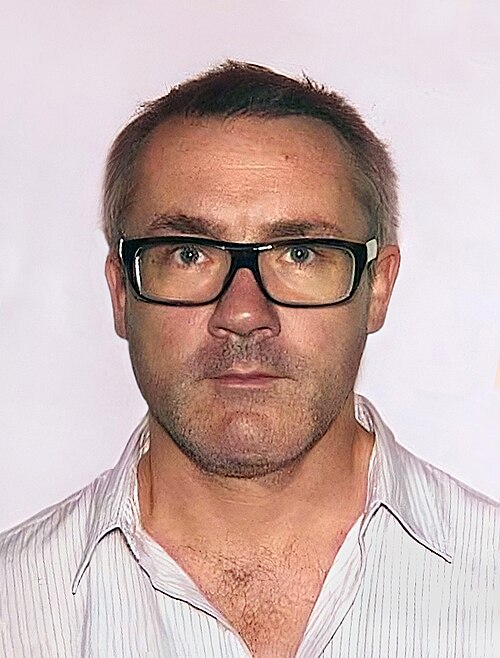
Olafur Eliasson(1967 — ?)
Ólafur Elíasson
Allemagne, Islande, Royaume de Danemark
6 min read
Danish-Icelandic contemporary artist born in 1967, famous for his immersive installations playing on light, color, water and perception. His work questions the viewer's relationship to nature and the environment.
Frequently asked questions
Key Facts
- Born in 1967 in Copenhagen to Icelandic parents
- Founded Studio Olafur Eliasson in Berlin in 1995
- Created The Weather Project at Tate Modern in London in 2003, drawing more than two million visitors
- Installed The New York City Waterfalls, artificial waterfalls, in 2008
- Made Ice Watch in 2014, transporting blocks of ice from Greenland to raise the alarm about global warming
Works & Achievements
An artificial sun and mist inside the Tate Modern; one of the most famous installations in contemporary art, seen by more than two million visitors.
Four giant artificial waterfalls in New York Harbor, a demonstration of art on the scale of an entire city.
A circular walkway of coloured glass crowning the ARoS museum in Aarhus (Denmark); visitors walk through the entire spectrum of colours.
A honeycomb envelope of tinted glass for Reykjavík's concert hall, which shifts with the changing daylight.
A solar lamp distributed worldwide to bring clean energy to regions without electricity; art in the service of society.
Blocks of ice from Greenland arranged in a circle on public squares, melting away to raise the alarm about global warming.
At the Louisiana museum (Denmark), a genuine riverbed of stones and water recreated inside the galleries, blurring the line between nature and museum.
Anecdotes
In 2003, Olafur Eliasson transformed the gigantic Turbine Hall of the Tate Modern in London into an artificial sunset: a vast glowing orange disc bathed the space in mist, and visitors lay down on the floor to gaze at their reflection in a ceiling of mirrors. *The Weather Project* drew more than two million people.
To understand light and landscapes, Eliasson travels very often to Iceland, his parents' homeland, where he photographs glaciers, waterfalls and moss. These stays directly feed his works on nature and climate.
In 2014, the artist set up *Ice Watch*: he brought in enormous blocks of ice broken off from a Greenland fjord and arranged them in a circle on a public square, like a clock. Passers-by watched the ice melt before their eyes, a warning about global warming.
Eliasson designed *Little Sun*, a small solar lamp shaped like a yellow flower, sold to bring clean electricity to regions of the world without an electrical grid. Here art becomes a concrete tool in the service of people.
In 2008, in the harbor of New York, he created four giant artificial waterfalls (*New York City Waterfalls*), one of them suspended beneath the Brooklyn Bridge, proving that a work of art can take hold of an entire city.
Primary Sources
I am interested in the way we perceive, and in the way we perceive our own perception.
Let us put this ice in front of people, where they can touch it, feel it, and respond to climate change.
Little Sun brings clean, affordable light to communities without access to electricity, while connecting those who live on the electrical grid with those who are cut off from it.
A work of art does not exist without the viewer; it is the viewer who, by experiencing the work, completes it.
Key Places
Eliasson's birthplace in 1967 and where he trained at the Royal Danish Academy of Fine Arts. It is also where he presented “Ice Watch” for the first time.
Eliasson set up his studio here in 1995, a vast workshop bringing together craftsmen, architects, engineers and researchers. It is the heart of his creative work.
The museum where he created “The Weather Project” in 2003 in the Turbine Hall, followed by the retrospective “In real life” in 2019.
The capital of his parents' homeland, which he visits frequently to study light and landscapes. There he designed the glass façade of the Harpa opera house.
The city where he installed the “New York City Waterfalls” in the harbor in 2008, including one waterfall beneath the Brooklyn Bridge.