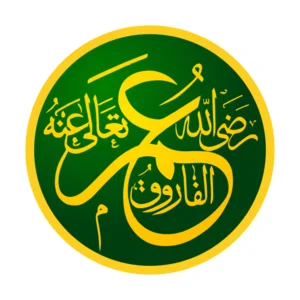

A close companion of the Prophet Muhammad, Umar ibn al-Khattab became the second caliph of Islam (634–644). His reign saw a lightning expansion of the Muslim empire, from Persia to Egypt.
Umar ibn al-Khattab(586 — 644)
Umar ibn al-Khattab
califat Rachidun
8 min read
Frequently asked questions
Key Facts
- Born around 586 in Mecca, into the Quraysh tribe
- Converting to Islam around 616, he became one of the closest companions of Muhammad
- Elected second caliph in 634, following the death of Abu Bakr
- During his reign (634–644), the Muslim empire conquered Syria, Iraq, Persia, and Egypt
- Assassinated in 644 by a Persian slave, Abu Lu'lu'
Works & Achievements
Omar established a state register providing regular pensions to all Muslim fighters and their families based on their seniority in Islam. This administrative innovation was one of the earliest organized social welfare systems in history.
Omar standardized the Islamic lunar calendar, taking the year of the Hijra (622) as its starting point. This calendar is still used today throughout the Muslim world to determine the dates of religious observances such as Ramadan.
Omar divided the empire into provinces (Amsar) with appointed governors, independent judges (qadis), and a codified tax system (kharaj on land, jizya on non-Muslims). This lasting administrative framework inspired the empires that followed.
A foundational document guaranteeing the safety of people, property, and Christian holy sites in Jerusalem. This text is considered one of the earliest treaties of religious tolerance in medieval history.
Omar ordered the construction of planned military cities in Iraq to serve as bases for the armies and centers for the spread of Islam. Kufa and Basra quickly grew into major intellectual and commercial metropolises of the Islamic world.
Anecdotes
Omar ibn al-Khattab was renowned for his uncompromising sense of justice, even toward his own family. When he learned that his son had committed a serious offense, he personally ordered that he be punished according to Islamic law, refusing to grant any special treatment. This strictness earned him the title of Al-Faruq, 'the one who distinguishes truth from falsehood.'
During the conquest of Jerusalem in 638, Omar entered the city not as a triumphant conqueror, but dressed plainly, on foot, leading his camel by the reins himself while his servant rode. This gesture of humility deeply moved the city's inhabitants and Patriarch Sophronius, who personally handed him the keys to the city.
Omar was known for making anonymous nightly rounds through the streets of Medina, seeking to ensure that no one was suffering from hunger or injustice. It is said that on one such occasion he discovered a woman alone with her starving children, and personally carried food from the public storehouses to help them.
Before his conversion to Islam around 616, Omar was one of the Prophet Muhammad's most fierce opponents. His conversion, sudden and complete, was seen as a major turning point: according to Islamic tradition, Muhammad had prayed that one of the two great Omars — ibn al-Khattab or Amr ibn Hisham — would embrace Islam, so greatly would either man's allegiance strengthen the young community.
Primary Sources
Omar wrote to the commanders of his armies: 'Do not advance without consulting the inhabitants, do not burn the crops, do not kill the livestock, respect the People of the Book in their places of worship.'
He grants its inhabitants security for their persons and their property, their churches and their crosses… their churches shall neither be inhabited nor destroyed, and no harm shall be done to their religion.
Omar wore a garment patched in twelve places. He ate barley bread with salt and oil, and would say: 'How could I eat meat when my subjects are suffering from hunger?'
In the year 18 of the Hijra, the Year of the Ash, Omar traveled in person to Syria to organize relief efforts. He personally distributed food to the populations affected by famine and plague.
Key Places
Birthplace of Omar ibn al-Khattab, religious center of pre-Islamic Arabia and cradle of Islam. It was here that he grew up, opposed Muhammad, and eventually converted — a turning point that shook the foundations of the nascent Muslim community.
Capital of the caliphate under Omar, the city where he lived, governed, and was assassinated in 644. It was in Medina that he introduced the sweeping administrative reforms of the Islamic empire, and where he rests in the Prophet's Mosque.
Holy city of the three Abrahamic religions, conquered in 638. Omar personally signed the famous Covenant of Omar, guaranteeing the protection of Christian and Jewish inhabitants — establishing a precedent of religious tolerance widely noted by historians.
Former capital of the Sassanid Persian Empire, captured in 637 by Muslim armies during the Battle of al-Qadisiyyah. Its fall symbolizes the collapse of Zoroastrian Persia and the eastward expansion of the Islamic empire.
Site of the decisive Battle of Yarmouk in 636, where Omar's armies crushed the Byzantines and opened the way for the conquest of Syria, Palestine, and Lebanon. This victory permanently redrew the map of the Middle East.
Typical Objects

Omar always carried a whip or cane as a symbol of authority and public order. He used it to bring to heel those who disturbed the peace, and the object became emblematic of his reputation as a strict but fair judge.

A direct Companion of the Prophet and one of the first to memorize the revelations, Omar contributed after Muhammad's death to the process of compiling the Quran. The sacred text was the foundation of all his political and judicial decisions.

During military campaigns, Omar lived in a simple tent, refusing any special comforts. On his journey to Jerusalem in 638, he slept in a tent identical to those of his soldiers, embodying the equality between the caliph and the believers.

A warrior before his role as caliph, Omar was renowned for his mastery of the sword. The weapon symbolized both the defense of the Islamic community and the military power of the Arab conquests of the 7th century.

Like Muhammad and the other caliphs, Omar used an engraved seal to authenticate his official letters, firmans, and treaties. This administrative tool reflects the bureaucratic organization he put in place.

Omar was famous for eating only simple food — barley bread, oil, and dates — even when he ruled over a vast empire. His plain satchel was the visible sign of his voluntary asceticism and his refusal of privilege.
School Curriculum
Vocabulary & Tags
Key Vocabulary
Tags
Daily Life
Morning
Omar rose before dawn for the Fajr prayer, the first of the five daily prayers, at the Prophet's Mosque in Medina. After prayer, he held a public audience (majlis) where any resident, rich or poor, could bring him a complaint or request. He dealt with judicial and administrative matters from the earliest hours of the day.
Afternoon
The afternoon was devoted to managing the empire: receiving messengers and dispatches from generals on the fronts in Syria, Persia, and Egypt, and dictating letters and decrees to his secretaries. Omar also oversaw the distribution of public provisions (bayt al-mal) and inspected the markets to ensure that prices were fair and transactions honest.
Evening
In the evenings, Omar frequently made night rounds through the streets of Medina, alone or with a companion, to make sure no one lacked the necessities of life. He would return home for the Isha (night) prayer, then retire to his austere house to study the Quran or consult companions of the Prophet on questions of Islamic jurisprudence (fiqh).
Food
Omar kept a deliberately frugal diet: barley bread, olive oil, dates, and water made up the bulk of his meals. He refused to eat meat more than a few times a month, believing he had no right to a richer diet than the poorest of his subjects. During the famine of 638 (the "Year of Ashes"), he imposed a strict fast on himself until all his subjects were fed.
Clothing
Omar wore a robe (thawb) and a cloak (rida) of coarse wool or unbleached linen, often patched. He refused the silk or gold-embroidered garments reserved for Byzantine and Persian rulers, preferring to be indistinguishable from an ordinary man. He wore a simple turban (imama) and plain leather sandals, with no adornment.
Housing
Omar lived in a mud-brick house in Medina — modest in size and bare of decoration. His home contained no fine furniture or precious carpets. He slept on a palm-leaf mat and refused to make his house more comfortable than those of his poorest neighbors, embodying the Islamic principle of equality (musawah) among believers.
Historical Timeline
Period Vocabulary
Visual Style
Direction artistique sobre et géométrique, inspirée des premières enluminures islamiques et des couleurs du désert arabique : ocre, indigo profond et ivoire sur fonds de calligraphie et d'architecture en pisé.
Sound Ambience
Ambiance sonore de l'Arabie du VIIe siècle : appel à la prière, marchés animés de Médine, cavalerie en campagne et récitation du Coran sous les étoiles du désert.
Liens externes & ressources
Références
Œuvres
Création du Diwan (registre des pensions)
Vers 636-638
Établissement du calendrier hégirien
638
Organisation administrative des provinces conquises
634-644
Traité de capitulation de Jérusalem (Al-'Uhda al-'Umariyya)
638
Fondation des villes garnisons (Amsar) : Koufa et Bassora
636-638