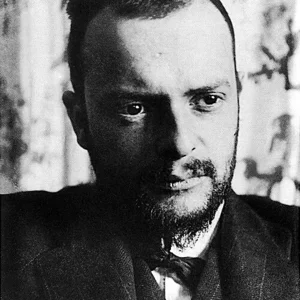

Paul Klee was a Swiss-German painter and a major figure of modern art. Close to the Bauhaus and Der Blaue Reiter, he developed a unique pictorial language blending abstraction, color, and poetry. His body of work, comprising nearly 10,000 pieces, had a lasting influence on 20th-century art.
Paul Klee(1879 — 1940)
Paul Klee
Suisse, royaume de Prusse
7 min read
Frequently asked questions
Famous Quotes
« Art does not reproduce the visible; rather, it makes visible.»
« Color possesses me. I don't have to pursue it. It will possess me always, I know it. That is the meaning of this happy hour: color and I are one. I am a painter.»
Key Facts
- Born in 1879 near Bern (Switzerland), died in 1940 in Muralto (Switzerland)
- Member of the Expressionist movement Der Blaue Reiter in Munich (1911-1912)
- A pivotal trip to Tunisia in 1914 revolutionized his relationship with color
- Professor at the Bauhaus from 1921 to 1931, where he taught the theory of form and color
- His works were labeled “degenerate art” by the Nazis in 1937, with more than 100 confiscated
Works & Achievements
Watercolour brought back from his trip to Tunisia, where the town dissolves into squares of colour. A record of his discovery of colour.
Oil painting blending a house, letters and geometric shapes within a dreamlike landscape. An example of his poetic, abstract language.
A small drawing of a famous angel, later interpreted by the philosopher Walter Benjamin as the “angel of history.”
A portrait-face built from coloured rectangles evoking a mask. One of his best-known works.
A painting on a dark background where a luminous fish seems to float, blending mystery and enchantment. A symbol of his poetic imagination.
A colourful checkerboard composition inspired by fields seen from a plane during a trip to Egypt. It evokes rhythm and perspective.
A theoretical work drawn from his teaching at the Bauhaus, fundamental to understanding modern art.
A late work with thick black lines, where a skull-face bears the German word “Tod” (death). A testament in the face of illness.
Anecdotes
In 1914, Paul Klee took a short trip to Tunisia with his painter friends August Macke and Louis Moilliet. Dazzled by the light of Kairouan, he wrote in his diary: “Color possesses me. I don't have to pursue it. It will possess me always, I know it. That is the meaning of this happy hour: color and I are one. I am a painter.” This stay marked a decisive turn toward color in his work.
Paul Klee was an accomplished violinist: before choosing painting, he long hesitated between music and the visual arts, since both of his parents were musicians. All his life he played the violin (notably Bach and Mozart), and music shaped the way he thought about pictorial composition, built from rhythms and harmonies.
In 1933, the Nazi regime declared him a “degenerate artist” and he was dismissed from his teaching post at the Düsseldorf academy. More than a hundred of his works were confiscated from German museums. Klee left Germany to take refuge in Bern, Switzerland, his hometown.
From 1935 on, Klee was stricken with a rare and incurable disease, scleroderma, which hardens the skin and made his movements painful. Far from stopping him, the illness sparked a final creative burst: in 1939 he produced nearly 1,200 works in a single year, often marked by thick black lines and somber themes.
Klee loved to give his paintings poetic, funny, or enigmatic titles such as “The Golden Fish” or “Senecio.” For him, the title was part of the work and invited the viewer to dream rather than to recognize. He said that art “does not reproduce the visible; rather, it makes visible.”
Primary Sources
Color possesses me. I don't have to pursue it. It will possess me always, I know it. That is the meaning of this happy hour: color and I are one. I am a painter.
Art does not reproduce the visible; rather, it makes visible.
An active line that wanders freely, without a goal. A walk for the sake of the walk. The agent is a point that shifts its position.
Everything becomes, everything is movement... Nothing is fixed. Within nature, in the very trunk of the tree, the sap flows.
Key Places
Village where Paul Klee was born in 1879, into a family of musicians. Switzerland would remain his home base all his life.
City where Klee trained as a painter and joined the Blaue Reiter group. A major center of the German artistic avant-garde of the early 20th century.
Holy city of the Maghreb visited in 1914, whose light dazzled Klee and triggered his revelation about color.
School of art and design where Klee taught from 1920 to 1931. There he developed his theory of form and color.
City where Klee taught at the academy of fine arts from 1931, before being driven out by the Nazis in 1933.
Town in Ticino where Paul Klee died in 1940, weakened by scleroderma and exile.
Typical Objects

Watercolor, a technique of water-based painting on paper, became one of Klee's favorite means of expression after his trip to Tunisia. It allowed him to play with the transparency and layering of colors.

Klee drew constantly in notebooks, accumulating lines, signs and figures. His drawings, at once childlike and learned, lie at the heart of his graphic research.

An accomplished musician, Klee played the violin almost every day. Music nourished his rhythmic and harmonic conception of painting.

A collection of his theoretical lessons in which Klee analyzes line, form and color. In it he formulates his famous idea of a “line that goes for a walk.”

A wooden stand on which the painter places a canvas or paper to work standing or seated. In his Bauhaus studio, Klee used it to compose his abstract paintings.

Klee made about fifty puppets for his son Felix out of salvaged objects (walnut shells, electrical plugs, bones). Funny and inventive, they reveal his taste for play and for materials.
School Curriculum
Vocabulary & Tags
Key Vocabulary
Daily Life
Morning
Klee often began his day with music: he played the violin to attune his mind before working. Methodical and unassuming, he then headed to his light-filled studio, where paper, brushes, and colors awaited him.
Afternoon
In the afternoon, he painted, drew, and experimented with techniques blending watercolor, ink, and oil. During the Bauhaus period, he also devoted time to preparing and giving his lessons on line, form, and color.
Evening
In the evening, Klee rejoined his family and led a quiet, homebound life. He read, listened to or played chamber music, and jotted down his reflections on art and life in his diary.
Food
Klee led a simple, middle-class life; his wife Lily, a piano teacher, often provided the household's income. Their meals were those of a modest family in early-twentieth-century Germany and Switzerland, with no particular luxury.
Clothing
A reserved man, Klee dressed plainly, in a suit and tie in the fashion of his day, much like a professor. Nothing in his attire betrayed the boldness of his imagination.
Housing
At the Bauhaus in Dessau, Klee lived in one of the modernist masters' houses designed by Gropius, which he shared with his friend Kandinsky. After going into exile, he lived in a modest apartment in Bern.
Historical Timeline
Period Vocabulary
Liens externes & ressources
Références
Œuvres
Hammamet et sa mosquée
1914
Angelus Novus
1920
Senecio (Tête d'homme devenant sénile)
1922
Route principale et routes secondaires
1929
Cahier pédagogique (Pädagogisches Skizzenbuch)
1925