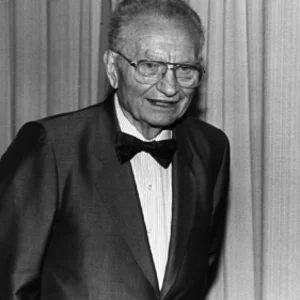

American economist, a major figure of the 20th century. The first American to receive the Nobel Prize in Economics in 1970, he helped found modern economics by introducing mathematical formalization into it, and was the author of a world-renowned economics textbook.
Paul Samuelson(1915 — 2009)
Paul Samuelson
États-Unis
6 min read
Frequently asked questions
Key Facts
- Born on May 15, 1915, in Gary, Indiana; died on December 13, 2009
- Published Foundations of Economic Analysis in 1947, which introduced mathematical methods into economics
- Published the textbook Economics in 1948, translated into dozens of languages and a worldwide best-seller
- Received in 1970 the first Nobel Prize in Economics awarded to an American
- Iconic professor at MIT (Massachusetts Institute of Technology) for decades
Works & Achievements
A method for inferring consumers' preferences from their observed choices, without relying on untestable assumptions.
A major result in international trade theory, explaining how opening up to trade affects the returns to labor and capital.
A landmark work in which Samuelson unified economics through mathematics, laying the foundations of modern economics.
The best-selling economics textbook in history, which spread the “neoclassical synthesis” throughout the world.
A pioneering analysis of goods whose use benefits everyone (defense, street lighting) and that the market alone cannot supply efficiently.
A framework for analyzing saving, pensions, and debt across generations, still central to macroeconomics today.
The first Nobel Prize awarded to an American economist, honoring his entire body of scientific work.
Anecdotes
In 1970, Paul Samuelson became the very first American to receive the Nobel Prize in Economics, just two years after the award was created. The Stockholm committee praised the man who had "done more than any other contemporary economist to raise the level of scientific analysis in economic theory.
His textbook *Economics*
published in 1948
became the best-selling economics book in history: millions of copies
translated into more than forty languages
and used by generations of students around the world. Samuelson liked to say:
I don't care who writes a nation's laws if I can write its economics textbooks.
For years, Samuelson wrote a regular column in *Newsweek* magazine, alternating with his great rival in ideas, the free-market champion Milton Friedman. The two men — one a Keynesian, the other a monetarist — thus offered the general public an ongoing debate on how to manage the economy.
A brilliant doctoral student at Harvard, Samuelson nonetheless chose to join nearby MIT, where he would build one of the most prestigious economics departments in the world. It is said that MIT struck one of the best "bargains" in its academic history.
Samuelson had an economist's humor when it came to risky forecasts: he joked that "the stock market has predicted nine of the last five recessions
a way of reminding everyone that markets often panic over nothing.
Primary Sources
The textbook popularized the “neoclassical synthesis” — blending Keynes's ideas with the traditional theory of markets — among millions of students.
In it, Samuelson argues that the same operational mathematical methods underlie economic fields that appear very different from one another.
In it, Samuelson defends the idea that economics can and must be treated as a rigorous science, formalized through mathematics.
In his columns, which alternated with Milton Friedman's, Samuelson explained the government's economic policy choices to the general public.
Key Places
Industrial city in the United States where Paul Samuelson was born in 1915, into a family of Jewish immigrants from Eastern Europe.
Where he pursued his first university studies, and where the young Samuelson discovered economics and, in his own words, fell “in love” with the discipline.
Where Samuelson earned his doctorate with a brilliant thesis that would become “Foundations of Economic Analysis.”
University in Cambridge where Samuelson taught and, over the course of decades, built one of the most renowned economics departments in the world.
Town near Boston where Paul Samuelson passed away in 2009, at the age of 94.
Typical Objects

The famous introductory economics textbook written by Samuelson in 1948, sold in millions of copies and translated into dozens of languages. It trained generations of students around the world.

The daily tool of the economist-mathematician, on which Samuelson translated economic behaviors into formulas and curves. It symbolizes the mathematization of economic science that he championed.

A calculating instrument used by scientists and economists before the computer age. Samuelson belonged to a generation that formalized economics by hand, before computing.

The working tool of the professor and columnist, on which textbooks, articles, and op-eds were typed. Samuelson was a prolific writer throughout his life.

The medal awarded to Samuelson in 1970, a symbol of the international recognition of his work. He was the first American to receive the Nobel Prize in Economics.

The American weekly in which Samuelson wrote a regular economics column, alternating with Milton Friedman. He made economics accessible to the general public.
School Curriculum
Vocabulary & Tags
Key Vocabulary
Tags
Daily Life
Morning
Samuelson often started his day early, in his office at MIT or at home, immersed in reading scientific journals and economic data. The morning was devoted to research: covering sheets with equations to model economic behavior.
Afternoon
In the afternoon, he taught his students and supervised the work of young researchers, several of whom would themselves go on to win Nobel Prizes. He also took part in the lively debates and seminars of the economics department he had helped to found.
Evening
In the evening, Samuelson wrote his articles, his columns for Newsweek, or new editions of his textbook. A father of six, he also shared time with his family away from the lecture halls.
Food
His diet was that of a well-off twentieth-century American academic, without excess or any notable peculiarity. Meals could be an opportunity to continue intellectual discussions among colleagues.
Clothing
He wore the classic attire of the university professor of his time: a plain suit, shirt and tie, sometimes the elbow-patched jacket typical of the academic world.
Housing
Samuelson lived in the Boston area, near Cambridge, in a comfortable house suited to his large family. His daily life was organized around his proximity to the MIT campus.
Historical Timeline
Period Vocabulary
Liens externes & ressources
Références
Œuvres
Théorie des préférences révélées
1938
Théorème de Stolper-Samuelson
1941
Foundations of Economic Analysis
1947
Economics: An Introductory Analysis
1948
Théorie des biens publics
1954
Modèle à générations imbriquées
1958
Prix Nobel d'économie
1970