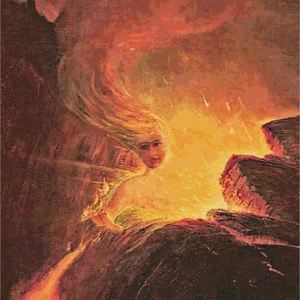

Goddess of fire, volcanoes, and creation in Hawaiian mythology, Pele is a central figure in Polynesian oral tradition. She is said to dwell in the Halemaʻumaʻu crater of the Kīlauea volcano on the island of Hawaiʻi. Her myth, passed down orally by the Hawaiian people, explains the formation of the volcanic islands of the Pacific.
Pele
Pele
8 min read
Frequently asked questions
Key Facts
- According to Hawaiian oral tradition, Pele originally came from Kahiki (a term referring to a distant land, likely the Society Islands or the Marquesas)
- She is said to have fled her homeland after a conflict with her sister Nāmaka, goddess of the sea, and journeyed from island to island before settling at Kīlauea
- Volcanic eruptions were interpreted by Hawaiians as expressions of her anger or her creative power
- Her myth is documented in traditional chants (mele) and narrative accounts (moʻolelo) collected from the 19th century onward by ethnographers such as Martha Beckwith
- Pele is still venerated today by a portion of the indigenous Hawaiian population
Works & Achievements
In Hawaiian mythology, Pele is credited with the continuous formation of the Hawaiian Islands through her eruptions. This narrative is considered the primary 'work' attributed to the goddess in the oral tradition.
A long epic poem spanning several thousand verses, passed down orally by haku mele (masters of chant), recounting the adventures of Pele and her beloved sister Hiʻiaka. It is considered the masterpiece of Polynesian oral literature.
A body of sacred hula chants and dances dedicated to Pele, performed during religious ceremonies. These performances served both as acts of devotion and as a living transmission of the myth.
Stories of the romantic relationship between Pele and the demigod Lohiʻau, exploring themes of jealousy, devotion, and divine power. These moʻolelo are among the most beloved tales in Hawaiian tradition.
Following European contact, Hawaiian music incorporated new instruments while preserving traditional themes. Many Hawaiian slide guitar pieces evoke Pele and the volcanic landscapes of the islands.
Anecdotes
According to Hawaiian tradition, Pele left her homeland — likely Tahiti or the Marquesas — after a dispute with her sister Nāmaka, goddess of the sea. She crossed the Pacific Ocean from island to island, digging craters to establish her home, until she found refuge in Kīlauea, deep enough that Nāmaka's waters could not reach her.
Pele is also known for her tragic love affair with the demigod Lohiʻau. She first saw him in a dream, played the drum and danced the hula with him, then sent her sister Hiʻiaka to bring him to her. Pele's jealousy triggered a series of volcanic catastrophes, illustrating how divine emotions shape the physical landscape of the islands.
In many Hawaiian stories, Pele appears disguised as an old woman or a young beauty to test the generosity of mortals. Those who welcome her and offer her food receive her protection; those who turn her away risk seeing lava swallow their lands. This tradition explains why hospitality was a core value in Hawaiian culture.
Kīlauea's eruptions are still interpreted by some Hawaiians today as expressions of Pele's mood. When lava flows toward the sea, it is said that Pele is expanding her domain and creating new land — a vision of destruction as an act of continuous creation, central to Polynesian cosmogony.
The Hawaiian epic chant 'Pele and Hiiaka', passed down orally for centuries before being transcribed in the twentieth century, describes in detail the adventures of Pele and her favorite sister. This narrative, spanning several thousand verses, is considered one of the richest works of literature in all of Polynesia.
Primary Sources
Traditional Hawaiian chant transmitted orally by kahuna (priests) and chanters, describing Pele's creative power, her journeys, and her settlement in Kīlauea. Collected and partially transcribed by missionaries and Hawaiian scholars in the 19th century.
Emerson gathered from Hawaiian chanters the epic songs recounting the adventures of Pele and her sister Hiʻiaka. He writes: 'These chants constitute the great Hawaiian epic, passed down from generation to generation by specialists in oral memory, the haku mele.'
Beckwith brought together Hawaiian mythological narratives collected from the last keepers of the oral tradition: 'Pele is described as the great ancestress, she whose body is the earth itself, and whose breath is the steam rising from the craters.'
David Malo, a 19th-century Hawaiian scholar, recorded in his work Moʻolelo Hawaiʻi fragments of Pele's mythology as transmitted by the chiefs and priests of his time, highlighting her role as the founding deity of the Hawaiian volcanic landscape.
Key Places
Pele's primary home according to Hawaiian tradition. This active crater on the Big Island is considered the goddess's sacred dwelling, and the eruptions that occur there are interpreted as her manifestations.
The largest and youngest island in the archipelago, shaped entirely by volcanic activity. It is considered Pele's favored domain — the island she created and continues to mold.
Pele's journey from her earliest islands to Kīlauea mirrors the northwest-to-southeast alignment of the Hawaiian Islands, from oldest to youngest — a striking parallel between myth and geology.
A sacred area encompassing Kīlauea and Mauna Loa, it serves as a place of pilgrimage for Hawaiians connected to their traditions. Visitors are traditionally asked not to take volcanic rocks, out of respect for Pele.
According to tradition, Pele originates from Kahiki, the Hawaiian term for the distant ancestral homeland of the Polynesian people. This reference grounds the myth in the memory of the great Pacific migrations.
Typical Objects

Large cylindrical drum covered in sharkskin, used during ceremonies honoring Pele. Legends depict her playing the pahu to call Lohiʻau to her in a dream.

The two types of Hawaiian lava flows are directly associated with Pele: pāhoehoe lava, smooth and ropy, represents her grace, while ʻaʻā lava, rough and jagged, embodies her fury.

Small spheres of naturally formed volcanic glass, black and lustrous, ejected during eruptions. Hawaiians regard them as the goddess's tears, and collecting them is surrounded by ritual respect.

Thin strands of solidified lava spun into volcanic glass, carried by the wind during eruptions. These golden or black threads are seen as Pele's hair scattered across the landscape.

A sacred plant used in Hawaiian rituals, particularly for protection against supernatural forces. Worn as a shield or garment during ceremonies dedicated to Pele.

A sacred koa wood vessel used for food offerings during rituals honoring Pele and volcanic deities. A symbol of the abundance and generosity expected of mortals.
School Curriculum
Vocabulary & Tags
Key Vocabulary
Tags
Daily Life
Morning
In Hawaiian stories, Pele awakens with the first light of dawn in her home at the Halemaʻumaʻu crater. She gazes out over the ocean from the heights of Kīlauea, sensing the geothermal currents that pulse through the earth. At times, she takes human form and descends to the villages to observe mortals.
Afternoon
Pele shapes and molds the land through her eruptions, creating new coastlines and valleys. In the moʻolelo, she plays the pahu drum, performs the sacred hula, and receives offerings from kahuna priests who come in procession to the crater's edge to appease or give thanks to her.
Evening
At night, Pele wanders in the form of a flame or a mysterious woman along the volcanic roads. It is during these hours that she tests travelers by asking them for help. She can also journey through dreams, as when she meets Lohiʻau, crossing the distances of the archipelago by the sheer power of her spirit.
Food
As a deity, Pele is nourished by ritual offerings — fish, pigs, fruits, and lehua blossoms left at the crater's edge by priests. In stories where she takes human form, she eats as mortals do, often invited to share a meal, which serves as a test of generosity for her hosts.
Clothing
Pele is often described wearing kapa, a cloth made from beaten and dyed paper mulberry bark. Her garments reflect the colors of fire — red, orange, and black — and are adorned with traditional Hawaiian geometric patterns. Her hair is long and black, often compared to flowing lava.
Housing
Pele's home is the Halemaʻumaʻu crater of Kīlauea, which she chose after a long journey across the archipelago. This subterranean dwelling of molten lava forms a natural palace of fire and rock. In stories where she travels, she may also take up temporary residence in volcanic caves or lava tubes.
Historical Timeline
Period Vocabulary
Visual Style
Un style visuel puisant dans les motifs géométriques polynésiens et les pétroglyphes hawaïens, dominé par les teintes de lave incandescente contrastant avec le noir du basalte et le ciel étoilé du Pacifique.
Sound Ambience
L'environnement sonore de Pélé mêle les grondements sourds du volcan actif, le sifflement de la lave entrant dans l'océan et les battements du tambour cérémoniel, créant une atmosphère à la fois sauvage et sacrée.
Liens externes & ressources
Références
Œuvres
Création des îles hawaïennes (mythe cosmogonique)
tradition orale ancienne
Cycle épique Pele and Hiʻiaka
tradition orale, transcrit en 1915
Hula pahu — danses rituelles en l'honneur de Pélé
tradition précoloniale
Moʻolelo (récits narratifs) sur Pélé et Lohiʻau
tradition orale, collectés au XIXe siècle
Kī hōʻalu (musique de guitare hawaïenne) inspirée de Pélé
XIXe-XXe siècle