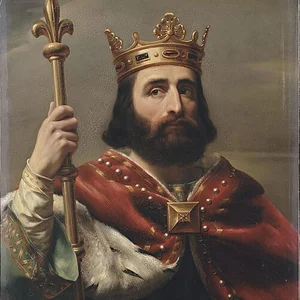

Pepin the Short (714–768) was the first king of the Carolingian dynasty. He overthrew the last Merovingian kings and founded a new dynasty that would dominate Western Europe for several centuries.
Frequently asked questions
Key Facts
- 741: Becomes Mayor of the Palace of the Frankish kingdom upon the death of his father Charles Martel
- 751: Deposes the last Merovingian king Childeric III and proclaims himself King of the Franks
- 752: Is consecrated king by the Pope, establishing an alliance between the papacy and the Carolingian dynasty
- 754: Receives the title of Patrician of the Romans from Pope Stephen II
- 768: Divides his kingdom between his sons Charlemagne and Carloman according to Frankish tradition
Works & Achievements
By overthrowing Childeric III, Pepin founded the first major new royal dynasty in the West in centuries. This lineage would give birth to Charlemagne and dominate Europe for two centuries.
Pepin introduced royal anointing in France, inspired by the Bible, permanently binding monarchy and religion together. This ritual would be practiced until Charles X in 1825.
By handing over the conquered Italian territories to the Pope, Pepin created the Papal States, which would exist until 1870. This act established the structural alliance between the papacy and the Frankish monarchy.
Pepin established a lasting partnership between the King of the Franks and the papacy, replacing Byzantine imperial protection of the Frankish king with Roman protection. This model would shape medieval Europe.
Together with Archbishop Boniface, Pepin organized reforming councils that restructured the Church in the Frankish kingdom, strengthening ecclesiastical discipline and ties with Rome.
Pepin retook Narbonne from the Arabs, ending Muslim presence in Gaul and consolidating the southern borders of the Frankish kingdom.
Anecdotes
Pepin the Short owed his nickname to his small stature, but his contemporaries testify that he made up for this modest height with extraordinary energy and authority. It is said that he wrestled a lion in single combat during a court spectacle, to demonstrate to his warriors that a courageous man was worth far more than a tall one.
In 751, Pepin consulted Pope Zachary through messengers to ask him a delicate question: 'Who should be king, the one who holds the title or the one who actually exercises power?' The pope replied that it was more just for power and title to belong to the same person, thus paving the way for the overthrow of the Merovingians.
At Pepin's coronation in Soissons in 751, and again at his second coronation by Pope Stephen II in 754, a new ritual made its appearance in the West: royal unction. The king was anointed with holy oil like the kings of the Old Testament, which gave the Carolingian monarchy an unprecedented sacred character.
To thank Pope Stephen II, who had crossed the Alps to crown him, Pepin led two military campaigns against the Lombards in 754 and 756. He gave the pope the conquered lands in central Italy, thereby laying the foundation for the future Papal States. This act, known as the 'Donation of Pepin', would shape European geopolitics for centuries.
Pepin was the first Frankish ruler to organize a true administration of the kingdom using missi dominici — royal envoys tasked with overseeing counts and enforcing royal decisions throughout the territory. This administrative innovation would later be taken up and expanded by his son Charlemagne.
Primary Sources
In the year 751, Pepin was elected king of the Franks and consecrated by the hands of Archbishop Boniface, of blessed memory, and raised to the throne by the Franks in the city of Soissons.
Boniface, by order and with the authorization of the Pope, consecrated Pepin king of the Franks according to the custom of the ancients, anointing him with holy oil.
We beseech you, O most excellent son, to take up the defense of the holy Roman Church and the people of God, so that the Lombards may no longer oppress it.
King Childeric was tonsured and sent to a monastery. Thus ended the reign of the Merovingians, and Pepin was proclaimed king by all the Franks.
Pepin, father of Charles, had wrested the kingdom from the hands of kings who, under the pretense of exercising royalty, had nothing royal left but the empty title.
Key Places
City where Pepin's coronation took place in 751, marking the official birth of the Carolingian dynasty. This place symbolizes the shift of power from the Merovingians to the Carolingians.
Royal abbey north of Paris where Pepin was anointed a second time by the Pope in 754 and where he was buried in 768. This site became the mausoleum of Carolingian royalty.
One of Pepin's main itinerant palaces on the Oise river, where he regularly held assemblies of the kingdom's magnates and administered justice.
Royal palace where Pepin received Pope Stephen II in January 754, sealing the historic alliance between the papacy and the new Carolingian dynasty.
Capital of the Lombard kingdom besieged by Pepin during his two Italian campaigns of 754 and 756. Its surrender enabled the donation of territories to the Pope.
Typical Objects

A long, single-edged combat knife, the favorite weapon of Frankish warriors. Pepin wore it at his belt as a symbol of his status as a military leader.

At his coronation in Soissons, Pepin received a scepter as the insignia of his new royal power, marking a break with the Merovingian tradition.

A vessel containing the oil used for anointing during the coronation. For the first time in the West, a Frankish king was anointed like the biblical sovereigns, conferring divine legitimacy upon Pepin.

Pepin used a seal to authenticate his diplomas and official acts, thereby asserting his royal and administrative authority over the entire kingdom.

During his many military expeditions (Italy, Aquitaine, Septimania), Pepin lived under a large royal tent, which served as a command post and reception hall for ambassadors.

A document written on parchment by which Pepin granted lands and privileges to monasteries or loyal subjects. These charters constitute essential historical sources today.
School Curriculum
Vocabulary & Tags
Key Vocabulary
Daily Life
Morning
Pepin rose at dawn to attend Lauds prayers with the clerics of his royal chapel. He then held council with his close advisers (the great men of the palace) to handle urgent military and administrative affairs. Mornings were often devoted to receiving missi, ambassadors, or bishops.
Afternoon
Afternoons were dominated by martial activities or hunting, essential for maintaining the warriors' training and feeding the court. Pepin also presided over plaids (judicial assemblies) where he dispensed justice, surrounded by his leudes (loyal warriors) and bishops.
Evening
In the evening, Pepin presided over the royal banquet where warriors, clerics, and nobles dined together in the great hall. Jugglers and storytellers entertained during these meals, which lasted late into the night. Before retiring, he attended Compline (the final prayer of the day) in his chapel.
Food
The royal table was abundant in game meats (boar, deer, fowl) and poultry, accompanied by wheat bread, vegetables, and cheeses. Wine was the main drink of the Frankish elite, supplemented by cervoise (ale) for everyday meals. On fast days imposed by the Church, the court made do with fish, vegetables, and fruit.
Clothing
Pepin wore a long tunic of fine wool dyed in vivid colors (red, green, blue), cinched with an ornate leather belt, and a cloak (chlamys) of wool or fur depending on the season. His chausses (a kind of trousers) were held in place by strips of fabric wound around the legs. During ceremonies, he displayed his crown, scepter, and a royal mantle embroidered in gold.
Housing
Pepin resided in itinerant royal palaces (Verberie, Quierzy, Compiègne) organized around a great hall of wood or stone for assemblies, a chapel, and quarters for the royal retinue. These palaces stood at the center of large agricultural estates (royal fiscs) that supplied food and resources. The court moved constantly from one estate to another to consume its reserves on site.
Historical Timeline
Period Vocabulary
Visual Style
L'univers visuel de Pépin le Bref s'inscrit dans l'esthétique des enluminures carolingiennes naissantes : ors byzantins, pourpres royaux et architecture romane austère, entre brutalité guerrière et splendeur liturgique.
Sound Ambience
L'ambiance sonore de la cour de Pépin mêle le fracas des armes et des chevaux de guerre au chant grégorien des monastères voisins, dans un monde où religion et pouvoir militaire sont indissociables.
Liens externes & ressources
Références
Œuvres
Fondation de la dynastie carolingienne
751
Institution du sacre royal en Occident
751-754
Don de Pépin et création des États pontificaux
756
Alliance franco-pontificale
753-756
Réforme de l'Église franque avec saint Boniface
743-747
Reconquête de la Septimanie
759