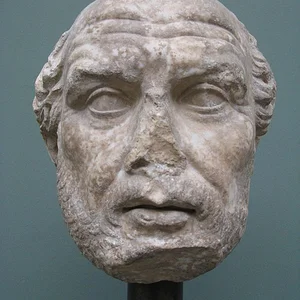

Phidias is considered the greatest sculptor of ancient Greece in the 5th century BC. He created the chryselephantine statue of Athena Parthenos and the statue of Zeus at Olympia, counted among the Seven Wonders of the Ancient World.
Phidias(499 av. J.-C. — 429 av. J.-C.)
Phidias
Athènes
10 min read
Frequently asked questions
Key Facts
- Around 490 BC: presumed birth in Athens
- Around 447–432 BC: supervision of the artistic works on the Parthenon under Pericles
- 438 BC: completion of the chryselephantine statue of Athena Parthenos
- Around 435 BC: creation of the statue of Zeus at Olympia, one of the Seven Wonders of the Ancient World
- Around 432 BC: accused of impiety and misappropriation of ivory, imprisoned in Athens
Works & Achievements
A colossal bronze statue of Athena as a warrior goddess, standing approximately 9 meters tall, erected on the Acropolis between the Propylaea and the Parthenon. So imposing was it that its gilded helmet and spear served as a landmark for sailors entering the port of Piraeus.
A bronze statue depicting Athena holding her helmet in her hand and showing her face without armor, commissioned by Athenian colonists on Lemnos. It was considered by Pausanias to be the most beautiful of all Pheidias's works.
The absolute masterpiece of Greek sculpture: a 12-meter statue in gold and ivory depicting Athena inside the Parthenon. Her shield bore carved scenes (the Amazonomachy), she held a Nike in her right hand, and her full armor was adorned with mythological scenes.
A 160-meter frieze in Pentelic marble carved in low relief depicting the procession of the Great Panathenaea, with horsemen, offering-bearers, and the gods of Olympus. Pheidias devised the iconographic program and oversaw its execution by his workshop.
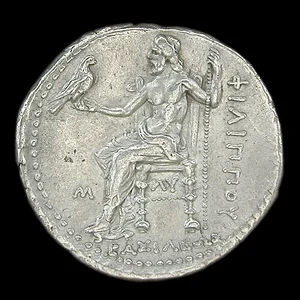
A seated statue of Zeus approximately 13 meters tall in gold and ivory, ranked among the Seven Wonders of the Ancient World. So immense was it that, according to Strabo, if the god were to stand he would break through the roof of the temple; it was admired for nearly nine centuries before disappearing.
A statue of Athena the war goddess in gilded cedarwood with face, hands, and feet in Pentelic marble, commissioned in gratitude for the victory at Plataea. It illustrates the mixed technique (acrolithic) that Pheidias had mastered before moving on to the chryselephantine technique.
Anecdotes
Phidias was a close personal friend of Pericles, the most powerful statesman in Athens. It was to him that Pericles entrusted the supervision of the entire Acropolis building project around 447 BC. This friendship earned him the hostility of the statesman's political enemies, who attacked Pericles through him around 432 BC by accusing Phidias of embezzling the gold and ivory intended for the statue of Athena.
To guard against any accusation of theft, Phidias had devised the idea of attaching the gold plates of the Athena statue in such a way that they could be removed and weighed at any time. Despite this precaution, his adversaries accused him of impiety for having depicted his own face and that of Pericles on Athena's shield — a sacrilege in the eyes of the Athenians.
In his workshop at Olympia — uncovered by archaeologists between 1954 and 1958 — sculptor's tools, terracotta molds, and a cup bearing the Greek inscription 'I belong to Phidias' (ΦΕΙΔΙΟΥ ΕΙΜΙ) were discovered. This find made it possible to pinpoint with certainty the place where the statue of Zeus was created, confirming that the workshop dated to the sculptor's own lifetime.
The statue of Zeus at Olympia was so colossal (approximately 13 meters tall) that the geographer Strabo wrote that if Zeus had risen from his throne, he would have burst through the roof of the temple. The Roman general Aemilius Paullus, conqueror of Macedonia in 168 BC, declared that he felt he was beholding the god himself when he gazed upon it.
Quintilian, a Roman rhetorician of the 1st century AD, made a celebrated judgment about Phidias: he had managed to 'add something to received religion,' so closely did the majesty of his works match that of the gods themselves. This phrase captures the idea that Phidias had not merely depicted the gods but had given them a definitive form in the imagination of the ancient world.
Primary Sources
Phidias presided over and supervised everything for Pericles, even though great architects and artists were employed on the various works. [...] The enemies of Pericles were jealous of his glory and attacked him through Phidias, accusing him of impiety for having represented on the shield of Athena his own portrait and that of Pericles.
The statue of Zeus is made of gold and ivory; the god is seated on a throne. In his right hand he holds a Nike in gold and ivory, and in his left hand a scepter adorned with every kind of metal, with an eagle perched at the top. The god's sandals are of gold, his mantle likewise; figures and lilies are wrought upon it.
Phidias is generally regarded as having revealed the glory of the art of chryselephantine sculpture. His Athena in the Parthenon stands twenty-six cubits high and is made entirely of ivory and gold; in the center of her helmet is placed an image of the Sphinx.
Phidias created the chryselephantine statue of Zeus for the temple at Olympia. It was so large that, although the temple itself was very spacious, the artist seemed to have misjudged the proportions: he seated the god, but the head almost touches the ceiling, giving the impression that if Zeus were to stand he would lift off the roof.
Phidias is judged the most skilled at representing gods rather than men. In ivory, none can be compared to him, and this would hold true even if one considered only the Jupiter at Olympia and the Minerva at Athens. He added something to the religion as received, so fully does the majesty of the work equal the majesty of the god.
Key Places
Temple of Athena Parthenos built between 447 and 438 BC on the rock of the Acropolis. Phidias oversaw the entire project and created the colossal chryselephantine statue of Athena housed within it, standing approximately 12 meters tall.
Site of the Olympic Games in the Peloponnese, where Phidias created the statue of Zeus between 435 and 432 BC — counted among the Seven Wonders of the Ancient World. His workshop, uncovered by archaeologists in 1954, stood adjacent to the temple.
A rectangular building discovered to the west of the Temple of Zeus, built to the same dimensions as the temple's nave so that work could be carried out at full scale. Excavations yielded tools, molds, and the famous cup bearing his name.
The heart of Athenian civic and intellectual life, where Phidias — as Pericles' official artist — rubbed shoulders with philosophers, architects, and politicians. It was also the setting for public trials, including the one that led to his condemnation.
Between the Propylaea and the Parthenon once stood the enormous bronze statue of Athena Promachos, created by Phidias around 460 BC. The gilded tip of her spear and her gleaming helmet were visible from Cape Sounion, over 50 kilometers away.
Typical Objects

An essential tool of the Greek sculptor, made of forged iron and used to carve marble or chisel ivory. Phidias mastered every sculpting technique, from large-scale marble works to the precision detailing of chryselephantine statues.

The gold of the Athena statue was crafted into thin removable plates fixed onto a wooden armature. Phidias designed this ingenious system so that the gold could be weighed and inspected at any time — a testament to his integrity in handling such a precious material.

A luxury material imported from Africa or India, ivory was used to sculpt the flesh-colored parts of chryselephantine statues. Working it required a special technique of softening in hot water to achieve the desired shape.

The invisible internal framework of chryselephantine colossi, built from rot-resistant cypress wood. For the Athena statue, the armature also had to incorporate a water reservoir to maintain the humidity needed to preserve the ivory.

A fragment of black-glaze cup bearing the Greek inscription 'I belong to Phidias,' discovered during excavations of the workshop at Olympia in 1958. A direct and moving piece of archaeological evidence of the sculptor's presence on the site.

Found in the Olympia workshop, these molds were used to shape the small decorative gold elements of the statues' clothing and accessories. They bear witness to the meticulous, near-industrial work required to produce the chryselephantine colossi.

Greek sculptors used measuring instruments to adhere to the canons of ideal human body proportions. Phidias worked with these tools to achieve the formal perfection that drew such admiration from his contemporaries.
School Curriculum
Vocabulary & Tags
Key Vocabulary
Daily Life
Morning
Phidias began his day before dawn in his workshop, checking the state of materials and preparing tasks for his teams. At sunrise, he inspected the Parthenon construction site alongside the architects Ictinus and Callicrates, distributing instructions to groups of sculptors, carpenters, and goldsmiths working under his direction.
Afternoon
Afternoons were devoted to precision work: Phidias himself carved the most delicate elements of the chryselephantine statues — ivory faces, hands, and drapery in hammered gold. He supervised the assembly of pieces onto the wooden framework and sometimes received representatives from the commissioning city-states to report on the progress of the work.
Evening
In the evenings, Phidias sometimes joined the intellectual circle of Pericles, which brought together the philosopher Anaxagoras, the playwright Sophocles, and the scholar Aspasia. These exchanges nourished his thinking on divine representation and ideal beauty. He often ended his evening studying clay maquettes and preparatory drawings for ongoing projects.
Food
Like any prosperous Athenian of the 5th century BC, Phidias ate barley or wheat bread, olives and olive oil, pulses (lentils, chickpeas), fresh or dried fish, and sheep's cheese. Wine mixed with water was the daily drink, and meat was reserved for feasts following religious sacrifices at major festivals.
Clothing
Phidias wore the chiton, a linen or wool tunic fastened at the shoulder, often covered by a himation (a large draped woolen cloak). In the workshop, he likely wore a short, simple outfit to allow free movement, his clothes protected from the white marble dust. As an artist who moved in Athenian elite circles, he took care with his appearance at official receptions.
Housing
Phidias lived in the lower city of Athens in a typical prosperous craftsman's courtyard house (oikos), with an attached workshop for smaller-scale work and storage spaces for his precious materials. At Olympia, he lodged in the purpose-built workshop constructed for the creation of the statue of Zeus, whose foundations have since been uncovered by archaeologists.
Historical Timeline
Period Vocabulary
Visual Style
Style art grec classique de l'âge de Périclès : marbre blanc du Pentélique, ors chryséléphantins, frises polychromes dans la lumière dorée de l'Attique. Grandeur divine et perfection formelle incarnant le sommet de l'art grec antique.
Sound Ambience
Ambiance de l'atelier de Phidias sur l'Acropole : coups de ciseau sur le marbre du Pentélique, craquements des échafaudages en bois, rumeur du grand chantier athénien et souffle de la brise égéenne portant les sons de la cité en contrebas.
Liens externes & ressources
Références
Œuvres
Athéna Promachos
c. 460 av. J.-C.
Athéna Lemnienne
c. 450 av. J.-C.
Athéna Parthénos (chryséléphantine)
438 av. J.-C.
Frise des Panathénées au Parthénon (supervision)
442-438 av. J.-C.
Zeus d'Olympie (chryséléphantine)
c. 435-432 av. J.-C.
Athéna Areia à Platées
c. 460 av. J.-C.