Character Catalog

Historical Library

CollectionGalaxy
Portrait de Philippe Auguste

Philippe Auguste

Philip II Augustus

1165 — 1223

France

PoliticsMonarqueChef militairePolitiqueMiddle Ages12th–13th centuries (late central Middle Ages)

King of France from 1180 to 1223, Philippe Auguste is one of the greatest monarchs of the Middle Ages. He strengthened royal power, vastly expanded the royal domain, and won the decisive victory of Bouvines in 1214. His reign marks the beginning of medieval France's rise as a major power.

Émotions disponibles (6)

N

Neutre

par défaut

I

Inspiré

P

Pensif

S

Surpris

T

Triste

F

Fier

Key Facts

  • Crowned and began his reign in 1180 at the age of 15
  • Victory at Bouvines in 1214 against a coalition of lords and the Holy Roman Empire
  • Conquest of Normandy and Anjou at the expense of the English Plantagenets (1202–1204)
  • Fivefold increase in the size of the royal domain during his reign
  • Participation in the Third Crusade (1190–1191) alongside Richard the Lionheart

Works & Achievements

Construction of the Louvre Fortress (vers 1190-1210)

Circular keep surrounded by moats, the first major royal defensive construction in Paris. It symbolized the power of the Capetian king and protected the capital against Norman invasions.

Wall of Philip II Augustus (Paris city walls) (1190-1215)

A great stone wall of more than 5 km encircling Paris on both banks of the Seine. This fortification transformed Paris into a protected royal city and asserted Capetian power.

Administrative Reform and Creation of the Bailiffs (vers 1190-1200)

Establishment of itinerant royal agents (bailiffs) tasked with dispensing justice and collecting taxes on behalf of the king in the provinces. This reform laid the foundations of the French royal administration.

Creation of the Treasury of Charters and the First Royal Registers (Ă  partir de 1194)

After the loss of his archives at Fréteval, Philip II Augustus organized the systematic preservation of royal acts. These registers are the direct ancestors of the French National Archives.

Conquest of Normandy, Anjou and Maine (1202-1204)

A series of military campaigns that wrested John Lackland's continental fiefdoms away from him and doubled the area of the royal domain. This was the greatest territorial expansion of the Capetian monarchy.

Foundation Charter of the University of Paris (1200-1215)

Royal confirmation of the privileges of Parisian masters and students, institutionalizing the greatest university of medieval Europe. Paris thus became the foremost intellectual center of Christendom.

Anecdotes

During the Third Crusade in 1191, Philip Augustus and Richard the Lionheart captured the city of Acre together after a long siege. But the two kings quarreled so violently over the division of the spoils and the choice of the King of Jerusalem that Philip returned to France as early as August 1191, leaving Richard to continue the crusade alone.

Philip Augustus was nicknamed 'Augustus' not at birth, but by a chronicler who admired the scale of his conquests and the growth of his kingdom, drawing a parallel with the Roman emperor Augustus. This nickname remained attached to him for eternity.

Before the Battle of Bouvines in 1214, Philip Augustus dismounted, knelt down, and prayed at length before the fight. When the melee turned against him, enemy soldiers managed to unhorse him and seize him by his garments — he was saved in extremis by his knights, which strengthened his legend as a warrior king.

Philip Augustus had the first great walls of Paris built and the main streets paved, exasperated by the smell of mud that rose all the way to his palace on the Île de la Cité. These works durably transformed the capital and made Paris a city worthy of the most powerful kingdom in the West.

His love life caused scandal: after the death of his first wife, he married Ingeborg of Denmark in 1193 but repudiated her the very day after their wedding without ever explaining why, triggering a diplomatic and religious conflict that lasted twenty years, with the Pope even threatening to excommunicate the kingdom.

Primary Sources

Gesta Philippi Augusti (The Deeds of Philip Augustus) (vers 1214-1220)
King Philip, having drawn up his battalions and commended his soul to God, charged with his men against the allied enemies and, by divine grace, won a complete victory at Bouvines.
Chronicle of Rigord, monk of Saint-Denis (vers 1186-1206)
The king ordered that all the streets of Paris be paved with hard and solid stones, so as to remove the unbearable stench rising from the mud of the city.
Guillaume le Breton, Philippide (Latin epic poem) (vers 1224)
Philip, surrounded by enemies, was seized by the hands and arms, but the strength of his companions freed him, and the banner of France flew victorious over the field of Bouvines.
Registers of Philip Augustus (royal archives) (vers 1190-1200)
We order that the bailiffs of our domain render account of their actions and their revenues each year at Candlemas, so that our treasury and our justice be precisely known.

Key Places

Paris – Palais de la Cité

Main residence of Philip II Augustus and administrative heart of the kingdom. It was from this palace that he governed and transformed Paris into a true royal capital.

Bouvines (Nord)

Village in Flanders where the decisive battle was fought on 27 July 1214 against the coalition of the Holy Roman Empire, England, and Flanders. This victory secured French dominance in Western Europe.

Château Gaillard and Normandy

Fortress built by Richard the Lionheart on the Seine, which Philip II Augustus besieged and captured in 1204, opening the conquest of Normandy and wresting the duchy from England.

The Louvre (Paris)

Fortress built around 1190–1210 by Philip II Augustus to defend Paris on the western side. This square keep was the first building of what would become the royal Louvre palace.

Abbey of Saint-Denis

Royal necropolis north of Paris, home of the Oriflamme and a site of symbolic legitimation for the kings of France. Philip II Augustus strengthened the bond between the monarchy and its divine protector there.

Typical Objects

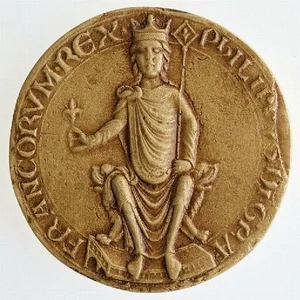
Royal seal

Large hanging wax seal depicting the king in majesty on his throne, used to authenticate royal acts. Philip Augustus generalized its use to assert sovereign authority over the entire kingdom.

Oriflamme of Saint-Denis

Red silk banner with golden flames, the war standard of the kings of France kept at the Abbey of Saint-Denis. Philip Augustus had it carried at Bouvines as a sign of divine protection granted to the kingdom.

Helm and hauberk

Iron mail armor (hauberk) and cylindrical helm protecting the king's head in combat. Philip Augustus fought in person at Bouvines and nearly lost his life there.

Parchment and wax seals

Supports for administrative and diplomatic acts drafted in Latin by the clerks of the royal chancellery. Philip Augustus's reform of the archives gave rise to the first preserved royal registers.

Royal currency (denier parisis)

Silver coin struck with the royal effigy, symbol of monetary sovereignty. Philip Augustus strengthened royal control over coin minting within his expanding domain.

Crossbow bolt

Projectile of the crossbow, a formidable ranged weapon widely used in Philip Augustus's royal armies during the sieges and battles of the reconquest of the Angevin fiefs.

School Curriculum

Cycle 4 (5e-3e)Histoire
Cycle 4 (5e-3e)Histoire — L'affirmation de l'autorité royale en France médiévale
Cycle 4 (5e-3e)Histoire — La bataille de Bouvines et ses conséquences politiques
Cycle 4 (5e-3e)Histoire — L'expansion du domaine royal capétien
Cycle 4 (5e-3e)Histoire — Les relations entre le roi de France et les seigneurs féodaux
Cycle 4 (5e-3e)Histoire — La féodalité et la construction de l'État royal

Vocabulary & Tags

Key Vocabulary

Royal domainVassalageFeudalismSuzeraintyCrusadeFiefCapetiansPlantagenets

Tags

Philippe AugusteDomaine royalVassalitéFéodalitéSuzerainetéCroisadeFiefCapétiensPlantagenêtXIIe-XIIIe siècles (fin du Moyen Âge central)

Daily Life

Morning

Philippe Auguste rose at dawn, attended morning Mass in the royal chapel of the Palais de la Cité, surrounded by his chaplains and clerks. He then received reports from his bailiffs and seneschals on the state of the kingdom, reviewing acts to be sealed and urgent judicial matters.

Afternoon

The afternoon was devoted to royal councils gathering the great barons of the kingdom, diplomatic audiences, and sessions of justice rendered in the king's name. During military campaigns — frequent under his reign — he inspected troops, planned sieges with his engineers, and rode at the head of his host.

Evening

In the evening, the king held court with his vassals and knights in the great hall of the palace, where an abundant meal was served accompanied by wines from France. Trouvères recited chansons de geste or chronicles glorifying royal exploits before evening prayer marked the end of the day.

Food

The royal table was rich in roasted meats (venison, wild boar, poultry), freshwater and sea fish on the lean days imposed by the Church, accompanied by white breads, vegetables, and fruit. Feast-day meals included oriental spices (pepper, cinnamon, ginger) and wines from Burgundy or the ĂŽle-de-France.

Clothing

Philippe Auguste wore a tunic and surcoat of fine embroidered cloth bearing the arms of France (golden fleurs-de-lis on an azure field), topped with the royal crown or a chaperon for travel. In war, he donned a mail hauberk, iron chausses, and a cylindrical helm, covered by a surcoat bearing the royal arms.

Housing

The Palais de la Cité on the island in the Seine was his principal residence, with its great vaulted halls, its Tower of the Treasury, and an early forerunner of the Sainte-Chapelle. During his travels across the kingdom, he stayed in his fortified castles (Fontainebleau, Vincennes) or with his great vassals, perpetuating the tradition of the itinerant king.

Historical Timeline

1180Philippe Auguste devient roi de France à 15 ans, après la mort de son père Louis VII.
1182Expulsion des Juifs du domaine royal et confiscation de leurs biens et créances.
1190Départ de Philippe Auguste pour la troisième croisade aux côtés de Richard Cœur de Lion.
1191Prise d'Acre et retour précipité de Philippe en France, laissant Richard Ier poursuivre seul la croisade.
1193Mariage puis répudiation immédiate d'Ingeburge de Danemark, déclenchant un long conflit avec la papauté.
1194Défaite de Fréteval contre Richard Cœur de Lion : Philippe perd ses archives royales, ce qui l'incite à créer un trésor des chartes permanent.
1200Traité du Goulet avec Jean sans Terre, roi d'Angleterre : reconnaissance provisoire des droits français en Normandie.
1202Philippe Auguste confisque les fiefs continentaux du roi Jean sans Terre, ouvrant la conquĂŞte de la Normandie.
1204Conquest de la Normandie, de l'Anjou et du Maine : le domaine royal double en superficie.
1209Début de la croisade des Albigeois contre les cathares du Midi, à laquelle Philippe Auguste refuse de participer directement.
1210Achèvement de la construction de la forteresse du Louvre, symbole du pouvoir royal parisien.
1214Victoire décisive de Bouvines sur la coalition anglo-flamande-allemande, consolidant l'hégémonie française.
1215Fondation de l'Université de Paris par charte royale, institutionnalisant les écoles parisiennes.
1223Mort de Philippe Auguste à Mantes ; son fils Louis VIII lui succède.

Period Vocabulary

Royal domain — Lands belonging directly to the King of France, over which he exercised full authority. Philip Augustus tripled its extent over the course of his reign.
Vassal — A lord who owes loyalty and military service to a more powerful suzerain in exchange for a fief. The Dukes of Normandy and Anjou were vassals of the King of France, even though they were also kings of England.
Bailiff — A royal officer instituted by Philip Augustus to represent the king's power in the provinces, administer justice, and collect taxes. He gradually replaced the local provosts, who were often corrupt.
Ost — The feudal army raised by the king, obliging his vassals to provide forty days of military service per year. Philip Augustus made it a formidable instrument of conquest.
Suzerain — The lord at the top of the feudal hierarchy, from whom vassals hold their fiefs. The King of France is the supreme suzerain of all lords in the kingdom.
Seal — An impression in wax or lead affixed to a document to guarantee its authenticity and authority. The great royal seal of Philip Augustus was indispensable for validating laws and treaties.
Crusade — A military expedition organised by Christendom to recapture Jerusalem and the Holy Land. Philip Augustus took part in the Third Crusade (1190–1191) before returning to France.
Charter — A written document on parchment granting rights, privileges, or liberties to a town, monastery, or community. Philip Augustus granted numerous town charters to secure political support.
Commune — An association of townspeople who had obtained from the king or a lord the right to govern themselves through aldermen or consuls. Philip Augustus encouraged their creation to counterbalance the power of the great lords.
Coalition (Battle of Bouvines coalition) — A military alliance formed in 1214 by England, the Holy Roman Empire, and Flanders against Philip Augustus. His victory at Bouvines broke this coalition and established France as the foremost power in the West.

Gallery

King Philip II of France

King Philip II of France

Augusta VictoriaDSCN4732

Augusta VictoriaDSCN4732

Philip II, King of France, in a 19th-century portrait by Louis-Félix Amiel

Philip II, King of France, in a 19th-century portrait by Louis-Félix Amiel

Jerusalem Himmelfahrtskirche Innen Decke 2

Jerusalem Himmelfahrtskirche Innen Decke 2


Philip Augustus and Agnes of Meranialabel QS:Lfr,"Philippe Auguste et Agnès de Méranie"label QS:Len,"Philip Augustus and Agnes of Merania"

Philip Augustus and Agnes of Meranialabel QS:Lfr,"Philippe Auguste et Agnès de Méranie"label QS:Len,"Philip Augustus and Agnes of Merania"


French:  Sceau de Philippe Auguste (moulage).title QS:P1476,fr:"Sceau de Philippe Auguste (moulage)."label QS:Lfr,"Sceau de Philippe Auguste (moulage)."

French: Sceau de Philippe Auguste (moulage).title QS:P1476,fr:"Sceau de Philippe Auguste (moulage)."label QS:Lfr,"Sceau de Philippe Auguste (moulage)."

UsageOfImagesFromKBonWikimediaCommonsInWikipediaArticles 26092013

UsageOfImagesFromKBonWikimediaCommonsInWikipediaArticles 26092013

UsageOfImagesFromKBonWikimediaCommonsInWikipediaArticles 26032014 File2

UsageOfImagesFromKBonWikimediaCommonsInWikipediaArticles 26032014 File2

Cutting of the elm in Gisors, 1188 (engraving)

Cutting of the elm in Gisors, 1188 (engraving)

Frederick II receives the captured imperial eagle banner from King Philip of France, 1214

Frederick II receives the captured imperial eagle banner from King Philip of France, 1214

Visual Style

Style enluminure médiévale française gothique naissant : bleu royal, or, fleurs de lys et scènes de bataille héraldiques des XIIe-XIIIe siècles.

#1A3A6B
#C9A84C
#8B1A1A
#F5F0E0
#2D5A27
AI Prompt
Medieval illuminated manuscript style, French Gothic aesthetics of the late 12th and early 13th century. Rich ultramarine blue and gold leaf backgrounds, stylized fleur-de-lis patterns on royal blue banners, detailed chain mail armor gleaming in torchlight, Romanesque arches giving way to early Gothic pointed vaults, Paris cityscape with the Seine and nascent Notre-Dame cathedral under construction, royal seals in red wax, dramatic battle scenes at Bouvines with cavalry charges and heraldic shields, ornate lettering in Latin manuscripts.

Sound Ambience

Ambiance sonore du Paris médiéval royal : cloches d'églises, chantiers de construction, chancellerie royale et bruits de cour des XIIe-XIIIe siècles.

AI Prompt
Medieval French royal court ambiance, late 12th century Paris. Stone castle interiors with echoing footsteps on cobblestones, quill scratching on parchment in the royal chancellery, Latin chants drifting from the royal chapel, distant hammering of stonemasons building the Louvre fortress walls, horses neighing and armored knights preparing for campaign, river Seine flowing nearby with boat traffic, market cries from the Île de la Cité, church bells marking the canonical hours, herald trumpets announcing royal decrees, the clatter of swords during military training.

Portrait Source

Wikimedia Commons — domaine public — 1180