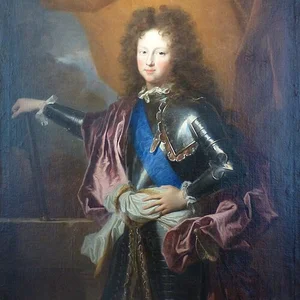

Regent of France from 1715 to 1723 during the minority of Louis XV, Philippe II d'Orléans governed the kingdom following the death of Louis XIV. A curious and libertine spirit, he was also a musician, painter, and patron of the arts, embodying the transition between the Grand Siècle and the Enlightenment.
Philippe II d'Orléans
Philippe II d'Orléans
France
10 min read
Frequently asked questions
Key Facts
- Born on August 2, 1674 at the Château de Saint-Cloud, nephew of Louis XIV
- Became Regent of France in 1715 upon the death of Louis XIV, when Louis XV was only 5 years old
- Introduced John Law's financial system (1716–1720), which ended in a spectacular collapse
- Established the polysynody, replacing ministers with collegial councils, before abandoning the experiment
- Died on December 2, 1723 at Versailles, shortly after Louis XV came of age
Works & Achievements
A lyric tragedy in five acts composed by Philippe II himself, set to a libretto by La Serre and premiered at the Académie royale de musique. This work demonstrates a genuine mastery of musical composition and places the Regent among the most serious amateur composers of his era.
An institutional reform replacing the secretaries of state with collegiate councils, designed to give the nobility a share in government following the absolutism of Louis XIV. Abandoned in 1718, it remains a testament to the Regent's desire to modernize France's governing institutions.
By backing John Law and nationalizing his bank in 1718, the Regent attempted an unprecedented financial revolution: paper currency, state credit, and a monopolistic trading company. Though ultimately disastrous, the experiment foreshadowed many of the financial instruments used in the modern world.
Philippe II substantially enriched both the royal collection and his own, acquiring works by Raphael, Titian, and Veronese. He commissioned works from Watteau and supported a generation of artists who would go on to define the Rococo aesthetic.
A diplomatic agreement concluded with Austria, England, and the Dutch Republic against Philip V's Spain, bringing an end to Spanish revisionist ambitions. The treaty secured a decade of external peace for France and strengthened the Regency.
A pupil of Antoine Coypel, Philippe II painted portraits, allegories, and mythological scenes whose quality was recognized by his contemporaries. These canvases, some of which are preserved at Chantilly and Versailles, illustrate his dual life as statesman and artist.
Anecdotes
Philippe II d'Orléans was an accomplished musician: he composed several operas, including Panthée, premiered at the Paris Opera in 1718. He personally directed rehearsals and played harpsichord alongside his musicians, which astonished courtiers accustomed to the rigid ceremonial protocol of Louis XIV.
As early as 1715, the Regent made a powerful symbolic gesture: he left Versailles to install the young Louis XV and the court at the Château de Vincennes, then at the Palais-Royal in Paris. This return of the royal court to the capital ended fifty years of Versailles isolation and restored Paris to its role as the political and cultural heart of France.
Each evening, Philippe II gathered around him a circle of libertines known as his 'roués,' with whom he would dine and debate philosophy, science, and the arts until dawn. These nightly gatherings at the Palais-Royal foreshadowed the atmosphere of the future Enlightenment salons.
In 1716, the Regent authorized Scottish financier John Law to open a private bank in Paris, then backed the creation of the Mississippi Company. The scheme proved to be a massive speculative bubble that collapsed in 1720, ruining thousands of families and casting serious discredit on the monarchy.
Philippe II died suddenly on December 2, 1723, at the Château de Versailles, at the age of 49, struck down by a sudden apoplexy during a conversation with his mistress, the Duchess of Falaris. His abrupt death deprived France of a regent who, despite his personal excesses, had managed to preserve peace and stave off state bankruptcy.
Primary Sources
The Duke of Orléans had a marvelous facility for understanding and retaining everything; painting, music, chemistry, mathematics — nothing was foreign to him; he loved the arts and pursued them with great success.
My son governs with great wisdom and firmness; he works enormously hard and does not allow himself to be swayed by his favorites. I hope he continues in this way.
The vizier Hoggia ruled the empire with a singular mixture of apparent weakness and real firmness, leading people to believe he gave himself over to pleasure while he held all the levers of the State firmly in hand.
His Royal Highness has declared that the affairs of the Kingdom shall henceforth be handled by councils composed of peers, high officers, and persons of merit, so that each department may be governed with order and fairness.
One sees all of Paris gripped with fever over shares in the Mississippi Company; coachmen, footmen, and milliners have made their fortunes in a single day and fancy themselves millionaires. It is a general madness that Mr. Law has unleashed.
Key Places
The Regent's main residence and the true center of power from 1715 to 1723. The gardens and apartments of the Palais-Royal were the setting for libertine suppers, intellectual debates, and the most important political decisions of the Regency.
Symbol of Louis XIV's reign, Versailles was largely abandoned during the Regency before welcoming the court again for the coronation of Louis XV in 1722. The Regent died there suddenly on December 2, 1723.
Property of the House of Orléans since 1658, Saint-Cloud was the Regent's favorite country retreat — a place to step away from affairs of state and host artist and scholar friends in a less formal setting.
This narrow street in the Les Halles district became the symbol of the speculative frenzy surrounding John Law's System in 1719–1720: speculators traded shares in the Mississippi Company there in a feverish, round-the-clock commotion, from dawn until nightfall.
The Académie Royale de Musique, housed in a hall adjoining the Palais-Royal, was where the opera Panthée — composed by Philippe II himself — premiered in 1718. The Regent was a regular attendee and a generous financial patron of operatic productions.
Upon the death of Louis XIV, the young Louis XV and the court were first installed at the Château de Vincennes for health reasons, before moving to Paris. This transfer symbolized the break with the Sun King's reign and the dawn of a new era.
Typical Objects

Philippe II regularly played the harpsichord and had several instruments installed at the Palais-Royal. Music was for him both a daily relaxation and a serious art form, and he would sometimes accompany his own composers during private rehearsals.

A pupil of the painter Antoine Coypel, the Regent practiced oil painting with genuine skill, producing portraits and mythological scenes. His studio at the Palais-Royal was considered one of the most active in Paris.

Philippe II composed several lyric works, including the opera Panthée (1718). His musical manuscripts, annotated in his own hand, bear witness to a serious artistic training and a sensitivity that was rare for a statesman.

A military officer trained under Vauban, the Duke of Orléans distinguished himself at the Battle of Almansa (1707) during the War of the Spanish Succession. The sword remained the emblem of his princely dignity, worn on all official occasions.

The Regent had a passion for chemistry and alchemy, maintaining a private laboratory at the Palais-Royal where he conducted experiments alongside scientists. This scientific curiosity already linked him to the encyclopedic spirit of the early Enlightenment.

As Regent, Philippe II signed royal decrees and affixed the seals in the name of the underage king. These legal instruments symbolized the daily exercise of sovereign power delegated to him by the Parlement de Paris.

His official journeys between the Palais-Royal, Versailles, and Saint-Cloud were made in a richly decorated carriage bearing the colors of the House of Orléans. This vehicle was an essential marker of rank within the court hierarchy of eighteenth-century France.
School Curriculum
Vocabulary & Tags
Key Vocabulary
Tags
Daily Life
Morning
Philippe II rose late, around nine or ten o'clock, after nights that often stretched into the small hours. His morning routine was far less ceremonial than Louis XIV's: a few intimates and secretaries would wait in his chamber at the Palais-Royal to brief him on urgent affairs while his valets dressed him.
Afternoon
Afternoons were devoted to political work: receiving ambassadors, sitting in on sessions of the Regency Council, and reading dispatches. He also set aside time for his painting studio or chemistry laboratory, moving from head of state to amateur artist or scientist with disconcerting ease.
Evening
The Regent's evenings were the talk of Paris: lavish suppers with his 'roués', lively philosophical and scientific debates, chamber music, and performances of his own compositions. These late-night gatherings at the Palais-Royal lasted until dawn, blending libertinism, erudition, and a passionate zest for life.
Food
The Regent's table was renowned for its refinement and abundance. He had a fondness for fine Burgundy and Champagne wines, elaborate dishes prepared by his cooks, and exotic fruits imported from the colonies. His late-night suppers featured numerous courses and a level of alcohol consumption that Saint-Simon considered excessive.
Clothing
Philippe II wore the justaucorps embroidered in gold and silver, a silk waistcoat beneath, knee breeches with white silk stockings, and buckled shoes. His long powdered wig was obligatory at official ceremonies, though he was noticeably more relaxed about dress etiquette at his private evening gatherings.
Housing
The Palais-Royal — a vast architectural complex at the heart of Paris, built under Richelieu — served simultaneously as official residence, seat of government, and everyday home. The Regent had fitted it out with a picture gallery, a chemistry laboratory, a cabinet of curiosities, and several state reception rooms, creating a cultural microcosm unique in Europe.
Historical Timeline
Period Vocabulary
Visual Style
Esthétique Régence française : intérieurs dorés aux boiseries raffinées, portrait aristocratique à la Rigaud, lumière de chandelle sur velours et dentelles, transition visuelle entre le Grand Siècle et la légèreté rococo naissante.
Sound Ambience
Ambiance sonore du Palais-Royal sous la Régence : musique baroque de chambre, conversations savantes nocturnes, agitation de la cour parisienne, contrastant avec le silence studieux du laboratoire de chimie du prince.