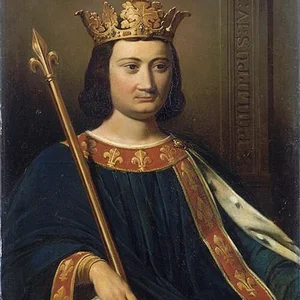

King of France from 1285 to 1314, Philip the Fair considerably strengthened the royal Capetian power against the papacy and the great feudal lords. His reign is marked by the trial of the Knights Templar and the convening of the first Estates General.
Philip the Fair
Philip the Fair
6 min read
Frequently asked questions
Key Facts
- Becomes King of France in 1285 upon the death of his father Philip III the Bold
- Major conflict with Pope Boniface VIII, culminating in the Outrage of Anagni in 1303
- Convenes the first Estates General in 1302 to support his policy against the papacy
- Orders the arrest of the Knights Templar on 13 October 1307; the order is dissolved in 1312 and Jacques de Molay burned at the stake in 1314
- Dies in 1314, leaving behind a kingdom with a strongly centralized royal power
Works & Achievements
Summoning of the three orders (clergy, nobility, towns) to support the king against the pope: the first great representative assembly of the kingdom.
Development of the legists, the Parlement of Paris and the Chamber of Accounts, professionalizing the government and asserting the monarchical state.
Conflict with Boniface VIII over the taxation of the clergy and sovereignty, leading to the Outrage of Anagni and the assertion of the independence of royal power.
Arrest of the Templars, a sensational trial and the suppression of the order, allowing the confiscation of its assets for the benefit of the Crown.
Debasement of the currency, new taxes and confiscations (Jews, Lombards) to finance wars and administration, at the cost of great unpopularity.
Major works in Paris, including the great hall of the Palace, asserting royal majesty at the heart of the capital.
Anecdotes
Nicknamed "the Fair" for his great physical beauty, Philip IV was known for his impassive face and his almost constant silence. Bishop Bernard Saisset reportedly said of him: "He is neither a man nor a beast, he is a statue." This coldness impressed and unsettled his contemporaries.
In 1307, on Friday, October 13th, Philip the Fair had all the Templars of France arrested throughout the kingdom, at dawn and simultaneously. This formidably efficient secret operation aimed to seize the riches of the order, to which the king owed a great deal of money. The legend of unlucky "Friday the 13th" is said to come from this episode.
To finance his wars and his administration, Philip the Fair did not hesitate to manipulate the value of the currency, which earned him the scornful nickname of "the counterfeiter king." He also expelled the Jews from the kingdom in 1306 and arrested the Lombard bankers to confiscate their property.
In 1314, the king's daughters or daughters-in-law were at the heart of the Tour de Nesle scandal: Philip the Fair's daughters-in-law were accused of adultery. The lovers were executed and the princesses imprisoned, a tragedy that weakened the Capetian succession.
According to tradition, the Grand Master of the Templars Jacques de Molay, burned at the stake in March 1314, is said to have cursed the king and the pope from atop his pyre, summoning them before the tribunal of God. Philip the Fair died a few months later, in November 1314, which fed the legend of the "accursed kings."
Primary Sources
We declare, state, define and pronounce that it is absolutely necessary for the salvation of every human creature to be subject to the Roman Pontiff.
All the Templars of the kingdom of France were arrested on a single day, by order of the king, and their possessions seized for the benefit of the royal treasury.
The king summons the prelates, the barons and the good towns of the kingdom in order to deliberate on the affairs touching the honor of the king and of the kingdom in the face of the pope's claims.
Key Places
Royal residence on the Île de la Cité, greatly expanded by Philip the Fair, who had large halls built there. The center of the kingdom's power and administration.
The traditional site for the coronation of the kings of France, where Philip the Fair was crowned in 1286. The coronation made the king the Lord's anointed.
A town in Lazio where Philip the Fair's men, led by William of Nogaret, attacked and humiliated Pope Boniface VIII in 1303.
Royal residence where Philip the Fair was born and where he died in November 1314, following a hunting accident according to tradition.
A small island in the Seine near the Palais de la Cité where Jacques de Molay and Geoffroy de Charnay were burned alive in March 1314.
A Flemish town near which the army of French knights was crushed in 1302 by the communal militias at the Battle of the Golden Spurs.
Typical Objects

Closed crown worn by the king of France, a symbol of the sovereignty received at the coronation in Reims. It embodied the monarch's divine-right power.

Wax matrix used to authenticate the acts and ordinances issued by the royal chancellery. It depicted the king in majesty, enthroned with sceptre and crown.

Silver coin struck by the royal mint, whose metal content Philip the Fair altered to replenish the treasury. These manipulations earned him the nickname of the counterfeiter king.

Blue royal mantle scattered with golden fleurs-de-lis, worn during great ceremonies. The fleur-de-lis was the emblem of the Capetian dynasty.

Royal insignia held during the coronation: the sceptre represents command, the hand of justice the king's judicial power. They accompanied the sovereign during official ceremonies.

Document written on parchment recording the deliberations and the support of the three orders for the king, notably against the pope. It bears witness to the birth of a representation of the kingdom.
School Curriculum
Vocabulary & Tags
Key Vocabulary
Daily Life
Morning
The king would rise in his apartments at the Palais de la Cité and attend Mass, for the Capetian sovereign was deeply pious. He would then meet with his legal scholars and counselors such as Guillaume de Nogaret to examine the affairs of the kingdom.
Afternoon
The afternoon was devoted to governing: audiences, the reading of documents to be sealed, judicial decisions, and the reception of ambassadors. The king might also hunt, one of his favorite pastimes, in the royal forests.
Evening
In the evening the court gathered for the meal and sometimes for entertainments, music, or storytelling. The king, known to be taciturn, would withdraw early and devote time to prayer and rest.
Food
The royal table offered meats and game (deer, boar, poultry), fish on fast days, white bread, and wine. Costly spices, a mark of wealth, seasoned the lavish dishes served at the banquets of the court.
Clothing
The king wore precious fabrics, tunics and cloaks of silk or velvet, often blue and strewn with golden fleurs-de-lis. Jewels, furs, and ornate belts displayed his rank during ceremonies.
Housing
Philip the Fair resided in royal palaces and castles such as the Palais de la Cité in Paris and Fontainebleau. These vast stone dwellings housed the court, the administration, and the king's household.
Historical Timeline
Period Vocabulary
Liens externes & ressources
Références
Œuvres
Réunion des premiers États généraux
1302
Renforcement de l'administration royale
vers 1285-1314
Affrontement avec la papauté
1296-1303
Procès et dissolution de l'ordre du Temple
1307-1312
Politique monétaire et fiscale
vers 1290-1314
Agrandissement du Palais de la Cité
vers 1300-1314