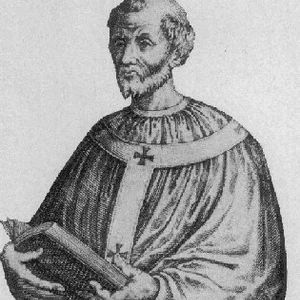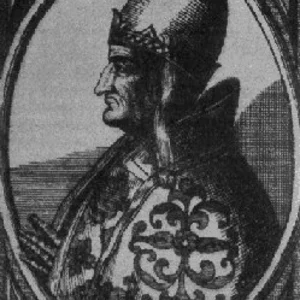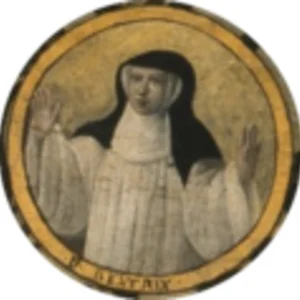

Archbishop of Reims from 969 to 989, Adalberon was a major political figure of the late 10th century. Advised by Gerbert of Aurillac, he played a decisive role in the accession of Hugh Capet to the throne in 987, bringing the Carolingian dynasty to an end.
Adalberon of Reims
Adalberon of Reims
6 min read
Frequently asked questions
Key Facts
- Becomes Archbishop of Reims in 969
- Relies on the scholar Gerbert of Aurillac to renovate the episcopal school of Reims
- Supports and secures the election of Hugh Capet as King of the Franks in 987, sidelining Charles of Lorraine
- Performs the coronation of Hugh Capet, founding the Capetian dynasty
- Dies in 989
Works & Achievements
By entrusting teaching to Gerbert of Aurillac, Adalberon made Reims a major center of learning where the liberal arts were reborn.
He undertook major works to embellish and refurbish the cathedral building.
The founding act by which Adalberon gave birth to the Capetian dynasty by crowning Hugh at Noyon.
A plea in favor of an elective kingship based on merit, reported by the historian Richer, which justified the change of dynasty.
Support for monastic discipline and regular life in the abbeys under the authority of the Church of Reims.
A skilled mediator, he maintained close ties with the Germanic Empire, at the risk of clashing with the Carolingian kings.
Anecdotes
After becoming Archbishop of Reims in 969, Adalberon surrounded himself with the greatest scholar of his time, Gerbert of Aurillac, whom he placed at the head of the episcopal school. Reims then became one of the great intellectual centers of the West, where astronomy, mathematics, and logic were taught.
The Carolingian king Lothair violently reproached Adalberon for his closeness to the Ottonian emperors of Germany. In 985, the archbishop was even summoned to answer a charge of treason, but the king's death in 986 caused the proceedings to be dropped.
In 987, when the young Louis V died without an heir, Adalberon delivered a decisive speech before the great lords of the kingdom, asserting that kingship was not transmitted by blood alone but should pass to the most worthy. He thus had Hugh Capet elected.
It was Adalberon himself who crowned Hugh Capet at Noyon in 987, placing the crown upon the head of the founder of a dynasty that would reign over France for more than eight centuries.
At his death in 989, Adalberon wished for his disciple Gerbert of Aurillac to succeed him on the see of Reims. But the new king Hugh Capet first preferred Arnulf, a Carolingian bastard, which triggered a long ecclesiastical quarrel.
Primary Sources
Adalbero, recalling that royal dignity is not acquired by hereditary right, urged the magnates to choose a king commendable for the nobility of his body and mind, and designated Hugh, Duke of the Franks.
Gerbert, writing on behalf of Archbishop Adalbero, attests to the trust the latter placed in him for conducting the affairs of the Church of Reims and to his role as a counselor.
The assembled bishops evoked the memory of Adalbero and the question of his succession to the archiepiscopal see of Reims, a matter of discord between Gerbert and Arnulf.
Key Places
Seat of Adalberon's authority for twenty years and heart of the famous episcopal school. Traditional site of the coronation of the kings of France.
Town where Adalberon crowned Hugh Capet king of the Franks in 987, ushering in the Capetian dynasty.
Site of the assembly of the kingdom's nobles where, through Adalberon's intervention, Hugh Capet was elected king in 987.
Capital of the last Carolingians, a strategic stronghold at the heart of the struggles between Lothair, Charles of Lorraine, and the Capetians supported by Adalberon.
Site of the council of 991, shortly after Adalberon's death, which settled the dispute over his succession in favor of Gerbert of Aurillac.
Typical Objects

A curved pastoral staff, the insignia of Adalberon's authority over the diocese of Reims. It symbolized his role as a shepherd watching over the faithful.

A band of white wool worn over the shoulders, granted by the pope, marking the dignity of metropolitan archbishop. It made Reims one of the most prestigious Churches in the kingdom.

A vial kept at Reims containing the oil of the coronation, said to have been used at the baptism of Clovis. The coronation of kings at Reims relied on this venerated relic.

A book copied by hand in the scriptorium of Reims, sometimes adorned with illuminations. Adalberon's episcopal school produced them for study and liturgy.

A calculating board perfected by Gerbert of Aurillac at the school of Reims, using counters to make operations easier. It bears witness to the scientific revival encouraged by Adalberon.

A wax matrix used to authenticate the acts and charters of the archbishop. It committed Adalberon's authority in both religious and political affairs.
School Curriculum
Vocabulary & Tags
Key Vocabulary
Tags
Daily Life
Morning
Adalbero began his day before dawn with the liturgical offices, notably matins and lauds, in the cathedral. These were followed by Mass and prayer, the heart of an archbishop's life.
Afternoon
The afternoon was devoted to the administration of the diocese: audiences, the drafting of charters, the settling of disputes, and the management of the Church's properties. He also visited the episcopal school and conferred with Gerbert.
Evening
In the evening, after vespers and compline, he sometimes received messengers or royal and imperial envoys. The end of the day blended reading, political correspondence, and prayer.
Food
The diet of a high prelate was based on bread, wine, fish, and vegetables, with days of fasting and abstinence imposed by the rule of the Church. Banquets for distinguished guests could be more lavish, featuring meats and game.
Clothing
He wore liturgical vestments (alb, chasuble, mitre) during ceremonies, along with the pallium that marked his dignity as archbishop. Outside of worship, he wore plain but high-quality ecclesiastical garments.
Housing
Adalbero resided in the archiepiscopal palace adjoining the cathedral of Reims. It was a spacious dwelling housing his apartments, his chapel, his administration, and the episcopal school.
Historical Timeline
Period Vocabulary
Liens externes & ressources
Références
Œuvres
Rénovation de l'école épiscopale de Reims
vers 972
Restauration de la cathédrale de Reims
vers 969-989
Sacre d'Hugues Capet
987
Discours de l'élection de Senlis
987
Réforme des monastères du diocèse
vers 970-989
Direction de la diplomatie franco-ottonienne
vers 978-987