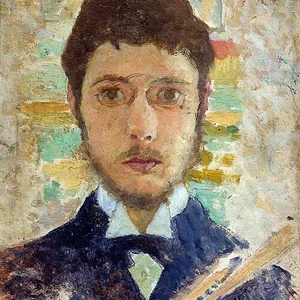

French Post-Impressionist painter and co-founder of the Nabis group. Celebrated for his intimate scenes in vibrant colors — interiors, nudes, gardens — Bonnard reinvented French painting in the first half of the 20th century.
Pierre Bonnard(1867 — 1947)
Pierre Bonnard
France
8 min read
Frequently asked questions
Famous Quotes
« Color is very difficult to find. You have to discover it.»
« I am searching for something difficult: depth without heaviness.»
Key Facts
- 1867: born in Fontenay-aux-Roses
- 1889: co-founds the Nabis group with Denis, Vuillard, and Sérusier
- 1891: first lithographic posters attract attention (*France-Champagne*)
- 1912–1939: regular stays in the South of France; sets up his studio in Le Cannet (1926)
- 1947: dies in Le Cannet, days after retouching one last painting
Works & Achievements
One of Bonnard's first major works, marked by the influence of Japanese prints in its asymmetrical framing and decorative flat areas of color. It asserts the nascent Nabi style.
A reclining nude of Marthe, rendered with gentle sensuality and a warm color palette. This canvas illustrates the intimate and tender gaze Bonnard casts on the female body.
A masterpiece of his mature period, this painting shows a set table before a window open onto a brilliant garden. It distills Bonnard's ability to make interior and exterior vibrate together in a single golden light.
One of the most celebrated depictions of Marthe in her bath, where the body is almost dissolved in the colored reflections of the water. A pinnacle of his chromatic exploration and intimate vision.
A bird's-eye view of the Mediterranean garden at his villa, bathed in warm, golden light. This canvas is emblematic of his Provençal years, bursting with pure, explosive color.
Bonnard's last major canvas, completed shortly before his death. An almond tree in full bloom against an intense blue sky — a final hymn to life and Mediterranean color.
Anecdotes
In 1889, Pierre Bonnard and his friends Paul Sérusier, Maurice Denis, and Édouard Vuillard founded the Nabis group — a Hebrew word meaning "prophets." Fascinated by Gauguin's lesson as conveyed by Sérusier on a cigar-box lid (known as the "Talisman
)
they set out to revolutionize painting by abandoning the illusion of volume in favor of pure color.
In 1893, Pierre Bonnard met Maria Boursin, a young woman who called herself Marthe de Méligny. She became his primary model for fifty years. Extremely modest and solitary, Marthe spent her days bathing: Bonnard painted her hundreds of times in the tub, transforming this daily ritual into an endless exploration of light and color.
Unlike his contemporaries, Bonnard never painted in front of his model. He sketched scenes in small notebooks he carried everywhere, then recreated his impressions from memory in the studio. He believed that memory retains what is essential where the eye records too much, and sought, as he put it
something truer than the truth.
In the 1920s, Bonnard had an affair with Renée Monchaty, a young painter who admired his work. When he finally married Marthe in 1925, a devastated Renée took her own life. This tragedy weighed on the final decades of his life, and her features can sometimes be recognized in certain female portraits from this period.
Having taken refuge in Le Cannet, in the hills above Cannes, during the Second World War, Bonnard continued to paint until he was 79. On his deathbed in January 1947, he asked his nephew Charles Terrasse to correct the grass in a painting that seemed to him too yellow — a final testament to his lifelong pursuit of the right color.
Primary Sources
“We are both seeking the same thing by different paths. What brings us together is that neither you nor I want to remain in the imitation of reality.”
“Nabi painting was a painting of formula. We had discovered something, and we followed that discovery. Afterwards, each of us had to find his own path, to return to nature, to sensation.”
“I work a great deal and am beginning to glimpse what painting might be as I conceive it — something fervent and luminous at the same time.”
“I have often wondered whether I had the right to call my canvases paintings. They are attempts to recapture an emotion I once felt, which is already distant by the time I begin to paint.”
Key Places
Bonnard's birthplace in 1867, then a leafy suburb of Paris surrounded by rose gardens. It was in this bourgeois, garden-rich setting that he developed his lasting taste for domestic intimacy.
It was in Paris, at the Académie Julian and the École des Beaux-Arts, that Bonnard helped found the Nabis group and launched his career. Montmartre was the heart of his artistic and bohemian life throughout the 1890s and 1900s.
The Bonnard family estate in the Dauphiné region. Pierre spent many summers there, painting the gardens and rural scenes that would become an enduring hallmark of his work.
In 1912, Bonnard acquired a small house called La Roulotte near Vernon. He cultivated a lush garden there, drawing from it countless canvases of exuberant colour bathed in the soft light of Normandy.
From 1927, Bonnard settled permanently in this villa in the hills above Cannes. The Mediterranean light transformed his palette; he lived and painted here until his death on 23 January 1947.
Typical Objects

Bonnard's palette, laden with pure colors often used unmixed, reflects his deeply physical relationship with pictorial matter. He favored warm tones — oranges, ochres, mauves — arranged with care before each working session.

Bonnard never went anywhere without his small notebooks, in which he jotted down scenes from everyday life — meals, gardens, silhouettes, light. These memory sketches served as raw material for composing his canvases in the studio.

The bathtub is one of the most recurring motifs in Bonnard's work: he painted Marthe in it dozens of times, transforming a daily hygiene ritual into a meditation on light, flesh, and the color of water.

Like the Impressionists before him, Bonnard was deeply influenced by the prints of Hokusai and Hiroshige. Their bold cropping, flat areas of color, and eye for decorative detail permeate his painting from the 1890s onward.

The dining table — white tablecloth, colorful crockery, fruit and glasses — is a central subject for Bonnard. He sees in it a microcosm of color and light, a space of domestic happiness transfigured through paint.

The mirror, a frequent presence in his interiors, allows Bonnard to multiply viewpoints and introduce an ambiguity between reality and its reflection. It becomes a pictorial device in its own right, revealing what the direct eye cannot see.
School Curriculum
Vocabulary & Tags
Key Vocabulary
Daily Life
Morning
Bonnard rose early and devoted his mornings to observation. Sketchbook in hand, he would wander through gardens and interiors, capturing fleeting impressions — light falling on a tablecloth, Marthe's silhouette, a bunch of flowers. He ate a simple breakfast before heading to the studio.
Afternoon
Afternoons were reserved for painting, often from memory based on his morning sketches. Bonnard worked on several canvases at once, returning to each of them months or even years later. He pinned his unstretched canvases directly to the wall and reworked them endlessly, searching for the right color.
Evening
In the evenings, Bonnard liked to dine with family or close friends — Matisse and Vuillard in particular. A laid table and a shared meal were for him a daily source of happiness that he regularly transposed onto canvas. He read little, but observed a great deal.
Food
Bonnard led a simple life at the table: fruit, vegetables from the garden, unpretentious home cooking. In Le Cannet, the Mediterranean cuisine — olives, tomatoes, fish — enriched his daily routine. Fruit arranged on a table served him as much as food as it did as a model for his still lifes.
Clothing
Bonnard dressed quietly, like a discreet bourgeois: a well-cut jacket and trousers, often a corduroy jacket in the studio. He made no effort to project the image of the bohemian artist and preferred to blend into the background during his observational walks.
Housing
Bonnard lived in simple but light-filled houses, chosen for their gardens and sunny aspect. In Le Cannet, his villa Le Bosquet looked out over a panorama of hills and sea. The interior was warm and modestly furnished, with canvases pinned all over the studio walls.
Historical Timeline
Period Vocabulary
Liens externes & ressources
Références
Œuvres
La Partie de croquet
1892
L'Indolente
1899
Nu dans la baignoire
1936-1938
Le Jardin du Cannet
1937
L'Amandier en fleur
1946-1947