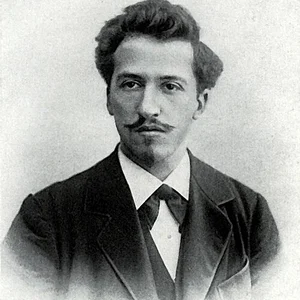

Piet Mondrian was a Dutch painter and a major figure of 20th-century abstract art. He founded the Neoplasticism movement and the De Stijl group, reducing painting to straight lines and primary colors.
Piet Mondrian(1872 — 1944)
Piet Mondrian
Royaume des Pays-Bas
6 min read
Frequently asked questions
Key Facts
- Born in 1872 in Amersfoort, in the Netherlands
- Co-founds the De Stijl movement and the magazine of the same name in 1917
- Develops Neoplasticism from the 1920s onward, based on black lines and primary colors
- Paints famous works such as the series of Compositions in Red, Yellow and Blue
- Dies in 1944 in New York, where he paints Broadway Boogie-Woogie (1942-1943)
Works & Achievements
Depiction of a windmill in bright colours, a witness to his still-figurative period yet already marked by a simplification of forms.
A series of paintings in which a tree is gradually broken down into curved and then geometric lines, illustrating Mondrian's move towards abstraction.
An emblematic work of Neoplasticism, with its grid of black lines and its flat areas of primary colours. It set Mondrian's visual language for the decades that followed.
One of the artist's most famous paintings, which has become a true icon of 20th-century geometric abstract art.
A New York canvas in which the black lines give way to strings of small coloured squares. It conveys the rhythm of jazz and the luminous energy of Manhattan.
His final work, left unfinished at his death. Composed on a diamond-shaped canvas, it expresses the hope of an Allied victory during the Second World War.
Anecdotes
Before becoming the master of abstraction, Mondrian spent a long time painting realistic landscapes of the Netherlands: windmills, trees and fields. You can follow his evolution through his series of trees, in which a simple apple tree gradually transforms into a network of almost abstract lines.
Mondrian loved jazz and modern dance, especially the boogie-woogie he discovered in New York. This rhythmic music directly inspired his final canvases, such as *Broadway Boogie-Woogie*, where the small colored squares evoke the flashing lights and energy of the city.
The painter was so devoted to his ideal of straight lines that he is said to have left the De Stijl group when his friend Theo van Doesburg began using diagonal lines. For Mondrian, only verticals and horizontals expressed universal balance.
His studio was a true work of art: he painted the walls white and pinned to them rectangles of red, yellow and blue cardboard that he rearranged regularly. Visitors said they were literally stepping into one of his paintings.
Mondrian first signed his works “Mondriaan,” with two “a”s, the Dutch spelling of his surname. He dropped one “a” around 1911–1912, in Paris, to give his name a more modern and international form.
Primary Sources
The life of today's cultured person is gradually turning away from the natural: it is becoming more and more an abstract life.
The new plastic art expresses pure relationships by means of the straight line and the pure rectangular plane, in the primary colors.
Equilibrium through the equivalence of opposites can only be attained through the pure relationship of position and not through symmetry.
I felt that only abstract art could achieve an expression of a truer reality.
Key Places
Mondrian's birthplace, where he was born in 1872 into a strict Protestant family. His father, a schoolteacher, passed on to him his first notions of drawing.
Mondrian studied at the Academy of Fine Arts here from 1892. It was here that he painted his first realistic landscapes of the Dutch polders.
It was in Paris, beginning in 1911, that Mondrian discovered Cubism and moved his painting toward abstraction. He lived and worked there for more than twenty years.
Fleeing the threat of war, Mondrian settled in London in 1938. The bombings of the Blitz drove him to leave again two years later.
Mondrian spent his final years in New York from 1940, fascinated by the rhythm of the city and by jazz. He died there in 1944 and created his most vibrant works in the city.
Typical Objects

The stretched support on which Mondrian painted his compositions. He often favored square formats to reinforce the balance of his grids.

Mondrian used only the three primary colors (red, yellow, blue) plus black, white, and gray. This reduced palette was at the heart of his theory.

To draw his perfectly straight lines, Mondrian relied on measuring tools and strips of tape. Geometric rigor was essential to his Neoplasticism.

Rectangles of red, yellow, and blue cardboard that he pinned to the white walls of his studio. He moved them around constantly, composing his living space like a painting.

Mondrian was passionate about music and dance; he owned jazz and boogie-woogie records. These rhythms fed into his final New York works.

A publication founded in 1917 that spread the movement's ideas and Mondrian's theoretical writings. It introduced Neoplasticism throughout Europe.
School Curriculum
Vocabulary & Tags
Key Vocabulary
Daily Life
Morning
Mondrian would wake up in a meticulously clean studio, with white walls adorned with colored rectangles. Methodical, he often began his day with long reflections on the balance of his compositions before touching a brush.
Afternoon
The afternoon was devoted to painting, a slow and patient labor. He could spend hours adjusting the position of a line or the size of a rectangle to achieve the perfect harmony he was seeking.
Evening
In the evening, Mondrian loved to go out dancing, being passionate about jazz and boogie-woogie. In Paris as in New York, he frequented cafés and dance halls, and listened to a great deal of music on his phonograph.
Food
Often living modestly, especially in his youth, Mondrian had a simple diet. In Paris, he frequently took his meals in small, inexpensive restaurants in the Montparnasse district.
Clothing
Always neat, Mondrian wore proper, well-fitted suits, reflecting the rigor of his art. He tended to his appearance with the same discipline he applied to his paintings.
Housing
He lived in modest studios that he transformed into true Neoplastic environments, painting the walls white and arranging panels of primary colors throughout. His home was at once his living space and an extension of his work.
Historical Timeline
Period Vocabulary
Liens externes & ressources
Références
Œuvres
Le Moulin rouge (Molen Mill)
1911
Composition en rouge, jaune, bleu et noir
1921
Broadway Boogie-Woogie
1943
Victory Boogie-Woogie
1944