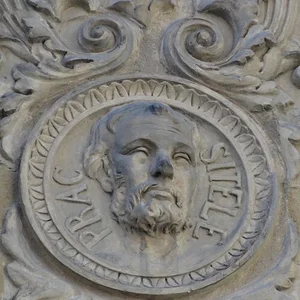

Praxiteles is one of the greatest sculptors of ancient Greece, active in Athens in the 4th century BC. He is famous for introducing grace, sensuality, and naturalness into statuary, notably with his Aphrodite of Knidos, the first major female nude in Greek art.
Praxiteles(394 av. J.-C. — 329 av. J.-C.)
Praxiteles
Athènes
6 min read
Frequently asked questions
Key Facts
- Active in the 4th century BC (c. 400-326 BC), mainly in Athens
- Created the Aphrodite of Knidos (c. 360-350 BC), the first major life-size female nude in Greek sculpture
- Made the Hermes carrying the infant Dionysus, kept in the Museum of Olympia and long considered an original
- Favored marble and invented a supple, hip-shifted pose known as the “Praxitelean curve”
- Known for his relationship with the courtesan Phryne, who is said to have been his model
Works & Achievements
The first great female nude in Greek art, depicting the goddess bathing. The most famous work of Antiquity, known through numerous Roman copies.
A marble statue discovered at Olympia in 1877, perhaps an original, showcasing the grace and polish characteristic of the sculptor.
Depicts a youthful Apollo about to spear a lizard, an image of languid youth typical of the Praxitelean style. Known through copies.
A figure of a young satyr leaning nonchalantly, one of the most copied works of Antiquity, embodying the softness of form found in Praxiteles.
A statue of the god of love given to Phryne and dedicated at Thespiae, where it was the object of a famous cult. Now lost.
A divine ensemble made for Mantinea, whose base carved with Muses and the contest of Marsyas has been partially recovered.
A type of half-draped Venus attributed to the workshop of Praxiteles, known through a famous copy held at the Louvre.
Anecdotes
Praxiteles is said to have sculpted his Aphrodite of Cnidus using the famous courtesan Phryne, with whom he was in love, as his model. The statue, the first great female nude in Greek art, caused a scandal but then became so admired that the people of Cnidus refused to sell it to King Nicomedes of Bithynia, even in exchange for the cancellation of their entire public debt.
According to an anecdote handed down by the ancients, Praxiteles had promised Phryne that he would give her his most beautiful work, but refused to tell her which one he preferred. Phryne then had a slave announce that the workshop was on fire; the panic-stricken sculptor cried out that he was ruined if the flames had reached his Satyr and his Eros, thus revealing his two masterpieces.
It is said that the people of Cnidus built a small temple open on all sides so that Praxiteles' Aphrodite could be admired from every angle. The statue drew so many visitors from all over Greece that it made the city famous and wealthy.
Not a single original marble sculpture by Praxiteles has come down to us with certainty: we know his works only through Roman copies. The Hermes Carrying the Infant Dionysus, discovered at Olympia in 1877, is sometimes considered an original, but specialists still debate this today.
Praxiteles was renowned for preferring to work in marble rather than bronze, and for the delicacy of his finishing touches. Pliny the Elder reports that the sculptor himself claimed to prefer those of his statues that the painter Nicias had heightened with colour, showing that Greek statues were painted.
Primary Sources
Praxiteles surpassed even himself in marble, and so became more famous still. His are the most admired works in Athens... but above all the statues, not only of Praxiteles but in the whole world, stands his Venus, which many have sailed to Cnidus to behold.
Later, other offerings were dedicated in the temple: a marble Hermes carrying the infant Dionysus, a work of Praxiteles.
From Cnidus he will take the Venus entire... that very statue which the Cnidians refused to surrender to King Nicomedes, even though he offered to discharge the city's entire debt.
Praxiteles, who loved her, sculpted his Eros and made her a gift of it; and she dedicated it at Thespiae, her homeland. Phryne also served as the model for the Aphrodite of Cnidus.
Key Places
Birthplace and main center of activity for Praxiteles, the artistic and intellectual capital of Greece in the 4th century BC. It was here that he kept his sculptor's workshop.
A Greek city in Asia Minor (present-day Turkey) that housed Praxiteles's Aphrodite in a temple open on all sides. The statue drew visitors from all over Greece.
A city in Boeotia, the homeland of Phryne, where the Eros of Praxiteles—which he had given to the courtesan—was consecrated. The cult of Eros was especially renowned there.
A great sanctuary of Zeus in the Peloponnese where Pausanias saw the Hermes carrying the infant Dionysus attributed to Praxiteles. The statue was rediscovered there during excavations in 1877.
A city in Arcadia for which Praxiteles created a group depicting Leto, Apollo, and Artemis, as well as a pedestal adorned with reliefs representing the Muses and Marsyas.
Typical Objects

An iron tool with a flat or toothed blade struck with a mallet to rough out and carve marble. A fundamental instrument of the Greek sculptor working in stone.

A hand drill driven by a bow, used to pierce marble and hollow out details such as locks of hair or deep folds. Praxiteles used it for his delicate effects of texture.

A wooden or bronze hammer used to strike the chisel and bite into the marble. The chisel's indispensable companion in the workshop.

Praxiteles's favored raw material, often the white marble of Paros, prized for its translucency and fine grain. It allowed for unique effects of flesh and softness.

Iron files and pumice stones used to polish the marble surface to a smooth, silky finish. It was this polish that gave the skin of Praxiteles's statues their lifelike appearance.

Mineral colors applied with hot wax to enhance marble statues (lips, eyes, hair, drapery). The painter Nicias colored the works of Praxiteles.
School Curriculum
Vocabulary & Tags
Key Vocabulary
Daily Life
Morning
The sculptor reached his workshop (*ergasterion*) early in the day, often set up near the *agora* or the Kerameikos district. He inspected the blocks of marble delivered from Paros or Mount Pentelicus and directed his apprentices in the rough-hewing work by daylight.
Afternoon
The afternoon was devoted to fine work: carving details with the drill, modelling the flesh, polishing with pumice. **Praxiteles** also received his patrons — cities or sanctuaries — who came to discuss statues of the gods.
Evening
When evening came, the artist might take part in a banquet (*symposion*) where poets, philosophers and courtesans such as **Phryne** mingled. There they drank wine mixed with water while discussing art and beauty.
Food
His diet rested on the Mediterranean triad: barley or wheat bread, olive oil and wine. To this were added vegetables, cheese, olives, fish and, more rarely, meat during sacrifices and festivals.
Clothing
**Praxiteles** wore a tunic (*chiton*) of linen or wool, sometimes covered by a cloak (*himation*) draped over the shoulder. In the workshop, simple clothing and an apron protected him from the marble dust.
Housing
He lived in a Greek house of mudbrick and stone organised around an inner courtyard. The workshop, spacious and well lit, adjoined the dwelling and housed tools, blocks and statues in progress.
Historical Timeline
Period Vocabulary
Liens externes & ressources
Références
Œuvres
Aphrodite de Cnide
vers 350 av. J.-C.
Hermès portant Dionysos enfant
vers 340 av. J.-C.
Apollon Sauroctone (tueur de lézard)
vers 350 av. J.-C.
Satyre au repos (Satyre verseur / anapauomenos)
vers 350 av. J.-C.
Éros de Thespies
IVe siècle av. J.-C.
Groupe de Léto, Apollon et Artémis (Mantinée)
IVe siècle av. J.-C.
Aphrodite d'Arles (Vénus du type)
IVe siècle av. J.-C.