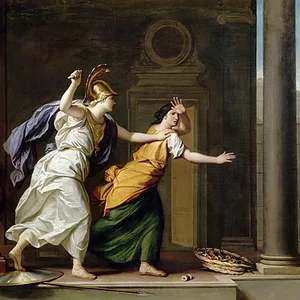

A mortal weaver from Lydia in Greek mythology, Arachne challenged the goddess Athena to a weaving contest. Defeated or shamed, she was transformed into a spider — giving arachnids their name.
Frequently asked questions
Key Facts
- Arachne was a mortal from Lydia renowned for her exceptional weaving talent
- She dared to challenge Athena (Minerva to the Romans), goddess of arts and crafts
- Ovid tells of her transformation into a spider in the *Metamorphoses* (Book VI)
- Her name is the origin of the scientific term 'arachnids', the class that includes spiders
- Her tapestry depicted the love affairs of the gods, which deepened her offense against Athena
Works & Achievements
Arachne's masterpiece depicting the amorous metamorphoses of the gods — Zeus as a bull abducting Europa, as a swan seducing Leda, as a shower of gold for Danaë. Technically flawless according to Ovid, this tapestry was destroyed by Athena for its blasphemous content.
Transformed into a spider, Arachne spins endlessly a perfect geometric web. This perpetual work embodies both divine punishment and the paradoxical immortality of genius — condemned to create forever, yet in darkness and obscurity.
Ovid's poem is the source that immortalized Arachne in Western culture. The 145 verses devoted to the character constitute the most complete and most influential version of the myth, transmitted throughout European literature.
A painting by Spanish Baroque master Diego Velázquez, widely interpreted as a staging of the myth of Arachne: in the foreground, spinners at work; in the background, a scene with Athena illustrating the divine confrontation.
Anecdotes
Arachne was so renowned for her talent that nymphs abandoned their rivers and forests to watch her fingers work the thread. Yet when asked whether Athena had taught her this art, she replied with contempt that she had never had a teacher — not even a goddess.
Athena, enraged by this pride, disguised herself as an old woman and visited Arachne to counsel humility. Arachne dismissed her without ceremony. The goddess then revealed her true identity, and the contest began: the two rivals wove side by side, before a crowd of astonished mortals and nymphs.
Athena wove a tapestry depicting the Olympian gods in their glory and mortals punished for their arrogance. Arachne, for her part, depicted Zeus's amorous scandals — as a bull, a swan, a shower of gold — openly humiliating the master of Olympus. Arachne's tapestry was technically flawless: neither the goddess nor Envy herself could find a single fault in it.
Unable to accept being equaled, Athena tore Arachne's cloth and struck her with her shuttle. Arachne, overwhelmed with shame, hanged herself. Seized by belated pity, Athena transformed her into a spider so that she could weave forever — punishment and mercy fused into a single divine act.
Arachne's name has traveled through the centuries into modern science: in 1801, the naturalist Lamarck named spiders, scorpions, and mites Arachnida, in direct reference to the Lydian weaver. This is one of the rare cases in which a purely mythological figure lent its name to an entire class of the animal kingdom.
Primary Sources
Arachne was famous not for the place of her birth nor for her lineage, but for her skill alone. […] She rejected this honor, indignant at having a mistress, even a goddess. Let Pallas come, she said; if she defeats me, I will suffer any punishment.
The spider, enemy of Minerva, hangs her light webs at the threshold and weaves her fragile web.
O Arachne, I saw you already half spider, wretched upon the remnants of the work you had woven to your own ruin.
Arachne, a Lydian woman, a weaver of great renown, who challenged Athena and was turned into a spider; from her name come the arachnids.
Key Places
City in Lydia identified by ancient sources as Arachne's hometown. The region was renowned in antiquity for the quality of its textile workshops and the beauty of its dyed fabrics.
Home of the Greek gods and dwelling place of Athena. It is from this summit that the goddess, angered by Arachne's fame, decides to descend among mortals to put an end to the weaver's presumption.
A central site of the cult of Athena as goddess of weaving, where the *peplos* offered to the goddess during the Panathenaic festival was displayed. This temple embodies the divine authority over weaving that Arachne claimed for herself.
A river valley in Asia Minor where Arachne's workshop was said to be located, according to ancient tradition. This fertile plain was known for its flocks of sheep whose wool supplied the region's textile workshops.
Typical Objects

The central tool of the myth, the Greek vertical loom allowed large pieces of cloth to be woven standing up. It is before this instrument that Arachne and Athena face each other, each revealing her technical mastery.

A thread-guiding piece of wood that passes between the warp threads to form the weft. It was with her own shuttle that Athena struck Arachne on the forehead, triggering the shame that led the weaver to hang herself.

Instruments for spinning raw wool into continuous thread, the necessary step before weaving. According to Ovid, even this preparatory gesture was so graceful in Arachne's hands that it drew the admiring gaze of the nymphs.

Arachne worked threads in graduated shades that legend compares to a rainbow after rain: from deep violet to the first light of dawn. These colors were achieved using precious plant-based and marine dyes.

Transformed, Arachne now weaves a perfect geometric web that the wind can destroy in an instant. The spider's web is the continuation of her art in natural form — a punishment that is also a perpetuation.

Humiliated by the destruction of her masterpiece, Arachne hanged herself. This desperate act inspired belated pity in Athena: rather than let her die, the goddess transformed her into a spider so that her life might continue through her art.
School Curriculum
Vocabulary & Tags
Key Vocabulary
Daily Life
Morning
Arachne began her day by selecting and carding raw wool to prepare the fibers, then spinning them on a spindle to produce even threads. In ancient Lydia, the inner courtyard of the house served as the main workshop, bathed in the soft morning light that favored precise work.
Afternoon
The afternoon was devoted to weaving at the upright loom, where Arachne stood with arms raised to pass the shuttle between the warp threads. According to Ovid, her movements were so graceful that nymphs would leave their springs and forests to watch her in silence.
Evening
In the evening, by the light of oil lamps, Arachne finished the embroidered borders of her fabrics and selected the colors for the following day. It was the hour of shared stories, orders negotiated with Lydian merchants, and the communal life of the women of the household.
Food
In ancient Lydia, the daily diet was built around grains — barley flatbreads and wheat bread —, legumes, olives, and wine diluted with water. Mutton or goat meat was reserved for feast days and religious banquets; fish from the nearby Aegean Sea was more common.
Clothing
Arachne wore the Lydian *chiton*, a linen or fine wool tunic fastened at the shoulders with fibulae, and a *himation* (draped cloak) when going out. By a twist of fate, her own garments were most likely products of her own loom — the finest weavers wore their creations as a living showcase of their talent.
Housing
Lydian houses of the Archaic period were built of mud brick on stone foundations, arranged around an open central courtyard. The *gynaikeion* — the women's quarters — housed the upright loom positioned near the source of natural light, the economic and social heart of the household.
Historical Timeline
Period Vocabulary
Liens externes & ressources
Références
Œuvres
La tapisserie des amours des dieux (œuvre mythique)
Temps mythiques
La toile éternelle (après la métamorphose)
Temps mythiques (perpétuel)
Métamorphoses, Livre VI — Ovide
vers 8 apr. J.-C.