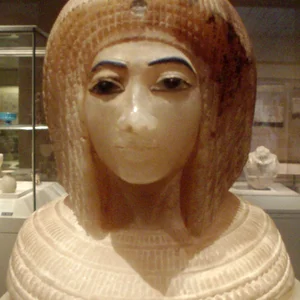

A secondary wife of Pharaoh Akhenaten, Kiya held a singular place at the court of Amarna in the 14th century BCE. Her identity and origins remain partly mysterious, though her name and likeness appear on several monuments from the Amarna period.
Kiya(1400 av. J.-C. — 1400 av. J.-C.)
Kiya
Égypte antique
8 min read
Frequently asked questions
Key Facts
- Kiya is attested as a secondary wife (
- Beloved
- ) of Pharaoh Akhenaten
- around 1345 BCE.
- Her name appears on canopic jars and reliefs discovered at Tell el-Amarna (ancient Akhetaten).
- Some Egyptologists have suggested she may have been of foreign origin, possibly Mitanni.
- Her representations were erased or reassigned to other royal figures after she disappeared from court.
- She may have been the mother of Tutankhamun, according to certain theories that remain debated.
Works & Achievements
A solar chapel built for Kiya at Amarna, known as the 'house of the shadow of the sun.' This exceptional privilege granted to a secondary wife testifies to her unique status at the court of the heretic pharaoh.
A series of carved limestone blocks depicting Kiya in ritual and domestic scenes alongside Akhenaten. Recovered at Hermopolis, these blocks form the primary iconographic corpus that allows her to be identified.
Certain reliefs in the royal tomb depict Kiya in a maternal role with a royal child. These funerary scenes are particularly significant for understanding her place in the Amarna succession.
A funerary set of four canopic jars intended for Kiya's burial, bearing her name and titles. Found reused in KV55, they are today among the rare material objects attesting to her existence.
Anecdotes
Kiya bore a title unique in all of ancient Egyptian history: “wrt hswt,” translated as “Great Beloved.” Never granted to a chief royal wife, this title suggests she enjoyed exceptional favor with Akhenaten, distinct from Nefertiti’s official status — a rank apart, neither principal wife nor mere concubine.
After Kiya’s disappearance, her name and likeness were systematically erased from the monuments of Amarna. Her representations were reassigned to the royal princesses, most notably Meritaten. This practice of memorial erasure — which historians call “damnatio memoriae” — was intended to deny any official existence to a figure who had fallen from favor.
Some Egyptologists have proposed that Kiya was in fact Tadukhipa, a Mitanni princess sent as a diplomatic bride to the Egyptian court by her father, King Tushratta. Her Egyptian name “Kiya” may be a phonetic adaptation of her foreign name, a common practice for foreign princesses integrated into the pharaonic court.
Canopic jars intended for Kiya’s burial were discovered in 1907 in the mysterious tomb KV55 in the Valley of the Kings — repurposed, with their cartouches partially erased. This reuse of her funerary equipment strikingly illustrates the deliberate erasure of her memory following the Amarna period.
Kiya had her own solar temple at Amarna, known as the “house of the shadow of the sun” (bit-shades). This privilege was normally reserved for the chief royal wife: that a secondary wife should possess a personal place of worship dedicated to Aten speaks volumes about the wholly singular place she occupied in the entourage of the heretic pharaoh.
Primary Sources
King Tushratta writes to Akhenaten to negotiate the sending of his daughter Tadukhipa and to demand the promised gold statues. These letters establish the matrimonial exchanges between the two courts and support the hypothesis of Kiya's Mitannian origin.
These blocks bear Kiya's name and depictions alongside her title 'wrt hswt' (Great Beloved). They document her special status at the Amarna court and the existence of her own solar sanctuary, found reused at Hermopolis.
Four canopic jars inscribed with Kiya's name were found in tomb KV55, their cartouches partially chiseled away. They attest to the reappropriation of her funerary equipment following her disappearance from the official record.
Certain reliefs in the royal tomb depict a royal wife accompanied by a child, identified as Kiya by her distinctive representational style. These funerary scenes suggest a maternal role of significance in the line of succession.
Key Places
The capital founded by Akhenaten in honor of Aten, this is where Kiya lived and was depicted on the walls of temples and palaces. Abandoned shortly after the pharaoh's death, its ruins are the principal archaeological site associated with Kiya.
A mysterious tomb where, in 1907, Kiya's repurposed funerary objects were discovered, including her canopic jars with deliberately defaced cartouches. This site is central to understanding how her memory was erased after the Amarna period.
A city neighboring Amarna where thousands of Amarna-period talatat blocks were reused as building material. It is here that blocks depicting Kiya and her solar temple were found, making her identification possible.
The ancient religious capital of Egypt, where Akhenaten first built temples to Aten before founding Amarna. Kiya most likely belonged to the royal court from those earliest years of his reign.
The presumed capital of the Mitanni kingdom, Kiya's hypothetical homeland if she is identified with the princess Tadukhipa. This kingdom maintained close diplomatic alliances with Egypt through royal marriages.
Typical Objects

Distinctive hairstyle featuring long curled locks worn by Kiya, visually setting her apart from Nefertiti and the royal princesses. This wig is one of the main criteria for identifying her depictions in Amarna reliefs.

Central symbol of the cult imposed by Akhenaten, depicted with rays ending in human hands holding the ankh. Kiya is consistently shown beneath the life-giving rays of Aten alongside the pharaoh.

Funerary vessels designed to hold embalmed organs, bearing Kiya's name and titles. Found repurposed in tomb KV55, their partially erased cartouches bear witness to the deliberate erasure of her memory.

Standardized limestone blocks (52 × 26 × 24 cm) bearing depictions of Kiya and her title *wrt hswt*. Found reused at Hermopolis, they constitute the main iconographic source on this figure.
Sacred percussion instrument associated with Egyptian religious ceremonies. As a royal wife, Kiya took part in rituals where the sistrum kept the rhythm of hymns sung in praise of Aten.
📷 CC0 · Wikimedia Commons ↗
Wide multi-row beaded collar, an emblematic jewel of the Amarna elite. Visible in depictions of Kiya, it symbolized her rank and wealth at Akhenaten's court.
School Curriculum
Vocabulary & Tags
Key Vocabulary
Tags
Daily Life
Morning
Kiya began her day at sunrise, a sacred moment dedicated to Aton. Servants helped her into her pleated white linen dress and adorned her with her faience usekh collar and gold bracelets. The early hours were devoted to prayers and ritual offerings in her personal chapel, facing the rising solar disk.
Afternoon
In the afternoon, Kiya attended receptions and audiences at the royal court, or withdrew to her apartments to oversee the education of the royal children. Craftsmen worked on the decoration of her bit-shades while she strolled through the gardens of the Grand Palace, cooled by canals fed from the Nile.
Evening
Evenings brought the royal family together for ritualized banquets enlivened by female musicians playing the sistrum and harp, and by dancers. Before nightfall, scribes read aloud hymns to Aton, including the famous Great Hymn attributed to Akhenaton himself, celebrating light as the sole source of all life.
Food
Kiya's diet was that of a great lady of the pharaonic court: beef and poultry, Nile fish, fresh vegetables (onions, leeks, lentils), and fruits (figs, dates, grapes). She drank fine beer and wines imported from the Delta or the Levant, served in alabaster or faience cups.
Clothing
Kiya wore robes of very fine white linen, sometimes pleated and near-translucent — the ultimate mark of refinement at the Amarna court. Her garments were enhanced with golden belts and complemented by flowing cloaks during ceremonies. Her distinctive wig with long Nubian ringlets set her visually apart from Nefertiti and every other woman at court.
Housing
Kiya resided in the Grand Palace of Akhetaten, a vast architectural complex stretching along the Nile. Her apartments featured columned halls decorated with vividly painted reliefs, and floors adorned with naturalistic scenes depicting the wildlife and flora of the Nile. A private garden and pool completed her living quarters in this capital built in haste to house Akhenaton's religious revolution.
Historical Timeline
Period Vocabulary
Visual Style
Style amarnien naturaliste et solaire : silhouettes allongées sur calcaire blanc, lumière dorée d'Aton, bleu égyptien et ocres du désert, scènes intimistes caractéristiques de la cour d'Akhetaten.
Sound Ambience
Atmosphère sonore de la cour royale d'Akhetaten : vents du désert, chants sacerdotaux à Aton, sistres et harpes, murmures feutrés des courtisans au bord du Nil.
Liens externes & ressources
Références
Œuvres
Temple solaire personnel de Kiya à Akhetaten (bit-shades)
vers 1345-1340 av. J.-C.
Talatat du temple d'Aton représentant Kiya
vers 1345-1342 av. J.-C.
Reliefs de la tombe royale d'Amarna (TA 26)
vers 1345-1336 av. J.-C.
Jarres canopes inscrites au nom de Kiya
vers 1340-1336 av. J.-C.