 flip
flipMaine lobster bake (steamed lobster on seaweed)
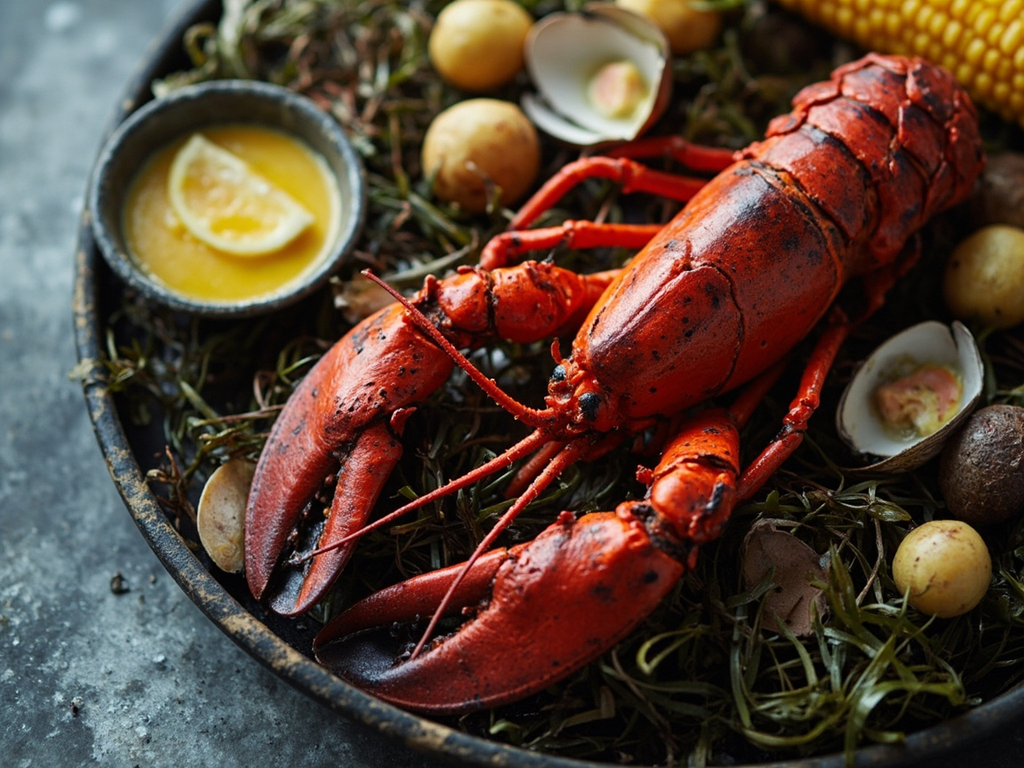
Maine lobster bake (steamed lobster on seaweed)
Why this dish? Carson spent summers on Southport Island, Maine, the land of lobster par excellence. The clambake — lobster and shellfish steamed on seaweed on the beach — is the great festive meal of this coast that she explored and described in The Edge of the Sea.
Freshly caught lobster steamed on a bed of seaweed, served with melted butter. The celebratory meal of the Maine coast, a direct celebration of the ocean of which Carson was the great voice.
There is nothing more honest than a lobster cooked on the very seaweed where it lived. On Southport beach, we would dig a hole, heat the stones, and cover everything with dripping kelp — the sea steam does the rest, believe me. I dipped the meat in melted butter and watched the fog rise from the water; we ate with our fingers, without ceremony, and understood at last that we are but a thread in this great living web. The lobster asks only one thing: that we do not overcook it and that we respect what it is.
- •Live Maine lobsters — one per person (centerpiece)
- •Fresh seaweed (rockweed/kelp) — an armful (flavored steam)
- •Clams and ears of corn (as available) — according to the tide (accompaniment)
- •Butter — a good lump (dipping)
- •Seawater — as needed (salty steam)
Maine lobster bake (steamed lobster on seaweed)
Freshly caught lobster steamed on a bed of seaweed, served with melted butter. The celebratory meal of the Maine coast, a direct celebration of the ocean of which Carson was the great voice.
Why this dish? Carson spent summers on Southport Island, Maine, the land of lobster par excellence. The clambake — lobster and shellfish steamed on seaweed on the beach — is the great festive meal of this coast that she explored and described in The Edge of the Sea.
There is nothing more honest than a lobster cooked on the very seaweed where it lived. On Southport beach, we would dig a hole, heat the stones, and cover everything with dripping kelp — the sea steam does the rest, believe me. I dipped the meat in melted butter and watched the fog rise from the water; we ate with our fingers, without ceremony, and understood at last that we are but a thread in this great living web. The lobster asks only one thing: that we do not overcook it and that we respect what it is.
Ingredients (period version)
- Live Maine lobsters — one per person (centerpiece)
- Fresh seaweed (rockweed/kelp) — an armful (flavored steam)
- Clams and ears of corn (as available) — according to the tide (accompaniment)
- Butter — a good lump (dipping)
- Seawater — as needed (salty steam)
Ingredients
- Live lobsters — 1 per person (500-600 g) (centerpiece)
- Fresh seaweed (or failing that: well-salted water) — a large handful (iodized steam)
- Clams or mussels — 500 g (accompaniment)
- New potatoes — 8 small (side)
- Corn on the cob — 4 ears (side (American staple))
- Salted butter — 150 g, melted (dipping)
- Lemon — 2, cut into wedges (acidity)
Method
- In a very large pot, arrange a bed of seaweed (or pour in 3 cm of very salty water) and bring to a rolling boil to create iodized steam.
- Add the potatoes, cook for 10 minutes, then add the corn.
- Plunge the lobsters headfirst, cover tightly, and steam for 12-15 minutes depending on size (the shell turns bright red).
- Add clams or mussels in the last 5 minutes, until the shells open.
- Melt the salted butter separately.
- Serve everything on a large platter, with melted butter and lemon wedges — and plenty of napkins.
How it was made : The clambake directly descends from the techniques of the Native American peoples of the Northeast coast, who cooked shellfish and fish in pits lined with hot stones and seaweed. New England colonists adopted the method; by the 20th century it had become the great summer social ritual on the beaches of Maine and Massachusetts.
The contemporary twist : Present the lobster opened on a bed of edible dried seaweed (grilled nori) with a lemon and dill butter sauce, a nod to the naturalist's study.
Sources : Rachel Carson, The Edge of the Sea (1955) · Sandra Oliver, Saltwater Foodways (1995)
Rachel Carson · Charactorium