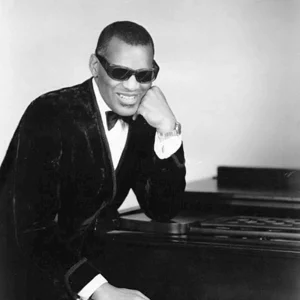

Ray Charles was an American singer, pianist, and composer, blind since childhood. A pioneer of soul, he blended gospel, blues, jazz, and rhythm and blues, becoming one of the major figures of 20th-century popular music.
Ray Charles(1930 — 2004)
Ray Charles
États-Unis
7 min read
Frequently asked questions
Famous Quotes
« I was born with music inside me.»
Key Facts
- Born on September 23, 1930, in Albany, Georgia; blind from around the age of 7
- Recorded “I Got a Woman” in 1954, considered a founding act of soul music
- Released the album “Modern Sounds in Country and Western Music” in 1962, a major success blending country and soul
- Received numerous Grammy Awards and was inducted into the Rock and Roll Hall of Fame in 1986
- Died on June 10, 2004, in Beverly Hills, California
Works & Achievements
A revolutionary fusion of gospel and rhythm and blues, regarded as one of the founding acts of soul music.
An electrifying hit built on gospel call-and-response, which became an enduring classic and a high point of his stage energy.
A cover that became his anthem; the official state song of Georgia since 1979.
A worldwide hit with biting humor, driven by the back-and-forth between Ray and the Raelettes.
A daring album in which Ray Charles makes country music his own, breaking down the boundaries between genres and audiences.
A ballad taken from his country album, a huge international hit that cemented his gift as a melodist.
An album of duets released shortly after his death, honored with multiple Grammy Awards.
Anecdotes
Ray Charles gradually went blind between the ages of 5 and 7, most likely from untreated glaucoma. Rather than overprotecting him, his mother forced him to learn to fend for himself: doing his chores, getting around, listening to the world. Ray would later say that her demands saved him.
In 1954, with “I Got a Woman,” Ray Charles had the daring idea of blending the fervor of church gospel with the secular lyrics of rhythm and blues. The mix shocked some preachers, who deemed it sacrilege to use sacred music to sing of earthly love, but it laid the foundations of soul.
In 1962, while he was a soul star, Ray Charles surprised everyone by releasing an entire country music album, “Modern Sounds in Country and Western Music.” The gamble seemed risky for a Black artist during the height of segregation, but the album became a huge success and broke down boundaries between genres.
In 1961, Ray Charles refused to perform before a racially segregated audience in Augusta, Georgia, his home state. In retaliation, he was banned from performing there. Years later, the State of Georgia would apologize to him and adopt his rendition of “Georgia on My Mind” as its official song.
Passionate about mechanics and electronics despite his blindness, Ray Charles took apart and repaired devices himself, identifying parts by touch and by ear. He also insisted on counting his money personally, sometimes folding bills in different ways to tell them apart.
Primary Sources
“I didn't want to be treated differently because I was blind. My mother taught me to fend for myself, and that's the finest thing she ever did for me.”
“Georgia, Georgia, the whole day through / Just an old sweet song keeps Georgia on my mind.”
The State of Georgia officially recognizes Ray Charles' version and adopts “Georgia on My Mind” as the state song.
Key Places
City in the segregated South where Ray Charles was born in 1930. He then grew up in the nearby small town of Greenville, Florida.
School for the blind and deaf where Ray learned braille, piano, and composition. It was there that he built his solid musical foundations.
Northwestern city where the young Ray, still a teenager, truly launched his musical career in the late 1940s. It was there that he met the young Quincy Jones, among others.
Ray Charles settled here and built his musical empire, notably his RPM International studios. He lived and worked here until his death.
Capital of the state that had banned him from performing after he refused to play a segregated concert, and which later apologized to him and adopted “Georgia on My Mind” as its official song.
Typical Objects

Ray Charles's instrument of choice, which he played with a virtuosity inherited from gospel and blues. He often composed and directed his pieces from the keyboard.

Having become his visual signature, the dark glasses protected his eyes and were part of his stage image. Today they symbolize the figure of Ray Charles.

Blind, Ray Charles learned music through braille, memorizing one hand after the other. This raised writing system gave him access to composition and to reading music.

Ray Charles surrounded himself with a big band and brass sections that gave soul its power. The saxophone held a central place in his arrangements.

The medium on which Ray Charles's hits spread all over the world. The vinyl record is the object through which the general public discovered soul.

A trio, then quartet, of female backing singers who answered Ray Charles in echo, in the call-and-response tradition of gospel. Their vocal presence is inseparable from his style, as in “What'd I Say.”
School Curriculum
Vocabulary & Tags
Key Vocabulary
Tags
Daily Life
Morning
Often in bed late after concerts, Ray Charles tended to get up in the late morning. Coffee and a hearty meal accompanied his first hours of the day, before he headed to the studio or the piano to work.
Afternoon
The afternoon was devoted to music: rehearsals with his big band, meticulous arrangements that he dictated note by note, recording sessions. A stickler for detail, he demanded perfection from his musicians.
Evening
Evening was the time for the stage: intense concerts where he sang, played the piano, and traded lines with the Raelettes. On tour, his life unfolded largely at night, between performance venues and travel.
Food
Raised in the poverty of the South, Ray Charles enjoyed African American soul food cuisine: fried chicken, leafy greens, cornbread. As a famous adult, he remained attached to these Southern dishes of his childhood.
Clothing
On stage, Ray Charles wore elegant suits and tidy ties, topped off with his inseparable dark glasses. This stylish attire reflected the star status he had earned.
Housing
After a childhood in modest dwellings of the rural South, he lived mainly in Los Angeles, where he had his own recording studios built, RPM International, the central place of his professional life.